Fleischmann's Glass Frog
- Centrolenella fleischmanni
- Centrolenella viridissima
- Cochranella decorata
- Cochranella millepunctata
- Hylella cappellei
- Hylella chrysops
Centrolenella fleischmanni
- Centrolenella fleischmanni
- Centrolenella viridissima
- Cochranella decorata
- Cochranella millepunctata
- Hylella cappellei
- Hylella chrysops
| Family | Centrolenidae |
|---|---|
| Genus | Hyalinobatrachium |
| IUCN category (World) | LC |
Introduction
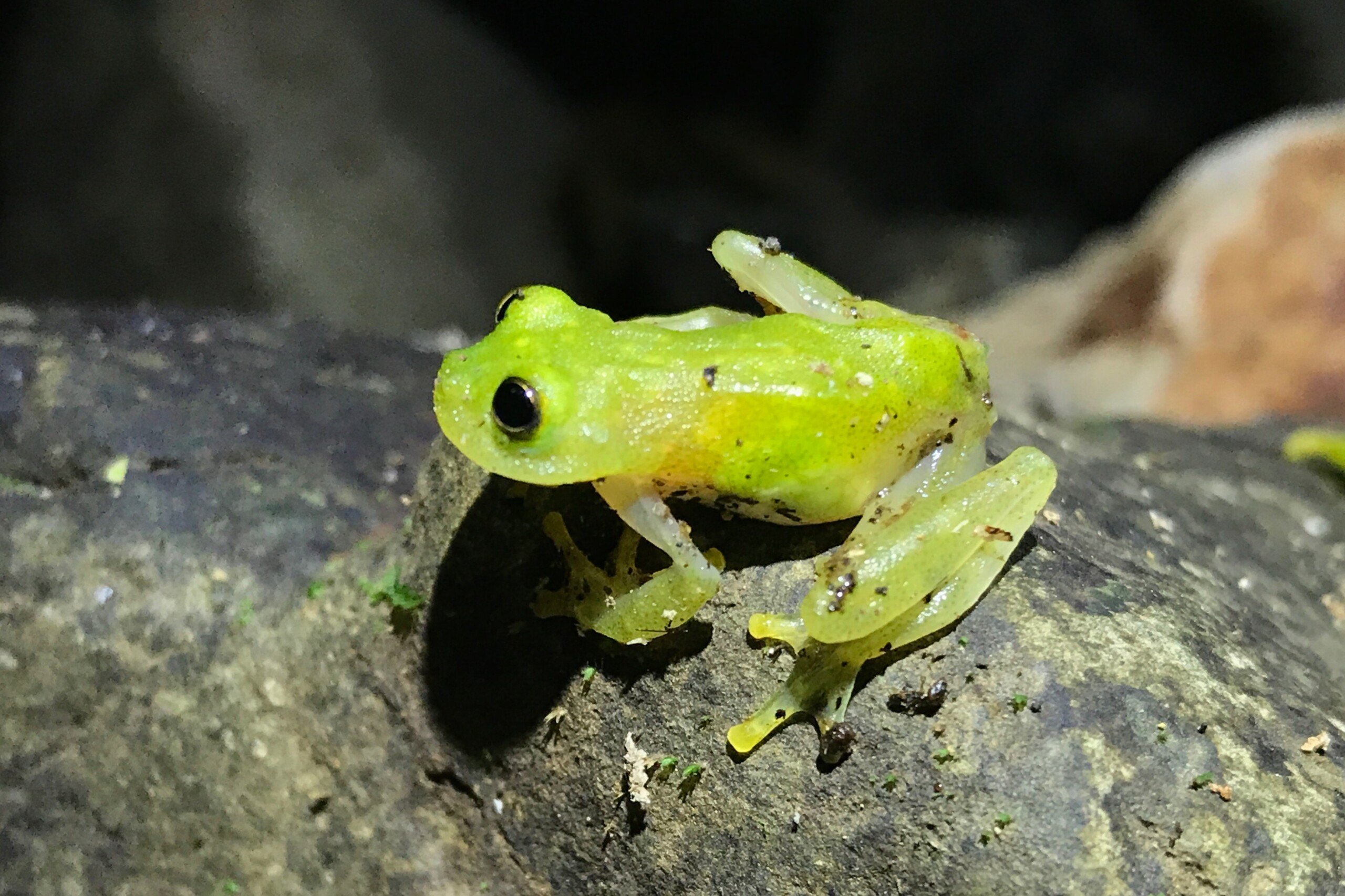
Hyalinobatrachium fleischmanni, commonly known as Fleischmann's glass frog, is a species of amphibian in the family Centrolenidae. Long considered to be widespread from Mexico to Ecuador, the distribution range of this species has recently been redefined following genetic, morphological, and bioacoustic analyses.
Populations from Mexico, Guatemala, Belize, and northwestern Honduras are now classified under the name Hyalinobatrachium viridissimum, while those from South America have been reassigned to Hyalinobatrachium tatayoi or Hyalinobatrachium guairarepanense in Venezuela.
The current range of Fleischmann's Glass Frog is thus limited to the Mosquitia region in eastern Honduras and Nicaragua, extending southward through the Tilarán Range and the Central Valley of Costa Rica. This once abundant species is facing local declines due to deforestation, agricultural pollution, and chytridiomycosis, although its ability to tolerate certain habitats gives it relative resilience.
Who is it?
Morphology
-
Female size2.3 - 3.2 cm
-
Male size1.9 - 2.5 cm
-
Female size2.3 - 3.2 cm
-
Male size1.9 - 2.5 cm
How to recognize this amphibian ?
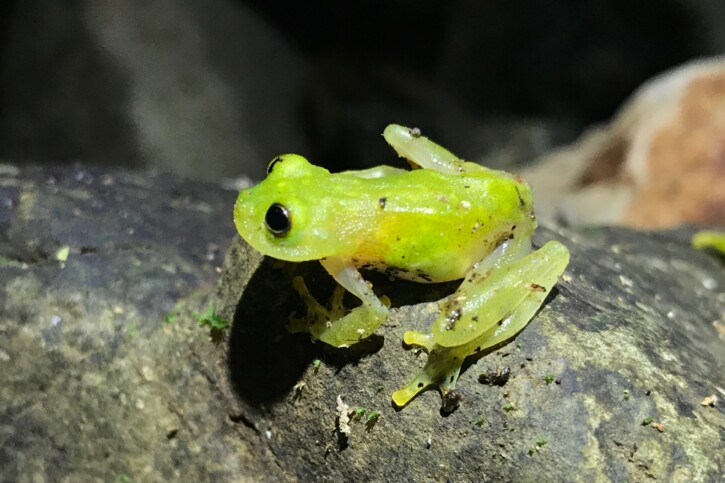
The silhouette is slender, typical of centrolenids. Its skin is smooth and remarkably transparent on the ventral side, allowing observation of internal organs, beating heart, and skeleton through the abdominal wall.
The dorsal side displays a bright green to yellowish-green coloration, often speckled with small white or cream spots. The eyes are large, prominent, forward-facing, with iris patterns ranging from golden to silvery. The limbs are long and slender, adapted for arboreal life, with well-developed adhesive discs at the fingertips for gripping onto leaves. Adult size typically ranges between 2 and 3 cm, with females slightly larger than males.
Sexual dimorphism
In this species, the female is larger than the male as adults.
Behaviour & Life cycle
-
Sociabilitysolitary
-
Way of livingdiurnal
-
VenomousNo
-
Dietpredator
This species is typically rather sedentary with primarily nocturnal activity. It exhibits reduced mobility and a close dependence on riparian habitats, limiting its movements and promoting fragmented genetic structure in the face of geographical barriers. Males call from vegetation overhanging waterways, often several meters high, and provide remarkable parental care by monitoring egg masses deposited under leaves.
Hyalinobatrachium fleischmanni is an insectivorous predator. Its diet likely consists of small arboreal and riparian invertebrates such as flies, mosquitoes, small beetles, and spiders, which it ambushes from the leaves overhanging waterways. Its hunting technique relies on silent approach and rapid tongue projection, typical of small-sized anurans. Its perched position allows monitoring both the surrounding vegetation and water surface, optimizing chances of capturing prey without moving, in line with its low mobility and strong territorial dependence.
Reproduction
-
Reproductionovipare
Hyalinobatrachium fleischmanni is oviparous and reproduction occurs outside of water.
Females lay gelatinous and transparent egg masses on the underside of leaves overhanging fast or slow-moving streams.
After hatching, tadpoles drop directly into the water below, where they continue their development. The larvae are likely burrowers, digging into sediments and leaf litter at the bottom of watercourses until metamorphosis. Males remain near the egg masses, sometimes several simultaneously, providing active defense against parasitoids and predators.
Harmless species
The species is harmless to humans. Small in size and lacking powerful toxins or aggressive defense mechanisms, it poses no risk. However, its transparent and fragile skin requires extremely delicate handling to avoid physiological damage.
Origin and distribution
Geographic distribution & Conservation
The current distribution range covers the Mosquitia region (Honduras and Nicaragua) and the Caribbean slope as well as the Central Valley of Costa Rica, between 25 and 1,740 meters altitude. The species is absent from more northern areas (now occupied by H. viridissimum) and South American regions (occupied by H. tatayoi and others). It inhabits humid tropical and subtropical forests, both lowland and mountainous, favoring densely vegetated riparian zones. Although locally common, it faces pressures from agriculture, logging, and urbanization, with notable declines in mountainous areas of Costa Rica linked to emerging diseases.
What is its habitat?
Natural environment characteristics
-
Temperature22 - 28 °C
Biotope presentation
This frog resides in low vegetation and shrubs along forest streams, requiring dense vegetation cover to maintain humidity and provide breeding sites. It frequents both intact primary forests and secondary regenerating areas, demonstrating adaptability to human disturbances as long as water quality and riparian vegetation structure are preserved. The temperature and humidity of these microhabitats are crucial for egg development and tadpole survival in watercourses below.
To go further
To read on the web
Sources & Contributions
Participation & Validation
The Fishipedia team and specialist contributors are committed to providing high-quality content. However, although the information comes from scientific sources or testimonials from specialists, the cards may contain inaccuracies.

Adrien Falzon
Translation
Translation done with the valuable contribution of our translators, who make this information available to a wider audience. We sincerely thank them for their commitment.
Bibliographic references
Scientific partners