
shortfin mako
- Squalus cepedii
- Squalus cepedii
| Family | Lamnidae |
|---|---|
| Genus | Isurus |
| IUCN category (World) | EN |

Introduction
The shortfin mako, Isurus oxyrinchus, is a pelagic predator with a worldwide distribution in tropical and temperate seas. It is sometimes encountered near coasts. In June 2023, a specimen washed ashore on a beach in Marseillan, in the south of France. The shortfin mako is a member of the Lamnidae family, which includes three genera: Carcharodon, Lamna, and Isurus.
This species is highly sought after for its flesh as well as its fins and skin. Due to intensive fishing, it has been classified as endangered since 2018. Populations of this species are experiencing significant declines in all oceans, except the South Pacific.
Traditionally, the Shortfin Mako Shark is used in various ways, including fresh, dried, salted, smoked, and frozen. Additionally, a vitamin-rich oil is extracted from this species. Its fins continue to be targeted for shark fin soup preparation. The jaws and teeth of the Shortfin Mako Shark are also sold as ornaments and trophies.
This species is considered dangerous although attacks are rare. A study conducted by Kabasakal and de Maddalena in 2011 reported a historical record of a large specimen captured in the Mediterranean Sea off the coast of Turkey. This individual measured around 585 cm. Most observations report adult individuals measuring less than 3 meters.
Who is it?
Morphology
-
Type
-
Average size270 cm
-
Maximum size400 cm
-
Longevity32 year
-
ShapeRectangular
-
Type
-
Average size270 cm
-
Maximum size400 cm
-
Longevity32 year
-
ShapeRectangular
How to recognize This fish ?
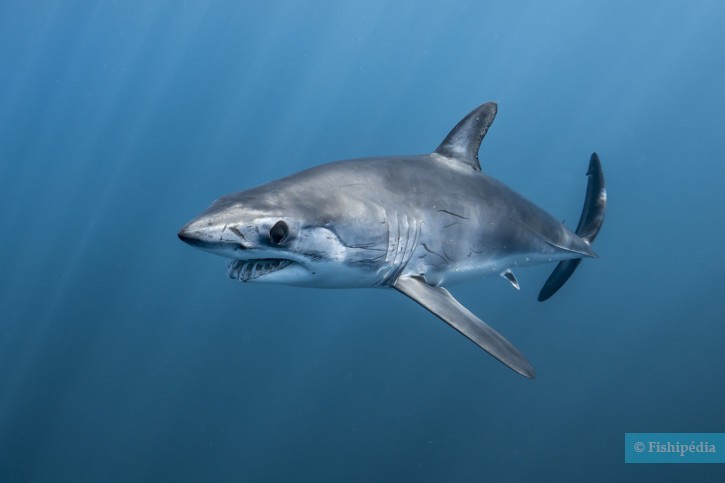
The shortfin mako is distinguished by its uniform color, with a mostly gray/blue body and a lighter belly. This species is specially designed for speed thanks to its hydrodynamic shape.
Its snout is pointed, its body is streamlined, and its first dorsal fin is rounded. The pectoral fins are long and triangular. The eyes of the shortfin mako are large and black, and the gill slits are wide. Its teeth are thin, hook-shaped, curved inward in its mouth.
Sexual dimorphism
The male has a pair of claspers, reproductive organs derived from the modification of pelvic fins, used to fertilize the female.
Behaviour & Life cycle
-
dietcarnivorous
-
Sociabilitysolitary
-
territorialNo
-
Way of livingdiurnal
The Shortfin Mako Shark is a solitary predator with a lively and nervous temperament, holding an important place among the large predators of the pelagic zone.
This species is able to maintain its body temperature at a level 10°C higher than that of the surrounding water. Combined with its hydrodynamic body with wide gill slits, this adaptation allows it to perform lightning-fast accelerations.
Reaching an impressive speed of 110 km/h, the Shortfin Mako Shark is one of the fastest fishes in the world, alongside the sailfish. It exploits this ability to carry out lightning attacks, often from below. Additionally, it is capable of performing spectacular leaps out of the water. Its average speed is estimated at 50 km/h.
Adults mainly feed on bony fish, other sharks, and cephalopods. Large individuals may also prey on larger species such as swordfish and small cetaceans. These behavioral characteristics make the Shortfin Mako Shark a central predator, playing an essential role in the balance of the marine ecosystems it inhabits.
Reproduction
-
Reproductionovovivipare
The shortfin mako is an ovoviviparous fish with intrauterine cannibalism. After a gestation of 15 to 18 months, this species gives birth to 4 to 25 pups measuring 60 to 70 cm. The interval between two births is 3 years, making this species particularly vulnerable.
Risks for humans
-
VenomousNo
-
BiteYes
This species may attack if it feels threatened. It is important to be particularly vigilant, especially during diving or fishing sessions.
Origin and distribution
Geographic distribution & Conservation
There is no information on the absolute size of the global population of the Shortfin Mako Shark. Studies have been conducted in various regions around the globe to assess the status of Shortfin Mako Shark populations. In the North Atlantic, formerly considered healthy, the stock is now classified as overexploited and subject to overfishing. Although stock assessments in the South Atlantic are deemed unreliable, it is likely that fishing mortality is unsustainable. In the Indian Ocean, the stock is not currently overexploited, but is subject to overfishing, with indications of biomass trajectories suggesting overexploitation trends. Conversely, in the North Pacific, the stock is likely not overexploited and there are no signs of overfishing. In the South Pacific, the population appears to be increasing.
The most alarming situation is in the Mediterranean Sea where it is reported to have lost 99.9% of its abundance since the early 19th century.
Conservation and international regulations
What is its habitat?
Natural environment characteristics
-
Temperature24 - 28 °C
-
Depth1 - 500 m
-
EnvironmentActive pelagic
Biotope presentation
The shortfin mako is found at depths of less than 500 m. Most often, it swims in shallow waters or at the surface. This shark is semi-pelagic. Although it is sometimes observed near coasts, it mainly inhabits open seas.
To go further
To read on the web



Sources & Contributions
Participation & Validation
The Fishipedia team and specialist contributors are committed to providing high-quality content. However, although the information comes from scientific sources or testimonials from specialists, the cards may contain inaccuracies.

Adrien Falzon

Benoit Chartrer

Silvia Gomez
Translation
Translation done with the valuable contribution of our translators, who make this information available to a wider audience. We sincerely thank them for their commitment.
Benoit Chartrer
Bibliographic references
- GBIF — Isurus oxyrinchus
- iNaturalist — Isurus oxyrinchus
- Reproduction and Embryonic Development of the Shortfin Mako, Isurus oxyrinchus Rafinesque, 1810, in the Northwestern Pacific — Shoou-Jeng Joung — Hua-Hsun Hsu — Zoological Studies —
Scientific partners




Tags
#Lamnidae
#Isurus
#plein eau
#shark
#Bay of Bengal
#Gulf of Mexico
#Persian Gulf
#mer d'Oman
#Tasman Sea
#Caribbean Sea
#Philippine Sea
#Mediterranean Sea
#Red Sea
#South East Asian Seas
#Indonesian seas
#Atlantic Ocean: North Coast of Brazil
#Océan Atlantique Est Afrique - Angulhas
#Océan Atlantique Est Afrique - Golfe de guinée
#Temperate Eastern Atlantic Ocean
#Océan Atlantique Est Afrique - Transition & Cap Vert
#Cold temperate Northwest Atlantic Ocean
#Northwest warm temperate Atlantic Ocean
#Southwest warm temperate Atlantic Ocean
#Eastern tropical Atlantic Ocean
#Southwest Tropical Atlantic Ocean
#western Indian Ocean
#Galapagos
#Océan Pacifique Nord Est Tempere Chaud
#Océan Pacifique sud-est tempéré chaud
#Tropical Eastern Pacific
#Western Tropical Pacific Ocean
#Canary Islands
#Réunion
#Lombok
#French Polynesia
#Sardinia
#Sicily


