Introduction
The golden mantella is a small frog endemic to Madagascar, classified as 'Endangered' by the IUCN due to its small range area (approximately 730 km²), severe population fragmentation, and continuous decline of its habitat.
Restricted to the Moramanga district in the central-eastern part of the island, the species only survives in two main areas about 35 km apart: the Ambatovy-Torotofotsy cluster (Analamay) in the northeast and the Andranomena-Mangabe cluster in the southwest.
Although the number of known breeding sites has increased through conservation efforts (from 26 to 139 occupied pools), 50% of these sites are actively threatened by habitat destruction, and the species has already disappeared from several historical localities. Its taxonomy is now stabilized, showing little internal genetic subdivision, despite the presence of other golden mantellas belonging to distinct species elsewhere.
Who is it?
How to recognize this amphibian ?
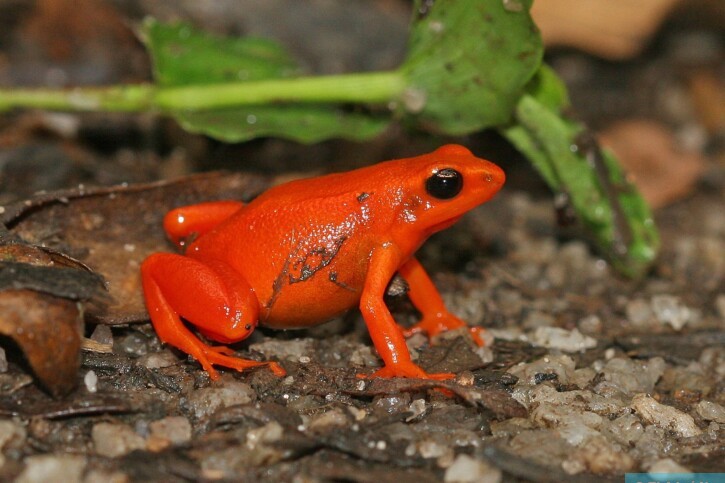
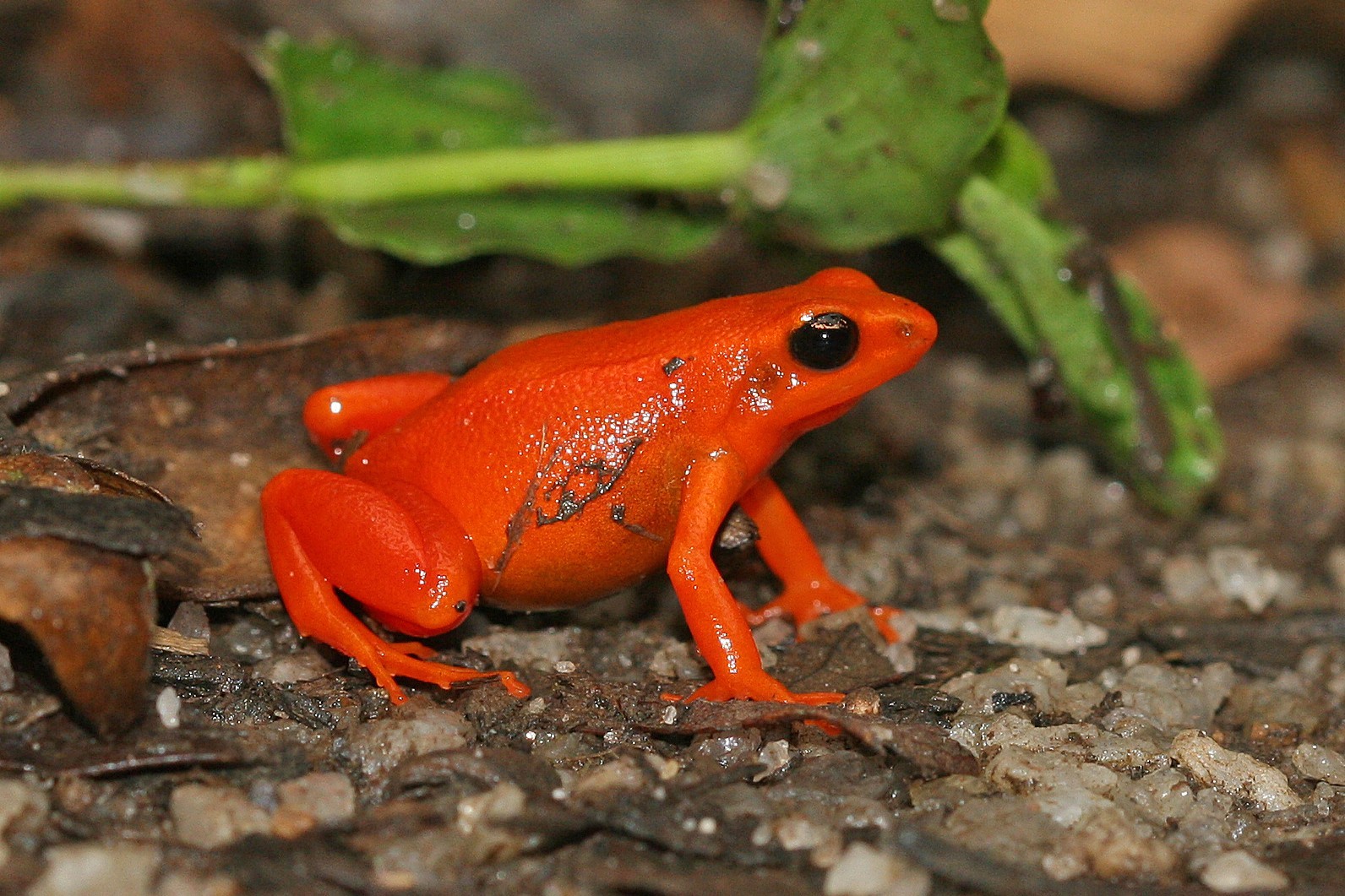
The golden mantella is distinguished by its uniform and vibrant coloration, ranging from bright yellow to reddish orange, devoid of distinct markings on the back, making it unique among amphibians in its region.
This vivid coloration serves as a warning signal (aposematism) indicating its toxicity to predators, due to the presence of alkaloids in its skin. Small in size, it generally measures between 2 and 3 cm in length. Its limbs are slender and adapted to life on the ground and in the humid forest litter. Juveniles may exhibit slightly paler coloration that intensifies with age to reach the uniform adult hue.
Sexual dimorphism
Sexual dimorphism is visually slight, with males and females sharing the same warning coloration. The distinction relies mainly on size, with females being slightly larger, and on the presence of vocal sacs in males. The latter are more vocally active, emitting calls from the ground or low vegetation to attract females to breeding sites during the rainy season.
Behaviour & Life cycle
-
Sociabilityliving in a group or alone
-
Way of livingdiurnal
-
VenomousYes
-
Dietpredator
The golden mantella is a diurnal species with social behavior varying according to life stage. As adults, it alternates between discreet living under litter in the dry season and highly gregarious (aggregative) behavior during the breeding season, forming dense gatherings around pools (up to 3,000 individuals per hectare). In the larval stage, tadpoles display active social preferences: they spontaneously choose to join groups rather than remain solitary and are capable of discriminating group size, preferring to be closer to the largest number of conspecifics, although this preference diminishes with age.
Contrary to the misconception that their toxicity protects them from all predators, this species faces significant predation. Direct observations in the wetlands of Torotorofotsy have reported successful predation by lizards (Zonosaurus madagascariensis) and snakes (Thamnosophis lateralis), which appear insensitive to the frog's toxins. Experiments have confirmed that while some snakes prefer non-toxic prey, those consuming the golden mantella show no signs of intoxication. Birds and spiders also count among potential predators, although reptiles seem to be the main drivers of evolutionary defense strategies (coloration and toxins) in this species.
Reproduction
-
Reproductionovipare
Reproduction occurs during the rainy season, when temporary pools and marshes fill with water. The golden mantella employs an original reproductive strategy: females lay their eggs on moist ground, under litter, or in vegetation close to water bodies, rather than directly in the water.
With heavy rains, tadpoles hatch and are washed by runoff to pools, Pandanus marshes, or flooded areas of the forest, where they continue their development. This critical dependence on rainfall and connectivity between terrestrial egg-laying sites and water bodies makes the species vulnerable to climate change and fragmentation. Tadpoles live in social groups before metamorphosing and joining the forest litter.
Harmless species
The golden mantella poses no danger to humans. While it secretes toxic alkaloids to defend against natural predators (reptiles, birds), these substances are not harmful to humans through simple manual contact. The species is harmless and plays an important ecological role in controlling invertebrate populations.
Origin and distribution
Geographic distribution & Conservation
Endemic to Madagascar, the golden mantella is confined to an area of occupancy (AOO) of only 152 km² in the Moramanga district. Of the 139 confirmed breeding pools, 103 are located in the Mangabe cluster and 36 in the Analamay cluster. Nine of these pools also host its congener Mantella crocea sympatrically, and eleven others harbor Baron's mantella (Mantella baroni). Five of the sympatry sites with M. crocea are located in areas designated for clearance for legal mining.
Classified as 'Endangered,' the species faces immediate and severe threats. Agricultural expansion through slash-and-burn practices and mining activities (illegal artisanal gold mining, industrial nickel and cobalt extraction) constitute the primary dangers: 37 pools are directly affected by agriculture, 14 by illegal gold mining, and 8 more are destined for imminent destruction by the Ambatovy company's nickel/cobalt mines. Alarmingly, 51% of threatened pools are located within provisional protected areas, indicating that protection status alone is insufficient to halt degradation.
Moreover, the potential invasion of the Asian common toad (Duttaphrynus melanostictus) in its range poses a major risk of competition and disease transmission (chytridiomycosis), although the fungus Batrachochytrium dendrobatidis has not yet shown high virulence in the region. International trade for the aquarium industry also exerts pressure, necessitating increased monitoring.
Conservation and international regulations
What is its habitat?
Natural environment characteristics
-
Temperature22 - 28 °C
-
FlowStagnant
Biotope presentation
The golden mantella inhabits mid-altitude humid forests, between 867 and 1,065 meters. It is closely associated with Pandanus marshes and small lentic habitats (temporary pools, forest ponds) vital for its life cycle. Adults live in dense forest litter, under dead leaves and wood, around these water sources. The species shows some tolerance to moderate disturbances, persisting in forest fragments and even in recently burned areas, but does not survive in completely deforested or converted to intensive agriculture zones. The viability of breeding sites depends on the quality of the surrounding forest and water regime.
To go further
To read on the web
Sources & Contributions
Participation & Validation
The Fishipedia team and specialist contributors are committed to providing high-quality content. However, although the information comes from scientific sources or testimonials from specialists, the cards may contain inaccuracies.

Benoit Chartrer
Translation
Translation done with the valuable contribution of our translators, who make this information available to a wider audience. We sincerely thank them for their commitment.
Scientific partners