
Introduction
Acropora florida is a species of scleractinian hard coral from the family Acroporidae, emblematic of tropical Indo-Pacific reefs. Historically common and able to form large colonies several meters in diameter, it is facing severe population decline.
Classified as highly vulnerable, its populations are threatened by recurrent bleaching, increased susceptibility to diseases, and predation by the Crown-of-Thorns starfish. Projections indicate a potential decline of over 60% by 2050, mainly due to climate warming surpassing its thermal adaptation capacity.
Who is it?
Morphology
-
Size200 - 500 cm
-
StructureReefplate
-
Size200 - 500 cm
-
StructureReefplate
How to recognize This cnidarian ?
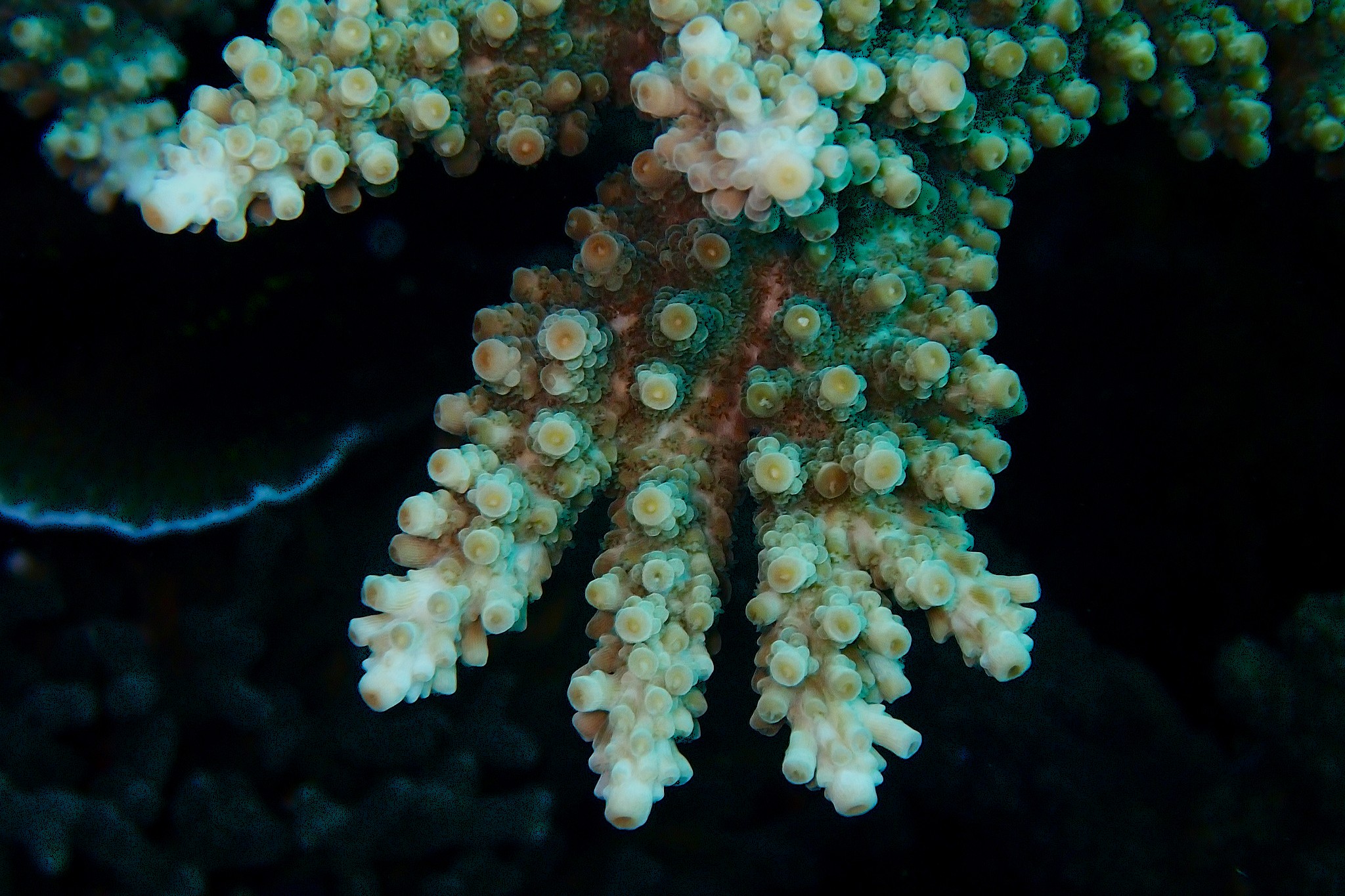
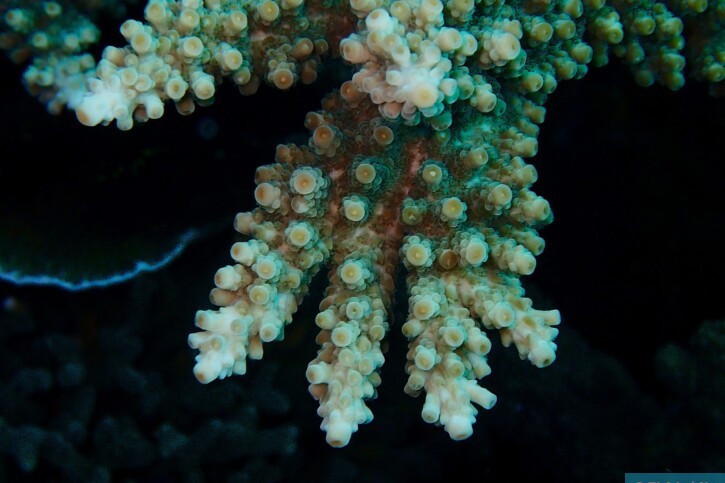
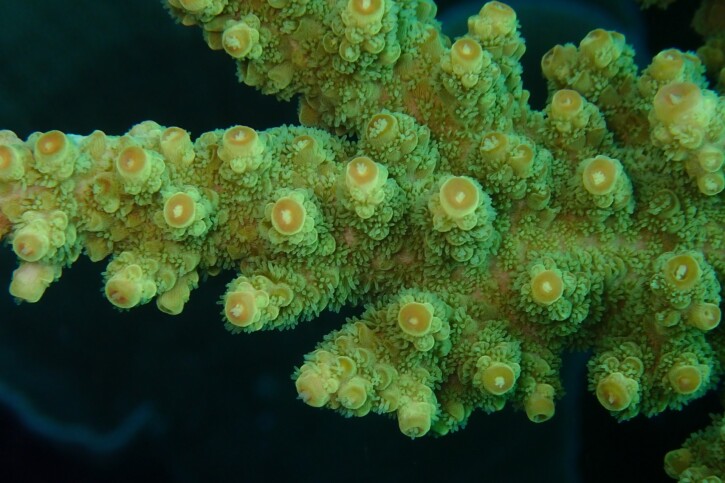
This species forms rough arborescent colonies, reaching several meters in diameter. Its structure is characterized by particularly stout and thick branches, measuring up to 25 cm in thickness.
The surface of these branches has a characteristic bumpy appearance, due to the presence of densely covering secondary ramules of uniform height. The axial corallites are tubular and prominent, while the radial corallites are immersed. The coloration varies from cream to brown, often with brightly colored branch tips (blue, purple, yellow) depending on light exposure and zooxanthellae density.
Behaviour & Life cycle
-
Sociabilityliving in colonies
-
Dietnot specified
-
Way of livingdiurnal
This branch coral is a fast-growing sessile species, typical of well-lit shallow reef zones. It deploys its polyps and stinging tentacles mainly at night to capture zooplankton, although this activity may continue during the day in murky waters.
The species is highly sensitive to environmental variations: it reacts to thermal stress (temperature anomalies >1°C) by expelling its zooxanthellae, leading to rapid bleaching. Unlike other more resilient corals, Acropora florida shows low recovery potential after such events and high susceptibility to diseases and predation by the Crown-of-Thorns starfish. Its presence is strictly tied to live reef structures, where it plays a major role in the structural complexity of the habitat.
This coral is mixotrophic. It derives most of its energy (up to 90%) from photosynthesis carried out by symbiotic algae (zooxanthellae) hosted in its tissues. In addition, it actively captures zooplankton, invertebrate larvae, and suspended organic particles using its stinging tentacles. This heterotrophic nutrition is crucial to support its rapid growth and calcification, particularly during periods of thermal stress when photosynthetic symbiosis is compromised.
Reproduction
-
Reproductionovipare
This coral is a synchronous hermaphroditic species. Sexual reproduction occurs during massive spawning events, generally synchronized with lunar cycles and summer temperatures. Mature gametes (eggs and sperm) are released into the coelenteron of each polyp and then expelled through the mouth directly into the water column.
External fertilization gives rise to a zygote that rapidly develops into a planktonic planula larva. After a drifting phase allowing species dispersion, the larva attaches to the substrate by its aboral pole. Metamorphosis then begins with the morphogenesis of tentacles, septa, and pharynx, transforming the larva into a founding polyp that initiates a new colony through asexual budding. Sexual maturity is reached around the age of 4 on average, with an estimated generation length of 10 years.
Risks for humans
-
VenomousNo
-
CutYes
This coral poses no direct danger to humans. It is not venomous upon contact, although handling living colonies may cause skin irritations due to nematocysts or cuts from the sharp and rough calcium skeleton.
Origin and distribution

Geographic distribution & Conservation
This branch coral is strictly tied to reef environments. It colonizes reef tops, vertical walls, and outer slopes in the subtidal zone (always submerged). Its bathymetry ranges from 3 to 35 meters deep, with optimal abundance between 5 and 30 meters. It prefers clear, well-oxygenated waters exposed to intense light necessary for symbiosis, but its restriction to shallow depths makes it particularly exposed to surface thermal fluctuations and sedimentation.
Conservation and international regulations
Where to see this species?

What is its habitat?
Natural environment characteristics
-
Temperature24 - 29 °C
-
Depth3 - 35 m
-
EnvironmentBenthic fixed
-
FlowMedium and Slow
Biotope presentation
This coral is strictly tied to reef environments. It colonizes reef tops, vertical walls, and outer slopes in the subtidal zone (always submerged). Its bathymetry ranges from 3 to 35 meters deep, with optimal abundance between 5 and 30 meters. It prefers clear, well-oxygenated waters exposed to intense light necessary for symbiosis, but its restriction to shallow depths makes it particularly exposed to surface thermal fluctuations and sedimentation.
To go further
To read on the web
Sources & Contributions
Participation & Validation
The Fishipedia team and specialist contributors are committed to providing high-quality content. However, although the information comes from scientific sources or testimonials from specialists, the cards may contain inaccuracies.

Benoit Chartrer
Translation
Translation done with the valuable contribution of our translators, who make this information available to a wider audience. We sincerely thank them for their commitment.
Where to see this species?
Scientific partners



Tags


