
Introduction
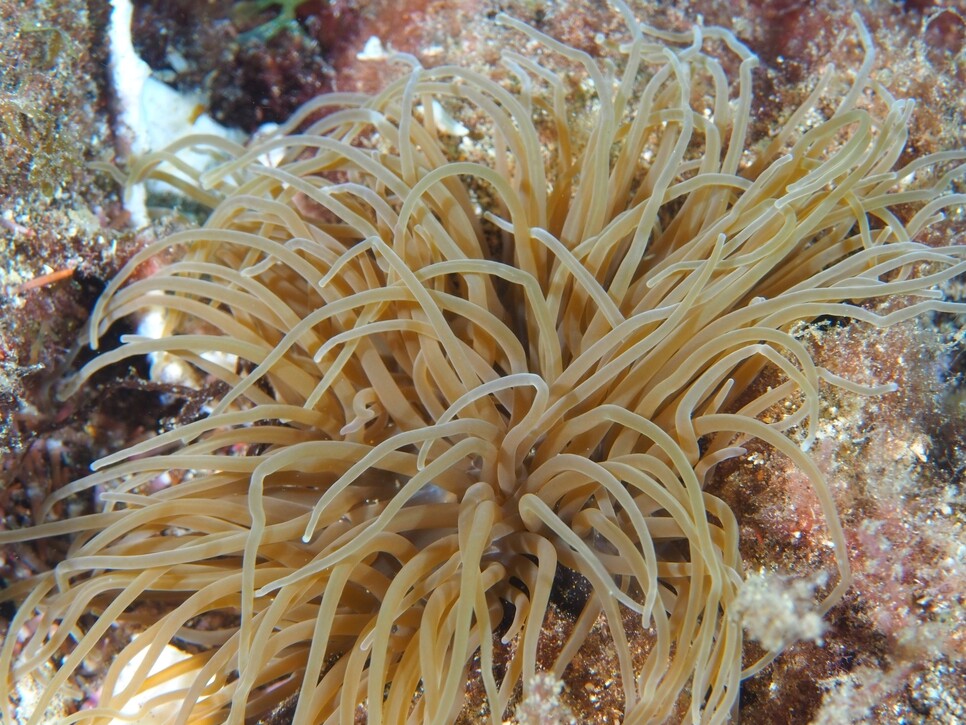
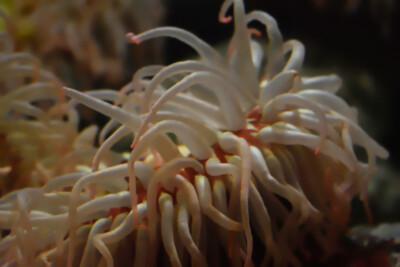
The snakelocks anemone (Anemonia sulcata), from the Actiniidae family, frequents rocky coasts and shallow bottoms in the Mediterranean and eastern Atlantic. It is recognized by its numerous long and flexible tentacles, often green, purplish, or brownish, usually ending in colorful tips.
Who is it?
Morphology
-
Size15 - 20 cm
-
Longevity4 year
-
Size15 - 20 cm
-
Longevity4 year
How to recognize This cnidarian ?
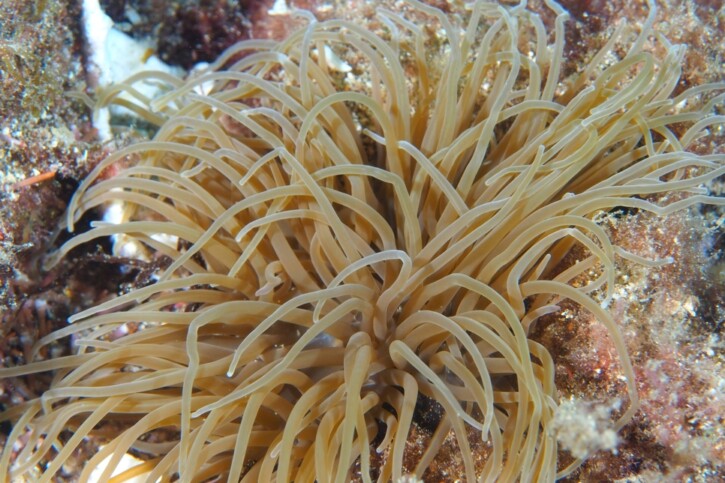
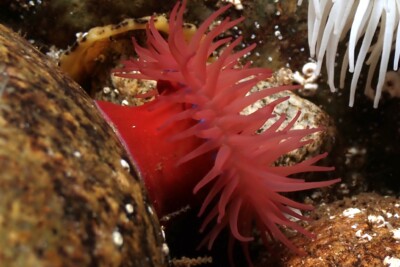
Anemonia sulcata has a cylindrical body attached to the substrate by an adhesive basal disc. The upper part bears numerous long, thin, and mobile tentacles arranged around the central mouth.
The coloration varies from bright green to brown, gray, or purplish depending on lighting and the presence of microscopic symbiotic algae in the tissues. The tips of the tentacles often have violet or pink hues.
The total diameter can reach approximately 20 cm when the tentacles are fully extended.
Sexual dimorphism
There is no visible sexual dimorphism in this anemone.
Behaviour & Life cycle
-
Sociabilityliving in a group or alone
-
Dietnot specified
-
Way of livingdiurnal
The snakelocks anemone lives attached to rocks, in crevices, or on hard substrates exposed to light and currents.
It is usually solitary but can locally form dense groups. Its tentacles contain stinging cells called cnidocytes used to capture prey and defend itself.
Like several tropical and temperate anemones, it hosts symbiotic microalgae that provide it with some of its energy through photosynthesis.
The snakelocks anemone is carnivorous. It captures small fish, crustaceans, larvae, and planktonic organisms with its stinging tentacles.
The nutrients produced by its symbiotic algae also supplement its diet.
Reproduction
-
Reproductionovipare
-
Larva typeplanula
Reproduction can be sexual with gamete release into the water and planktonic larval development.
The species can also reproduce asexually through division or budding, allowing for the formation of groups of genetically identical individuals.
Harmless species
The tentacles can cause irritations or mild burns in humans due to the stinging cells. Reactions are usually moderate but can be more pronounced in sensitive individuals.
Origin and distribution
Geographic distribution & Conservation
The snakelocks anemone is not threatened in its natural habitat.
Conservation and international regulations
Where to see this species?




What is its habitat?
Natural environment characteristics
-
Temperature18 - 22 °C
-
Depth3 - 25 m
Biotope presentation
The snakelocks anemone mainly lives in the Mediterranean and the nearby eastern Atlantic, especially along European and North African coasts.
It frequents shallow rocky areas, littoral basins, reefs, and seagrass beds between the surface and around 25 m depth.
This species appreciates well-lit areas conducive to its symbiotic algae.
To go further

Sources & Contributions
Participation & Validation
The Fishipedia team and specialist contributors are committed to providing high-quality content. However, although the information comes from scientific sources or testimonials from specialists, the cards may contain inaccuracies.

Adrien Falzon
Translation
Translation done with the valuable contribution of our translators, who make this information available to a wider audience. We sincerely thank them for their commitment.
Where to see this species?
Scientific partners




Species of the same family


