
Introduction
Aurelia aurita, more commonly known as common moon jelly or moon jellyfish, is a cnidarian that frequents the oceans worldwide, except for the icy polar regions.
This jellyfish is likely the most widespread in the world. It is highly sought after by predators for its rich nutritional values.
Who is it?
Morphology
-
Size25 - 50 cm
-
Longevity2 year
-
Size25 - 50 cm
-
Longevity2 year
How to recognize This cnidarian ?
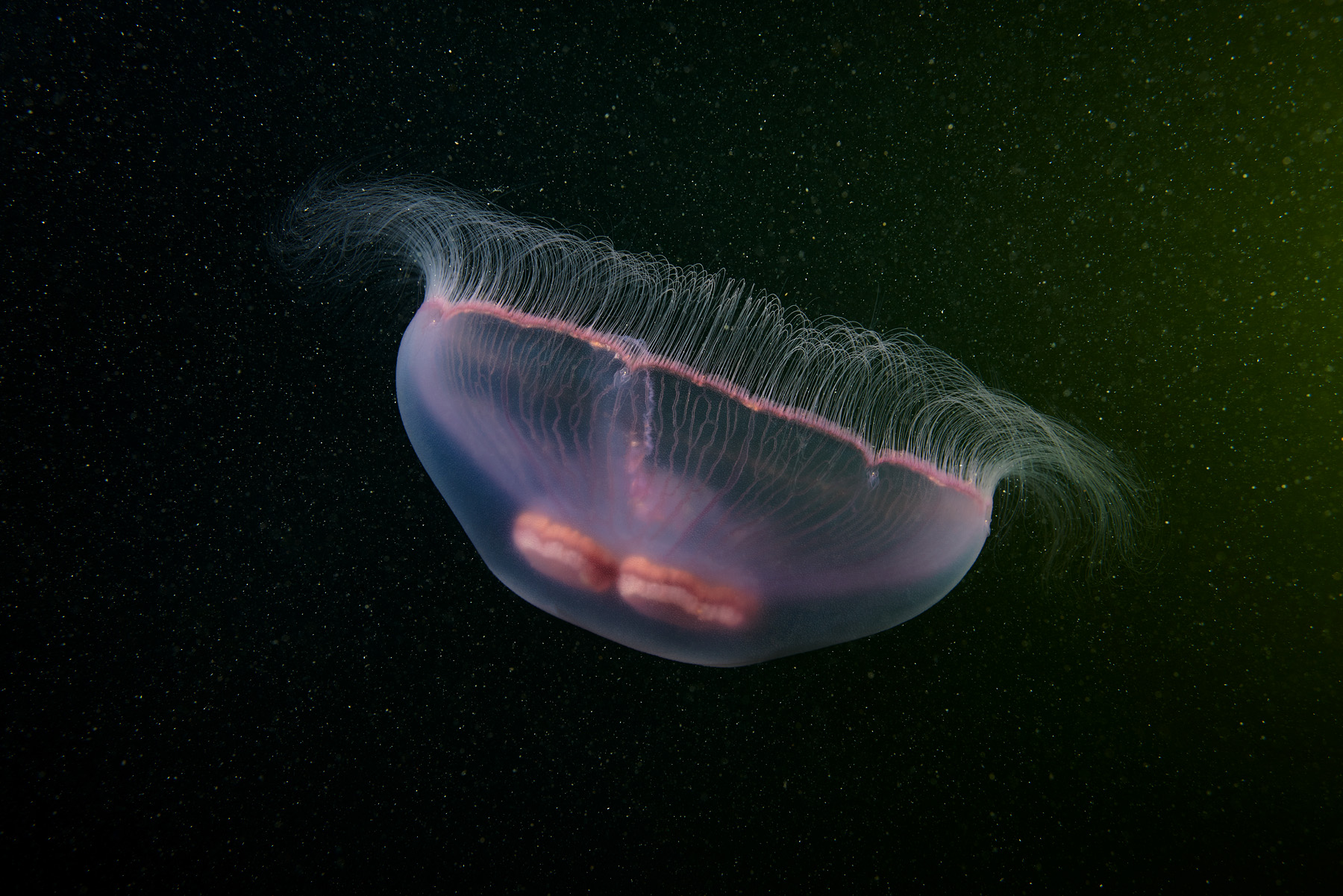
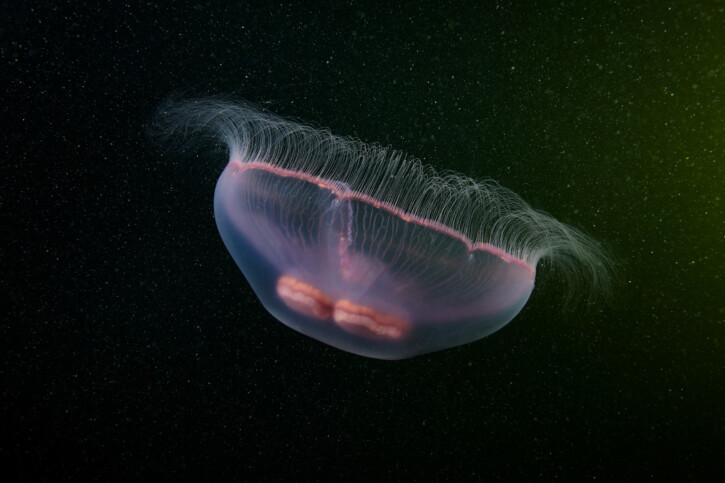
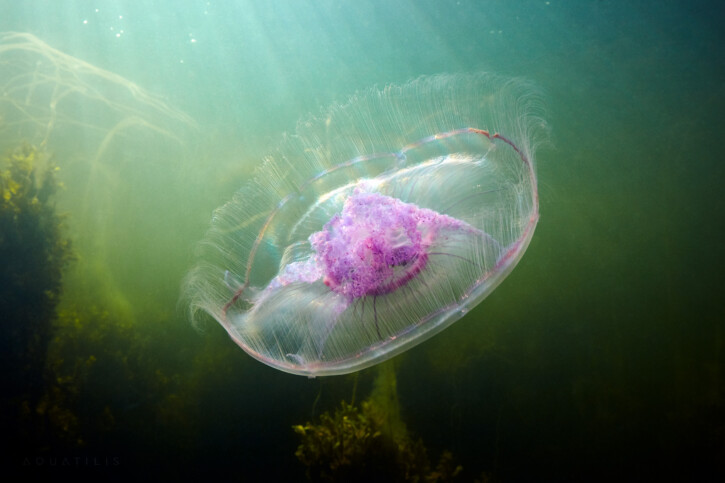
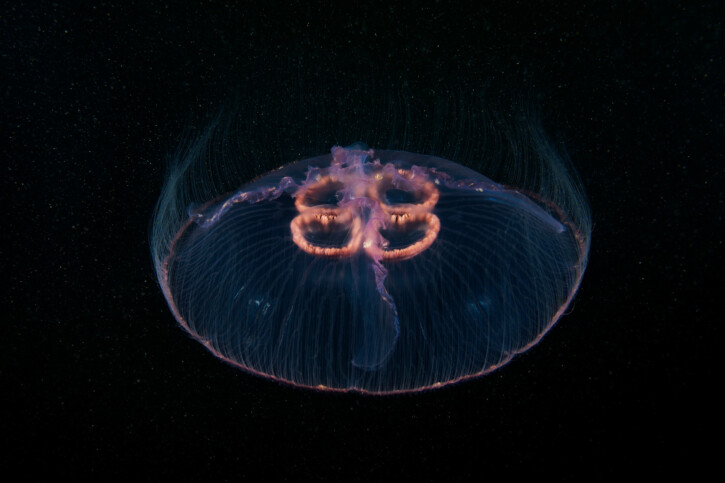
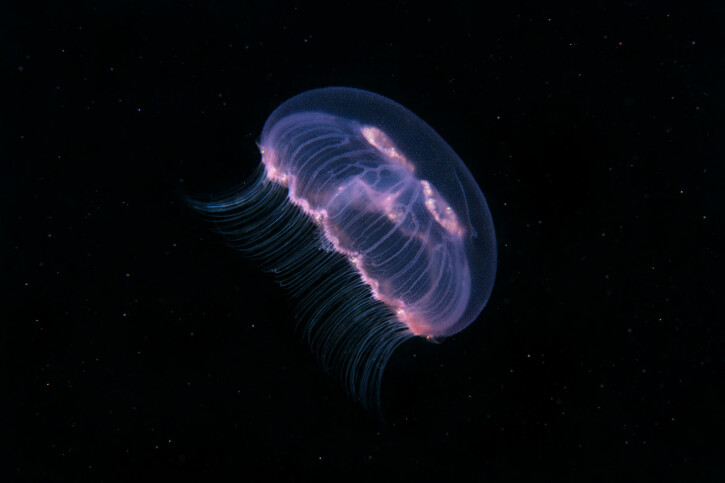
The common moon jelly can reach up to 50 cm in diameter. The overall shape of this jellyfish resembles a moderately flattened parasol. The numerous peripheral tentacles are thin and short. Four arms originate from the center of the oral side (lower side), around the mouth, with four reproductive organs (gonads) situated in a quincunx pattern from these arms, shaped like a horseshoe.
This jellyfish is typically translucent, with slightly pink or bluish-purple reflections. The reproductive organs are more distinctly colored in red or pink. The gonads are clearly visible in males and display hues ranging from red to bright pink.
Sexual dimorphism
The female's gonads are notably lighter and paler than those of the males.
Behaviour & Life cycle
-
Sociabilityliving in a group or alone
-
Dietpredator
-
Way of livingdiurnal
The common moon jelly exhibits limited social behavior, being primarily driven by environmental stimuli, especially the presence of food. It is a poor swimmer, which is why it is often found stranded along shorelines.
This species feeds on tiny organisms such as tintinnids, rotifers, cladocerans, as well as copepod larvae, barnacles, and fish. It captures its prey with the sticky texture of its small peripheral tentacles. This species is highly coveted by predators due to its high content of essential fatty acids and macronutrients.
Reproduction
-
Reproductionovipare qui pond en eau libre
-
Larva typeephyrule
The common moon jelly undergoes both sexual and asexual reproduction.
It is a viviparous organism. The sexes are distinct, and fertilization is internal. The eggs develop within the female. In the planula larval stage, the individual is released into the water column and becomes part of the plankton. This swimming larva will settle on the substrate with its aboral side. The oral side faces the surface.
Once attached, the larva matures into a small polyp that will grow and multiply, forming a colony of polyps. These polyps will bud and give rise to numerous young jellyfish, also known as ephyrae. These ephyrae will develop in open water to become adults.
Harmless species
The common moon jelly's urticant and unciform cells theoretically cannot penetrate human skin, so it poses no particular danger to humans if encountered in its natural habitat.
Origin and distribution
Geographic distribution & Conservation
The common moon jelly can be found in oceans worldwide, except for the icy polar regions.
Conservation and international regulations
Where to see this species?









What is its habitat?
Natural environment characteristics
-
Temperature5 - 25 °C
-
Depth0 - 1250 m
-
EnvironmentPlanktonic pelagic and Benthic fixed
Biotope presentation
The common moon jelly can be found up to 1250m deep, although it is usually very close to the surface.
It is predominantly a coastal species but can also be found in the open sea. It is also present in brackish waters, coastal bays, fjords, and estuaries.
To go further
To read on the web

Sources & Contributions
Participation & Validation
The Fishipedia team and specialist contributors are committed to providing high-quality content. However, although the information comes from scientific sources or testimonials from specialists, the cards may contain inaccuracies.

Adrien Falzon

Benoit Chartrer

Aurélien Calas
Translation
Translation done with the valuable contribution of our translators, who make this information available to a wider audience. We sincerely thank them for their commitment.
Bibliographic references
- GBIF — Aurelia aurita
- iNaturalist — Aurelia aurita
- Morphology, fluid Motion and Predation by the Scyphomedusa Aurelia Aurita — J. H. Costello — S. Colin — Marine Biology —
Where to see this species?
Scientific partners





Tags
#Ulmaridae
#Aurelia
#plein eau
#Hudson Bay
#Gulf of Alaska
#Bay of Bengal
#Gulf of Mexico
#Persian Gulf
#Great Barrier Reef
#Sea of Okhotsk
#mer d'Oman
#East China Sea
#Ross Sea
#Tasman Sea
#mer de Weddell
#Caribbean Sea
#Philippine Sea
#Greenland Sea
#Sea of Japan
#Labrador Sea
#North Sea
#Mediterranean Sea
#Black Sea
#Red Sea
#South East Asian Seas
#Mers d'Europe du Nord
#Mers d'Europe du Nord - Islande & Féroé
#Mers d'Europe du Nord - Norvège
#Indonesian seas
#Océan Atlantique Bahamas
#Océan Atlantique Bermudes
#Atlantic Ocean: North Coast of Brazil
#Océan Atlantique Est Afrique - Golfe de guinée
#Temperate Eastern Atlantic Ocean
#Océan Atlantique Est Afrique - Transition & Cap Vert
#Cold temperate Northwest Atlantic Ocean
#Northwest warm temperate Atlantic Ocean
#Southwest warm temperate Atlantic Ocean
#Southwest Tropical Atlantic Ocean
#Antartic ocean
#glacial ocean Artic
#East Indian Ocean
#Océan Pacifique Nord Est Tempere Chaud
#Océan Pacifique nord-est tempéré froid
#Tropical Eastern Pacific
#Western Tropical Pacific Ocean
#Oceania


