Introduction
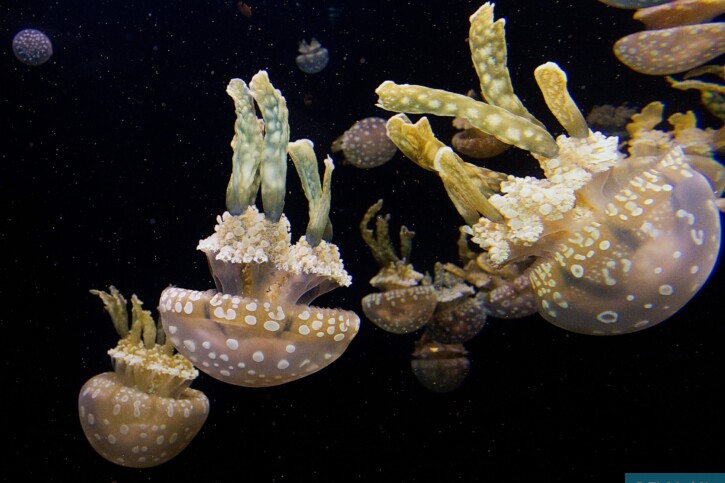
Mastigias papua is a scyphozoan jellyfish of the Mastigiidae family, taxonomically revised in 2018 by Souza and Dawson. Long considered a cosmopolitan species of the Indo-Pacific, it is now defined as endemic to the tropical western Pacific islands (West Papua, Palau, Marshall Islands), following the genetic distinction of several cryptic species.
Iconic of marine lakes and lagoons, it is known for its obligatory symbiosis with zooxanthellae and massive horizontal and vertical migrations. The designation of a neotype from Waigeo (West Papua) has stabilized the species identity in the face of historical confusion with M. albipunctatus and other distinct genetic lineages.
Who is it?
How to recognize This cnidarian ?
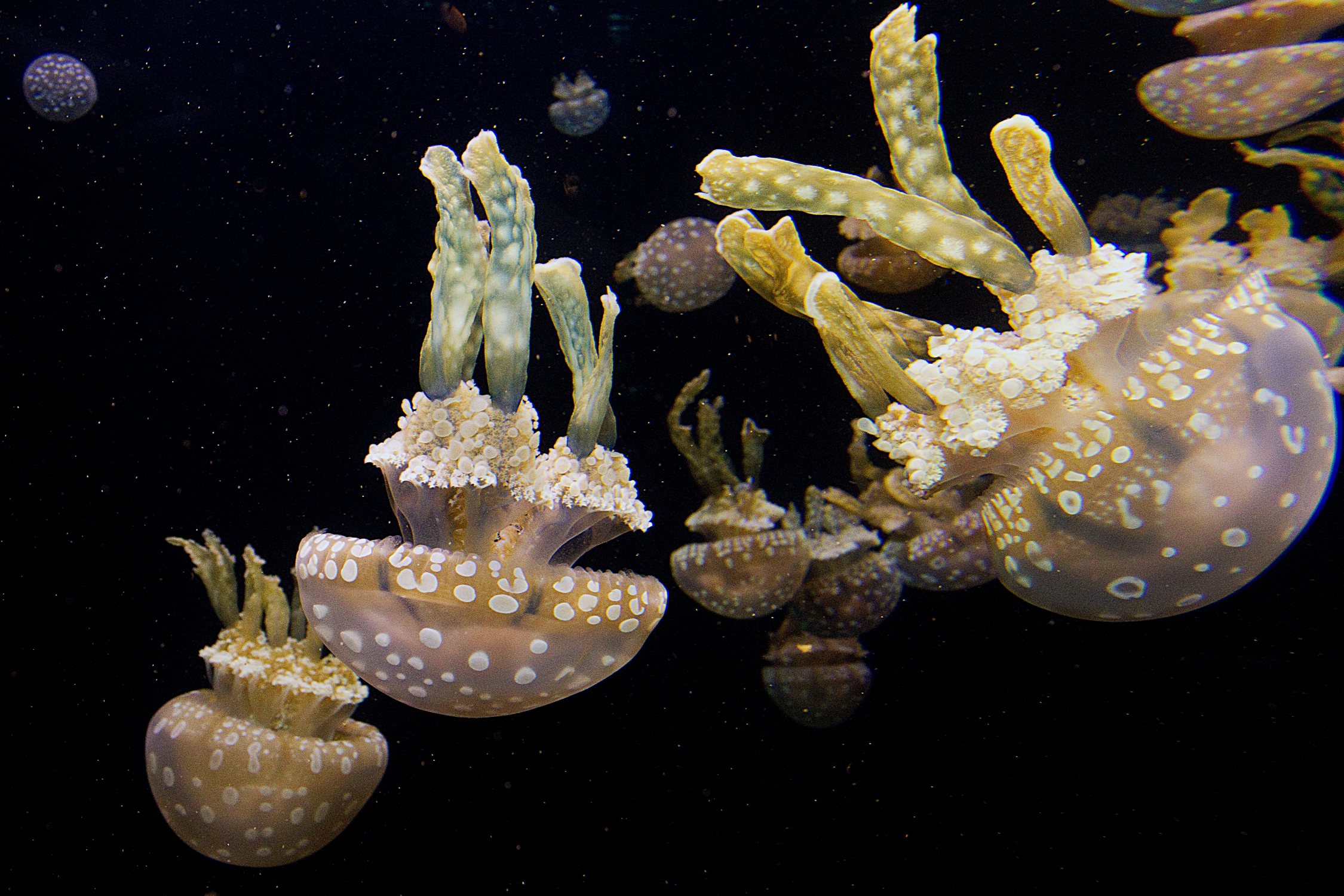
The species has a hemispherical bell that can reach up to 15–20 cm in diameter (although often observed between 8 and 12 cm), with a flexible mesoglea. The exumbrella is characterized by a yellow-brown color dotted with white spots of various sizes.
The oral arms, essential for nutrition, measure approximately 30% of the bell diameter. A major diagnostic characteristic lies in the terminal clubs, which have a typical triangular cross-section in 'tricornes' shape in lagoon specimens.
Behaviour & Life cycle
-
Sociabilityliving in a group or alone
-
Dietnot specified
-
Way of livingdiurnal
Mastigias papua is a pelagic species with complex migratory behavior rhythmically guided by the sun. During the day, it undergoes massive horizontal migrations (up to several kilometers in marine lakes) to follow sunlight and optimize photosynthesis by its symbiotic zooxanthellae.
Vertically, it stays near the surface (a few meters deep) during the day and descends to deeper layers (tens of meters) at night. This behavior is observed in both coastal oceanic habitats and isolated marine lakes. The species is generally solitary in the ocean but can form dense swarms in lakes.
This jellyfish has a mixed diet. It derives a substantial portion of its energy from the translocation of photosynthetic products from its symbiotic zooxanthellae (Symbiodiniaceae), located in the tissues of the oral arms and bell. Additionally, it actively captures zooplankton and phytoplankton with its oral arms equipped with ctenophores.
Reproduction
-
Reproductionovipare qui pond en eau libre
Like all Scyphozoans, Mastigias papua is gonochoric. The life cycle involves an alternation of generations: the adult jellyfish releases gametes that give rise to a free-swimming planula larva. This larva settles on a hard substrate to form a benthic polyp (scyphistome), which reproduces asexually through strobilation to release young jellyfish (ephyrae). Sexual maturity is reached when the jellyfish develop brood filaments at the base of the oral arms (in females) or corresponding gonadal structures.
Harmless species
Mastigias papua is harmless to humans. Its venom is too weak to penetrate human skin or cause notable reactions. It is a key species for sustainable tourism in sites like the Jellyfish Lake in Palau.
Origin and distribution
Geographic distribution & Conservation
Following the 2018 revision, the authentic distribution range of Papuan spotted jelly is restricted to the tropical western Pacific: West Papua (type locality: Waigeo), Palau, and the Marshall Islands (Enewetak). Populations previously identified as Papuan spotted jelly in the Philippines, Japan, Indonesia (Berau, Komodo), and Australia actually belong to other species, mainly Mastigias albipunctatus or unnamed lineages (Solomon Sea clade).
This redefinition is based on molecular and morphometric analyses distinguishing three major monophyletic clades. The absence of a historical type specimen necessitated the designation of a neotype collected at Mastigias Papua Cove, Waigeo.
Conservation and international regulations
Where to see this species?

What is its habitat?
Natural environment characteristics
-
Temperature24 - 30 °C
-
Depth0 - 40 m
-
FlowMedium
Biotope presentation
The species frequents protected coastal waters, lagoons, and bays. It is observed from the surface down to 30–40 meters deep depending on the time of day. The presence of light is the primary limiting factor due to its symbiosis. Marine lake populations show rapid local adaptation, with distinct morphological variations (club size, density of spots) from neighboring oceanic conspecifics.
To go further
To read on the web
Sources & Contributions
Participation & Validation
The Fishipedia team and specialist contributors are committed to providing high-quality content. However, although the information comes from scientific sources or testimonials from specialists, the cards may contain inaccuracies.

Benoit Chartrer
Translation
Translation done with the valuable contribution of our translators, who make this information available to a wider audience. We sincerely thank them for their commitment.
Where to see this species?
Scientific partners




Tags