
starry trigger-fish
- Abalistes stellaris
Abalistes stellaris
- Abalistes stellaris
| Family | Balistidae |
|---|---|
| Genus | Abalistes |
| IUCN category (World) | LC |
Introduction
Abalistes stellatus is a marine fish species originating from the Indo-Pacific zone.
Who is it?
Morphology
-
Average size40 cm
-
Maximum size60 cm
-
Average size40 cm
-
Maximum size60 cm
How to recognize This fish ?
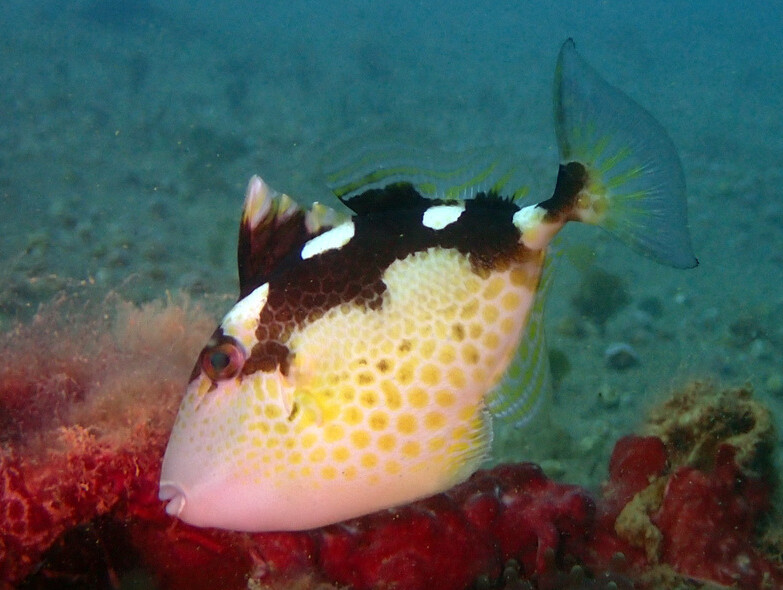
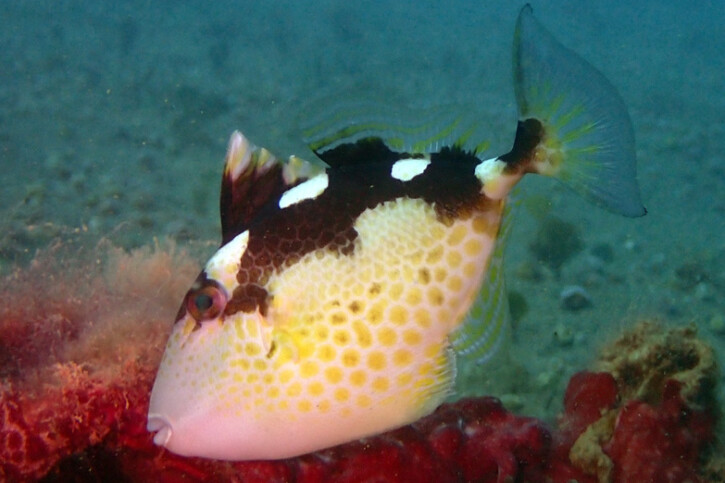
Abalistes stellatus, commonly known as starry trigger-fish, is a marine fish species belonging to the family Balistidae. It is characterized by its stout, laterally compressed body and its typical coloration with small light spots reminiscent of a starry sky, hence its name. Its coloration ranges from gray-blue to greenish-brown, with lighter shades on the belly. It can reach a maximum size of about 60 to 80 cm, although most observed specimens measure around 40 to 50 cm. Its first dorsal fin consists of three powerful spiny rays, used for defense or anchoring in crevices.
Sexual dimorphism
Sexual dimorphism is subtle in this species. Males may be slightly larger and more brightly colored during the breeding season, but there are no marked morphological differences easily observable without dissection or behavioral analysis.
Behaviour & Life cycle
-
dietcarnivorous
-
Sociabilitysolitary
-
territorialNo
-
Way of livingdiurnal
Being benthopelagic, Abalistes stellatus frequents lagoons, outer reef slopes, and sandy or muddy areas between 10 and 80 meters deep, although it can descend to 100 meters. Solitary or in small loose groups, adults mainly feed on crustaceans, mollusks, and echinoderms which they crush with their powerful jaw equipped with robust teeth.
Reproduction
-
Reproductionovipare
Reproduction is still poorly documented for this species, but like other trigger-fish, it is believed to be oviparous with nest spawning. The female would dig a nest in the sand where she would deposit her eggs, often guarded and fanned by both parents, especially the female. Reproductive behavior is often seasonal, linked to temperatures and lunar cycles.
Harmless species
For humans, Abalistes stellatus poses no direct threat, but like several trigger-fish, it can become aggressive during the breeding season when guarding its nest. Some populations may also carry toxins (notably ciguatera), making consumption risky in certain geographical areas.
Origin and distribution
Geographic distribution & Conservation
The species is currently not considered globally threatened. It is classified as of "least concern" (LC) by the IUCN, although it may be locally affected by overfishing or reef habitat degradation.
Conservation and international regulations
What is its habitat?
Natural environment characteristics
-
Temperature23 - 28 °C
-
Depth7 - 350 m
Biotope presentation
Abalistes stellatus is most commonly found at depths between 7m and 350m. Its biotope includes coral reefs, adjacent sandy areas, and loose substrates where it can dig for prey. It is distributed in the Indo-Pacific, from the Red Sea and East Africa to the Pacific Islands and northern Australia.
To go further
Species of the same family
To read on the web

Sources & Contributions
Participation & Validation
The Fishipedia team and specialist contributors are committed to providing high-quality content. However, although the information comes from scientific sources or testimonials from specialists, the cards may contain inaccuracies.

Adrien Falzon
Translation
Translation done with the valuable contribution of our translators, who make this information available to a wider audience. We sincerely thank them for their commitment.
Scientific partners



Tags
Species of the same family


