Introduction
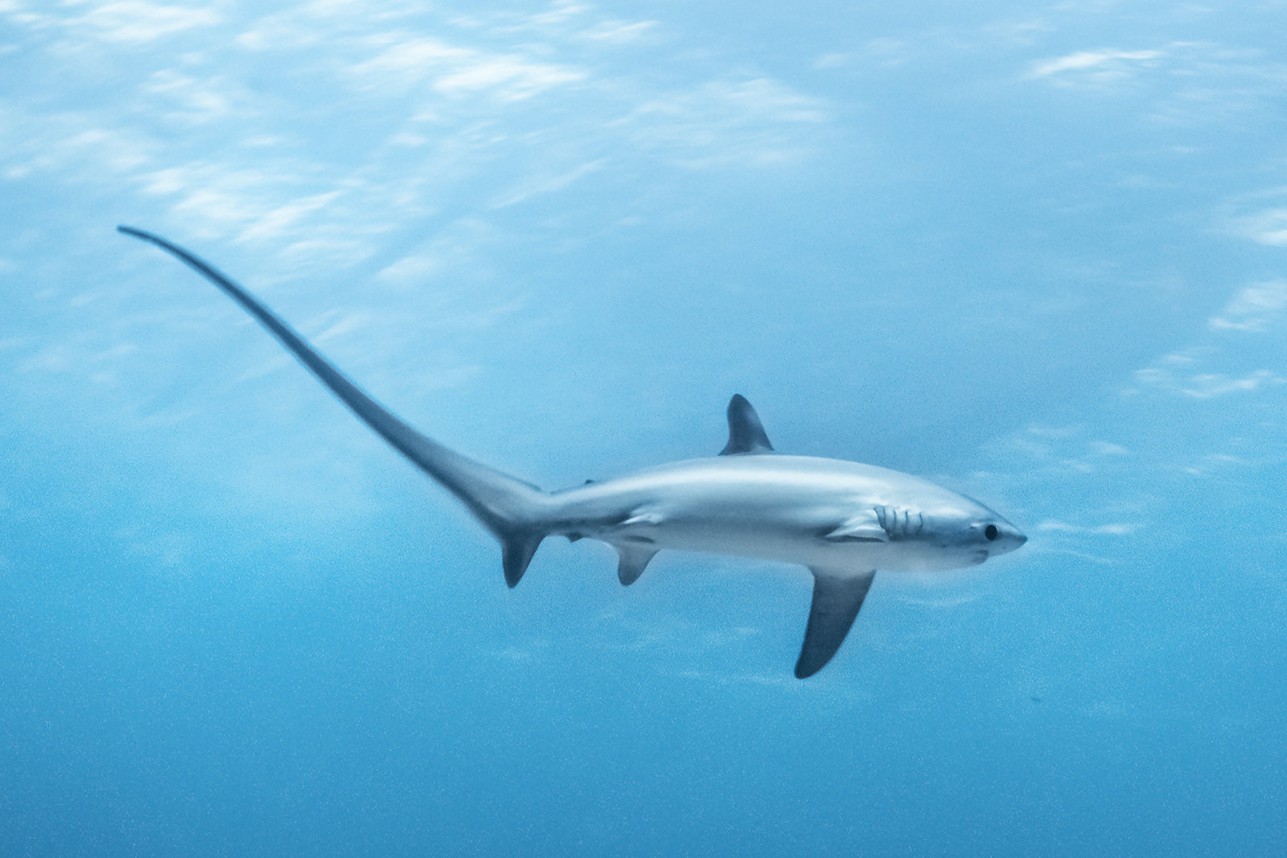
The thresher shark (Alopias vulpinus) is a cosmopolitan large marine predator found in temperate and tropical seas. It is recognizable by its immense whip-like caudal fin, which it uses to corral and stun its prey. Highly exploited for its flesh, fins, and liver, this species is vulnerable to overfishing.
Who is it?
Morphology
-
Type
-
Average size450 cm
-
Maximum size573 cm
-
Type
-
Average size450 cm
-
Maximum size573 cm
How to recognize This fish ?
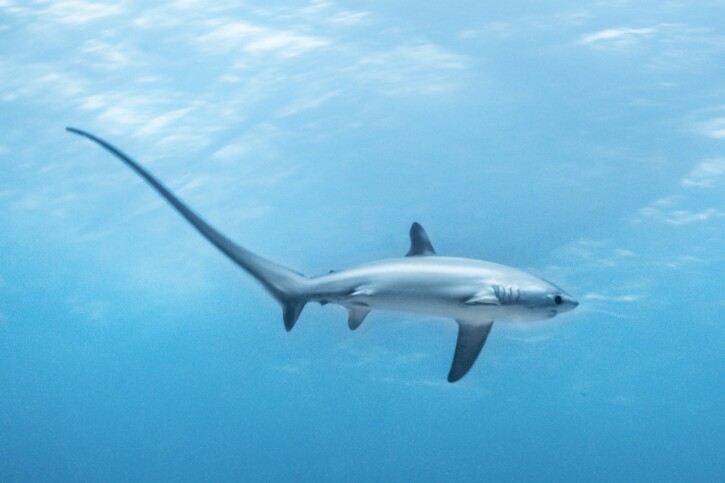
This species can reach up to 5.7 m in length and 350 kg. The streamlined body has a gray to dark blue back contrasting with a white belly. The pectoral fins are curved, the second dorsal fin is reduced, and the eye relatively small. The upper half of the caudal fin is exceptionally elongated, often as long as the rest of the body.
Sexual dimorphism
Sexual dimorphism is slight. Females, however, reach a slightly larger size than males (up to 5.5 m compared to 4.6 m).
Behaviour & Life cycle
-
dietcarnivorous
-
Sociabilitysolitary
-
territorialNo
-
Way of livingdiurnal
It is an active predator in coastal and pelagic zones. It mainly preys on schooling fish such as mackerel, sardines, and herrings, but can also target squid and crustaceans. It uses its caudal fin to corral and stun its prey before swallowing them. Juveniles frequent shallow bays, while adults explore open water and continental slopes.
Reproduction
-
Reproductionovovivipare
The thresher shark is ovoviviparous with oophagy. After the yolk sac is absorbed, the embryos feed on eggs produced by the mother. Litters usually consist of 2 to 4 young, measuring 1.2 to 1.5 m at birth. The cycle is annual or biennial. Maturity is reached late (13 years in females in the North Atlantic). Maximum lifespan is estimated at 38 years.
Risks for humans
-
VenomousNo
-
BiteYes
The species is not considered dangerous to humans, though its size commands respect. Some questionable interactions with boats have been reported. It can cause damage to fishing gear.
Origin and distribution

Geographic distribution & Conservation
The species is widely distributed in the Atlantic, Indian Ocean, and Pacific. It is absent from the eastern Mediterranean but reported elsewhere in the Mediterranean and in all temperate to tropical waters, from the surface to 650 m. Populations show distinct genetic structuring between the Atlantic and Pacific, but form a single global unit.
The status of this species varies by region: a marked decline is observed in the North Atlantic and Mediterranean, but relative stability in the Pacific, after fishery regulation. Overall, the species is classified as vulnerable by the IUCN, with an estimated decline of 30 to 49% over three generations, mainly due to overexploitation for its flesh, fins, and liver.
Conservation and international regulations
What is its habitat?
Natural environment characteristics
-
Temperature12 - 28 °C
-
Depth0 - 650 m
Biotope presentation
The thresher shark mainly inhabits temperate waters near coasts, continental shelves and slopes, but also the open sea up to 650 m. Juveniles are often seen in shallow bays.
To go further
To read on the web


Sources & Contributions
Participation & Validation
The Fishipedia team and specialist contributors are committed to providing high-quality content. However, although the information comes from scientific sources or testimonials from specialists, the cards may contain inaccuracies.

Adrien Falzon
Translation
Translation done with the valuable contribution of our translators, who make this information available to a wider audience. We sincerely thank them for their commitment.
Scientific partners