
Introduction
Ameca splendens, commonly known as butterfly splitfin, is a freshwater fish endemic to the Río Ameca basin in the state of Jalisco, Mexico. The sole representative of the genus Ameca, this species is emblematic of the Goodeidae family, characterized by matrotrophic viviparous reproduction (embryos are nourished by specialized ovarian tissue). Classified as Critically Endangered (CR) by the IUCN, the species has seen a drastic reduction in its distribution range, having disappeared from several historical localities (Almoloya, El Molino). It now mainly survives in the springs of Teuchitlán, where it faces accelerated habitat degradation due to agricultural pollution, fragmentation of the hydrographic network, and pressure from invasive species.
Who is it?
Morphology
-
Type
-
Average size8 cm
-
Maximum size13 cm
-
Longevity5 year
-
Type
-
Average size8 cm
-
Maximum size13 cm
-
Longevity5 year
How to recognize This fish ?
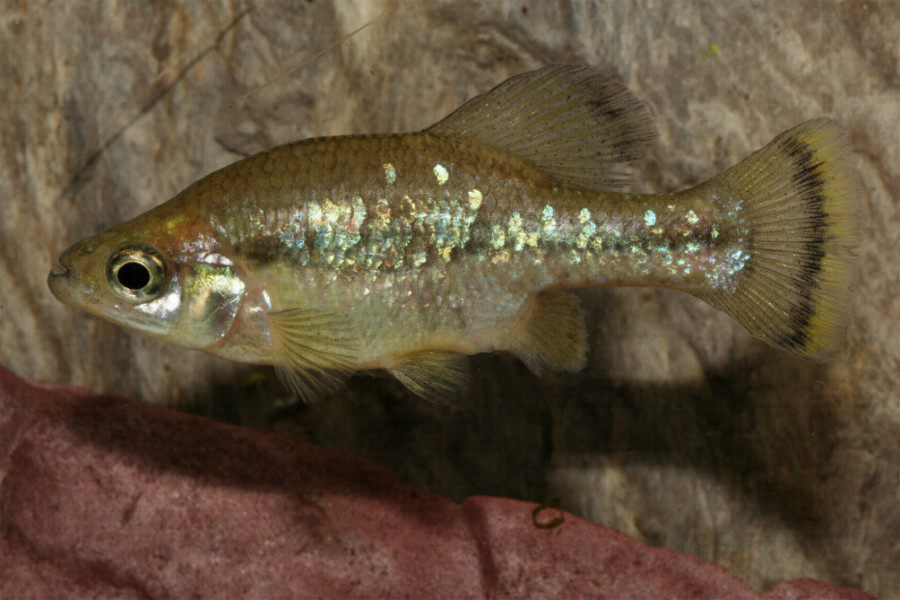
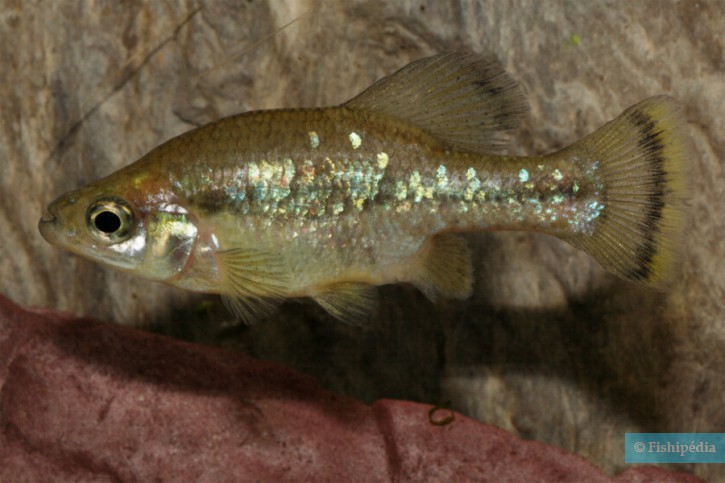
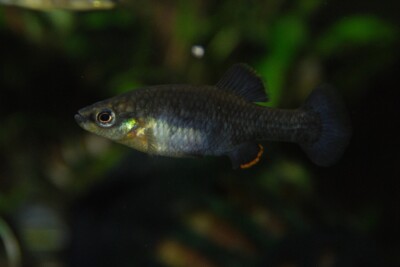
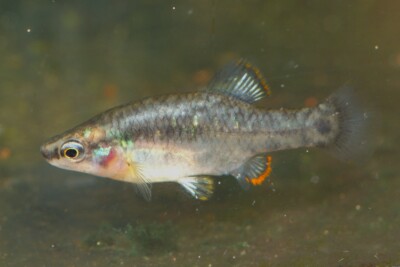
The overall body coloration is silvery to golden, often enhanced with bluish or greenish hues on the sides. The pectoral, pelvic, and anal fins may have bright orange or reddish tones, particularly in males during courtship. Like all Goodeids, it has a "splitfin" (modified anal fin in males, but less specialized than the Poeciliid's gonopodium) and gives birth to fully formed fry. Its most distinctive feature lies in its high and wide dorsal fin, adorned with a pronounced black spot edged in white or yellow, resembling butterfly wings when spread.
Sexual dimorphism
Ameca splendens exhibits marked sexual dimorphism. Males, smaller in size, reach a maximum length of 8.0 cm (total length), while females can grow up to 12.0 cm. Sexual maturity is reached at around 2.7 cm in males.
Behaviour & Life cycle
-
dietcarnivorous
-
Sociabilityliving in small groups
-
territorialNo
-
Way of livingdiurnal
Ameca splendens forms dominant groups often dominating the native community in its restricted habitat. It is mainly active in the spring area, where population density is highest, although it may also frequent downstream sections of the river.
It constantly grazes on algae and aufwuchs (biofilm composed of algae, bacteria, and detritus) adhering to rocks and concrete walls in the springs. This dependence on biofilms makes it particularly vulnerable to eutrophication.
Reproduction
-
Reproductionvivipare
Reproduction is matrotrophic viviparous, an advanced trait among teleost fish. Females give birth to free-swimming and independent fry. Although precise data on fecundity and seasonality in the wild are limited, the species successfully reproduces in captivity (notably in Florida, where it is commercially bred for the aquarium trade). Early sexual maturity (from 2.7 cm) allows for rapid generation turnover, a crucial strategy in the face of declining wild populations.
Harmless species
Ameca splendens is harmless to humans.
Origin and distribution
Geographic distribution & Conservation
Endemic to Mexico, Ameca splendens was found in the rios Ameca and Teuchitlan. Now nearing extinction in the wild, the species only survives in a single basin located at the sources of the Rio Teuchitlan near the village of the same name, in the state of Jalisco. The sources of this river are naturally warm (25 to 32°C). They have been transformed into swimming pools. The species has already disappeared from the Magdalena basin (Almoloya) and the El Molino pond (Laguna de Sayula valley).
Conservation and international regulations
What is its habitat?
Natural environment characteristics
-
Temperature15 - 32 °C
-
pH (acidity)7 - 8
-
gh (hardness)10 - 30
Biotope presentation
The species is confined to clear water springs with sandy and silty bottoms, typical of the Teuchitlán region. It clearly prefers the main spring area (emerging under the roots of a large Metasequoia) to downstream sections of the river. The Teuchitlán type site has a specific configuration: a spring approximately 25 m long by 12 m wide, with concrete walls partially lined with rocks, and a depth of about 1 meter. The water is clear and constantly flowing.
To go further


Sources & Contributions
Participation & Validation
The Fishipedia team and specialist contributors are committed to providing high-quality content. However, although the information comes from scientific sources or testimonials from specialists, the cards may contain inaccuracies.
Translation
Translation done with the valuable contribution of our translators, who make this information available to a wider audience. We sincerely thank them for their commitment.

Benoit Chartrer
In collaboration with : Association France Vivipare
Bibliographic references
Scientific partners




Species of the same family


