
wolf eel
| Family | Anarhichadidae |
|---|---|
| Genus | Anarrhichthys |
| IUCN category (World) | LC |
Introduction
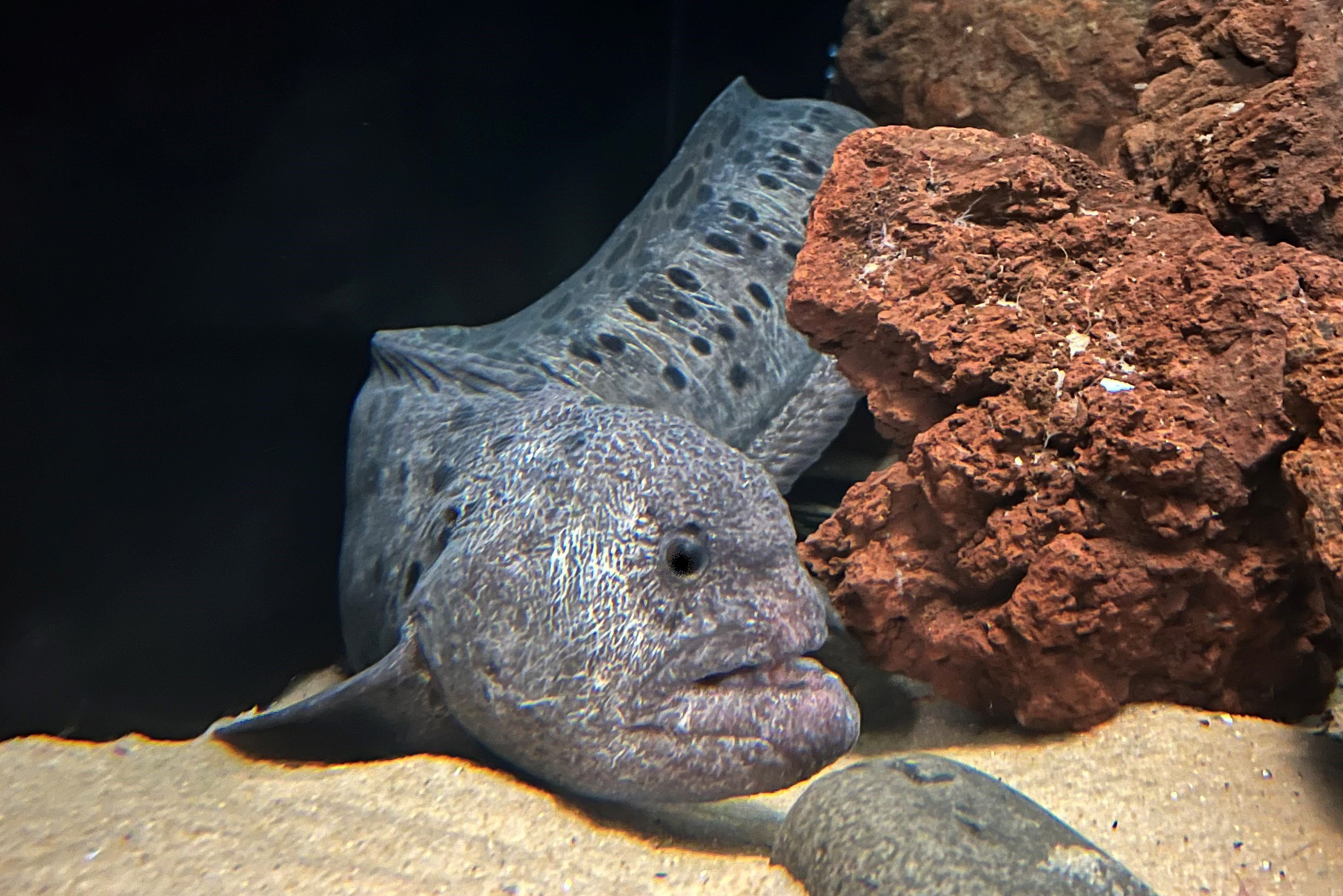
Anarrhichthys ocellatus, commonly known as wolf eel, is a marine fish native to the northeast coasts of the United States and Canada. Like its cousins, the Anarhichas, this territorial predator is a discreet hunter that mostly resides in a shelter among rocks.
It has sometimes been confused with the species Anarhichas orientalis, especially in the Sea of Japan. This species, prized for its flesh in the Americas, has been extensively studied for potential aquaculture.
Who is it?
Morphology
-
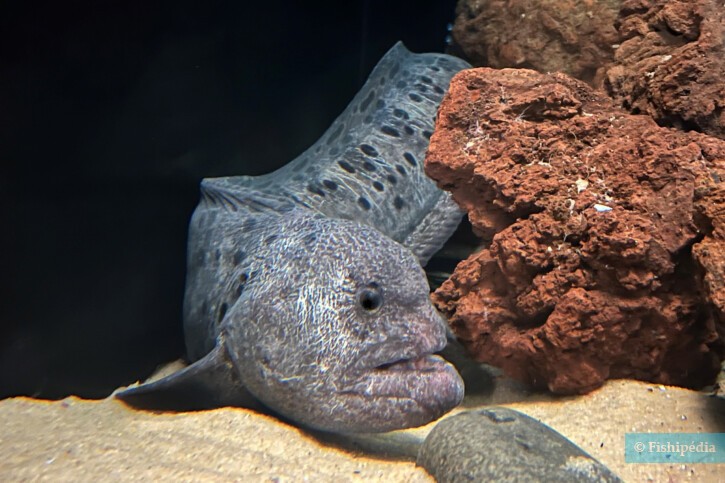
Average size200 cm
-
Maximum size240 cm
-
Mimicryrocky bottoms
-
Patternponctuations
-
Average size200 cm
-
Maximum size240 cm
-
Mimicryrocky bottoms
-
Patternponctuations
How to recognize This fish ?
The largest specimens reach over 2 meters. This species is easily recognizable by its violet-grey body covered with black spots. It lacks an anal spine and has a short caudal fin. It has an elongated shape and an imposing mouth.
Sexual dimorphism
Dimorphism is not obvious. Observers have reported that females have elongated heads, while males have larger, rounder heads. Males seem to grow faster and reach a larger size.
Behaviour & Life cycle
-
dietcarnivorous
-
Sociabilitysolitary
-
territorialYes
-
Way of livingnocturnal
During the day, adults reside in shelters among rocks. They defend this territory against other sedentary fish. These fish primarily feed on crustaceans and echinoderms. They particularly hunt flat sea urchins (Dendraster excentricus) and crabs (Cancer gracilis). They supplement this diet with mollusks and fish.
Juveniles are pelagic during the first two years of their life.
Reproduction
-
Reproductionovipare qui pond sur substrat découvert
During reproduction, the male rubs its head against the female's abdomen, wraps around her, and fertilizes her eggs as she extrudes them. The eggs are laid, and both parents wrap around the egg mass to protect it. The female wraps around the egg mass, and the male wraps around the female. Only one parent at a time leaves the eggs to feed.
Spawning typically occurs from October to February and seems to coincide with spring plankton blooms. After an incubation of 3 to 4.5 months, the larvae hatch at a standard length of about 4 cm. Fecundity is estimated at about 10,000 eggs, with first maturity reached at four years of age. These fish are monogamous but can establish new breeding pairs during the same spawning season.
Larvae and young juveniles are pelagic.
Risks for humans
-
VenomousNo
-
BiteYes
This species can attack if it feels threatened. It is important to be particularly cautious, especially during dives or fishing sessions.
Origin and distribution
Geographic distribution & Conservation
This species is found in the northern Pacific, from the Aleutian Islands to southern California. Some observations have been made in littoral zones in northern Mexico.
Conservation and international regulations
Where to see this species?

What is its habitat?
Natural environment characteristics
-
Temperature2 - 11 °C
-
Depth1 - 225 m
Biotope presentation
This species frequents rocky areas up to about 225 meters deep. Some observations have occurred at greater depths (244 meters). This species shelters in crevices and caves.
To go further
To read on the web

Sources & Contributions
Participation & Validation
The Fishipedia team and specialist contributors are committed to providing high-quality content. However, although the information comes from scientific sources or testimonials from specialists, the cards may contain inaccuracies.

Benoit Chartrer
Translation
Translation done with the valuable contribution of our translators, who make this information available to a wider audience. We sincerely thank them for their commitment.

Marine Kassel
Bibliographic references
- GBIF — Anarrhichthys ocellatus
- iNaturalist — Anarrhichthys ocellatus
- FIRST RECORD OF THE WOLF-EEL, ANARRHICHTHYS OCELLATUS (PISCES: ANARHICHADIDAE), FROM BAJA CALIFORNIA, MEXICO — RICHARD F. FEENEY — ROBERT N. LEA — California Fish and Game —
- Sequence and phylogenetic analysis of the mitochondrial genome for the Wolf-eel, Anarrhichthys ocellatus (Anarhichadidae: Perciformes) — Gang Lu — Jiangbo Qu — Li Bian — Qing Chang — Jianlong Ge — Changlin Liu — Shengnong Zhang — Siqing Chen — Fenghui Li — Xiangtang Chen — Mitochondrial DNA —
Where to see this species?
Scientific partners



Tags


