
Introduction
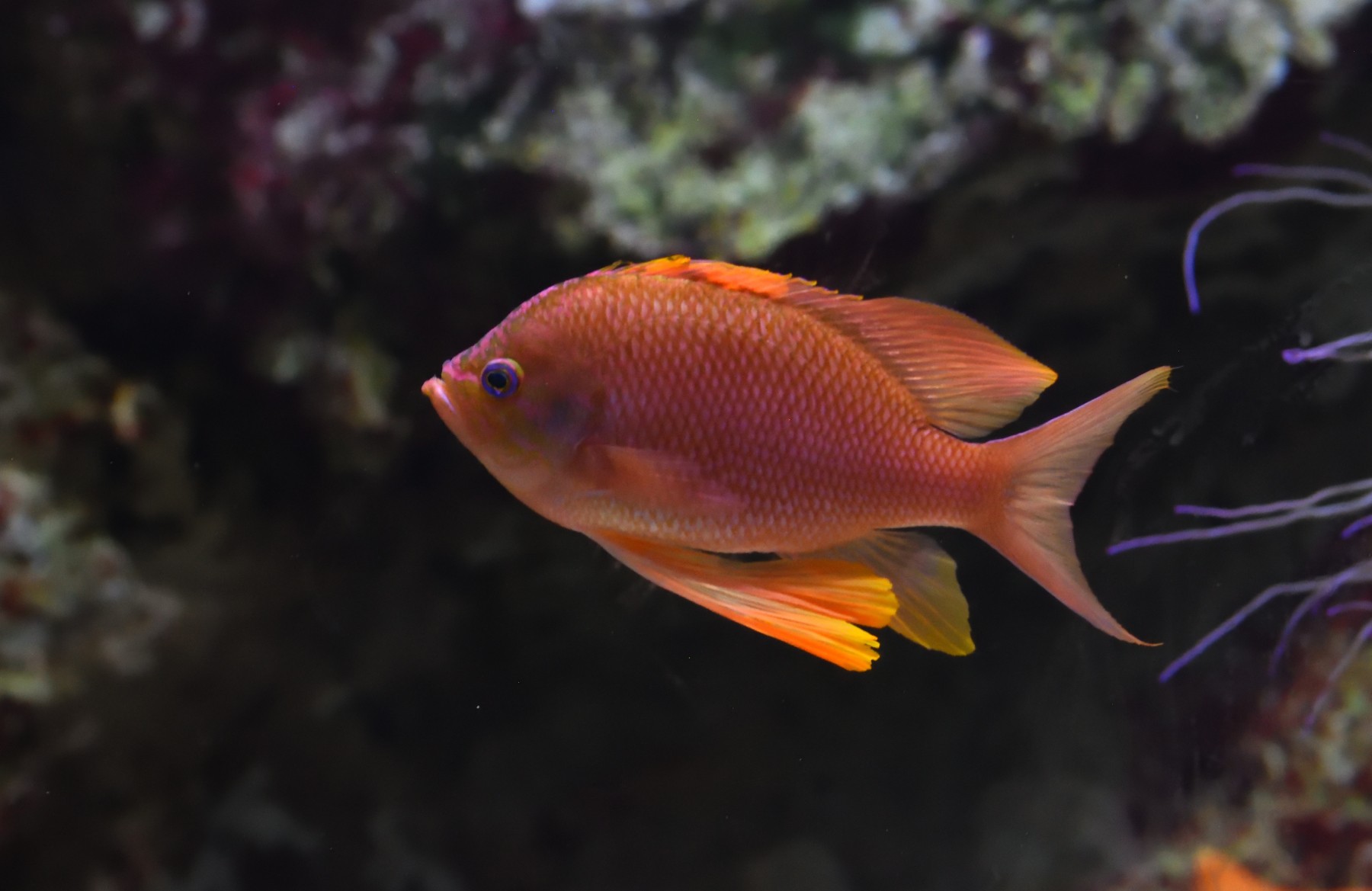
The swallowtail seaperch is one of the few pink fish found in the Mediterranean Sea.This nocturnal fish lives in coralligenous algae and underwater caves between 30 and 50 meters deep.
Who is it?
Morphology
-
Average size15 cm
-
Maximum size27 cm
-
Longevity7 year
-
ShapeOvoid
-
Average size15 cm
-
Maximum size27 cm
-
Longevity7 year
-
ShapeOvoid
How to recognize This fish ?
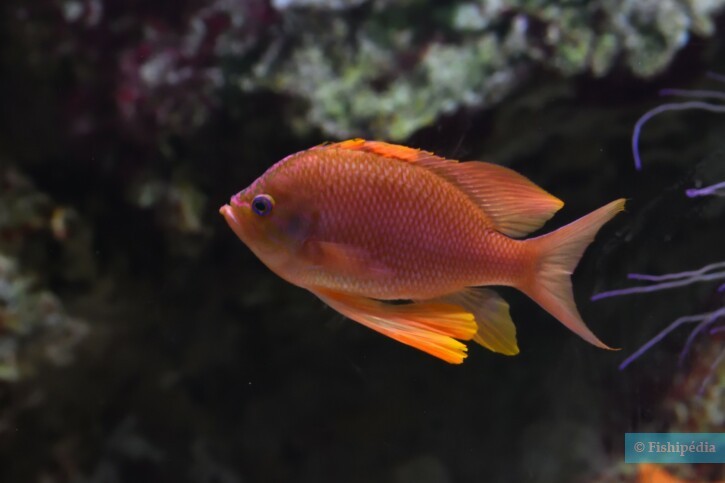
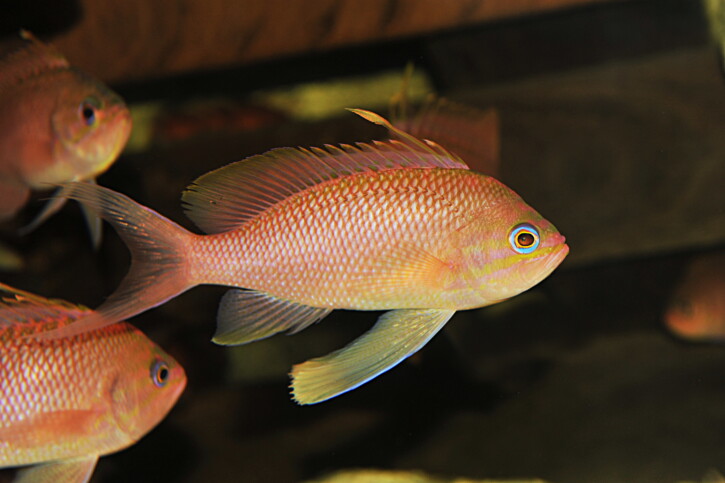
The swallowtail seaperch measures around 15 cm. Dominant males, however, can reach 25 cm. This fish is bi-colored with a mostly orange and pink body. It has an oval body and its lower jaw is slightly longer than the upper jaw. The second part of its dorsal fin has a sail-like structure. The pelvic fins and anal fin are long. The caudal fin is crescent-shaped.
Sexual dimorphism
The adult male is larger than the female. Additionally, they have golden stripes at the tips of their dorsal and anal fins. Males can be distinguished by the presence of yellow stripes radiating from their eyes.
Behaviour & Life cycle
-
dietcarnivorous
-
Sociabilityliving in shoals
-
territorialYes
-
Way of livingnocturnal
The swallowtail seaperch lives in schools at mid-depth and near the seabed. Schools are organized in a troupe, consisting of a dominant male and his harem of females.
It is a carnivorous species with a calm temperament. A small nocturnal predator, it specializes in hunting fish and crustaceans. It can also feed on zooplankton. Generally, it leaves its hiding spot and becomes active once dusk arrives.
Reproduction
-
Reproductionovipare
-
Hermaphroditeprotogynous
The swallowtail seaperch is an oviparous fish, always born female. As they grow, individuals change sex to become male, known as protogynous sequential hermaphroditism. Within a population, the oldest female will take the place of the dominant male when he dies.
In the Mediterranean, reproduction takes place between spring and autumn.
Harmless species
This species poses no particular danger to humans if encountered in its natural habitat.
Origin and distribution
Geographic distribution & Conservation
The distribution range of the swallowtail seaperch extends from the Atlantic Ocean to the Mediterranean Sea. It is not uncommon to encounter this fish near Portuguese coasts and even as far as Namibia and the Azores. This fish is also present in the Black Sea.
Anthias anthias is classified as “least concern” according to the IUCN Red List.
Where to see this species?





What is its habitat?
Natural environment characteristics
-
Temperature14 - 25 °C
-
Depth30 - 300 m
-
FlowSlow
Biotope presentation
The swallowtail seaperch is most commonly found at depths between 30m and 50m. However, it is not impossible to find this species at depths of up to 300m.
In subtropical to tropical areas, the swallowtail seaperch preferably inhabits coral reefs. This species also frequents rocky and pebbly reefs. This nocturnal fish is also the main fauna of underwater caves, caverns, and crevices.
To go further
Species of the same family
To read on the web


Sources & Contributions
Participation & Validation
The Fishipedia team and specialist contributors are committed to providing high-quality content. However, although the information comes from scientific sources or testimonials from specialists, the cards may contain inaccuracies.

Benoit Chartrer

Théo Guillaume

Adrien Falzon
Translation
Translation done with the valuable contribution of our translators, who make this information available to a wider audience. We sincerely thank them for their commitment.

Marine Kassel
Bibliographic references
- GBIF
- GUIDE DES POISSONS DE LA MEDITERRANEE — Harmelin-Vivien M. — Harmelin J.-G. — Delachaux et Niestlé —
- GUIDE D’IDENTIFICATION DES POISSONS MARINS, EUROPE ET MÉDITERRANÉE — LOUISY Patrick — Ulmer —
Where to see this species?
Scientific partners





Tags
Species of the same family


