reticulated pufferfish
| Family | Tetraodontidae |
|---|---|
| Genus | Arothron |
| IUCN category (World) | LC |
Introduction
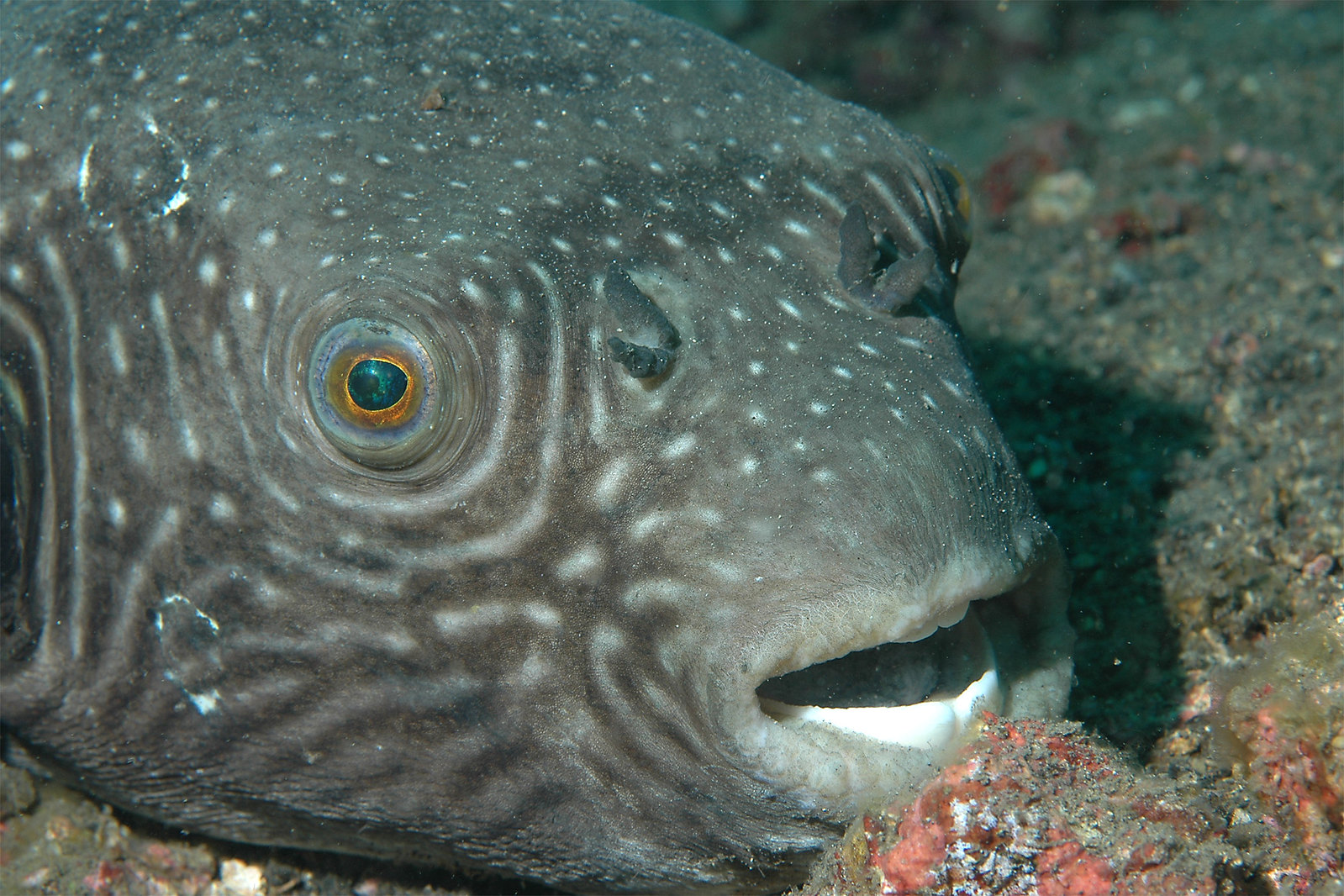
Arothron reticularis, also known as reticulated pufferfish, is a tropical species of the Tetraodontidae family. Found in the Indo-Pacific, it inhabits both marine and brackish waters. Like its relatives, it is capable of inflating when threatened and can accumulate toxins harmful to humans and predators.
Who is it?
Morphology
-
Type
-
Average size35 cm
-
Maximum size45 cm
-
ShapeOval
-
Patternponctuations
-
Type
-
Average size35 cm
-
Maximum size45 cm
-
ShapeOval
-
Patternponctuations
How to recognize This fish ?
This species belongs to the group of pufferfish. These fish are nicknamed like this because they have the ability to inflate themselves when they feel threatened.
To achieve this inflation, they swallow water and fill their stomach to more than double their volume. This is made possible by their stretchy skin. This subterfuge makes them look much more impressive to their predators. They are also much more complicated to swallow. This change in shape becomes a disadvantage for these fish that, once inflated, can hardly move.
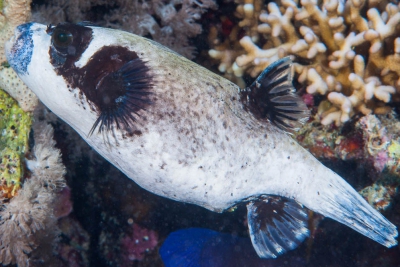
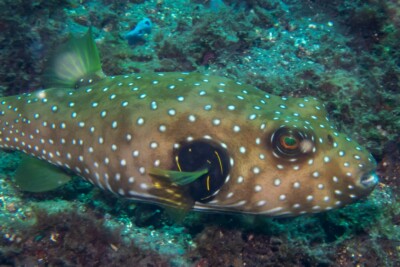
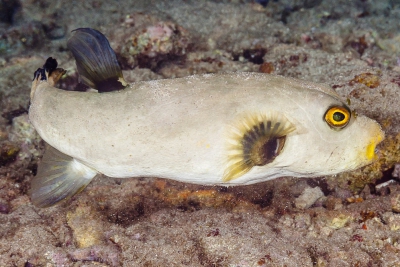
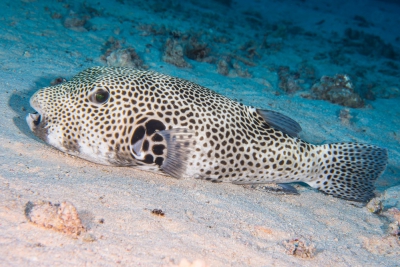
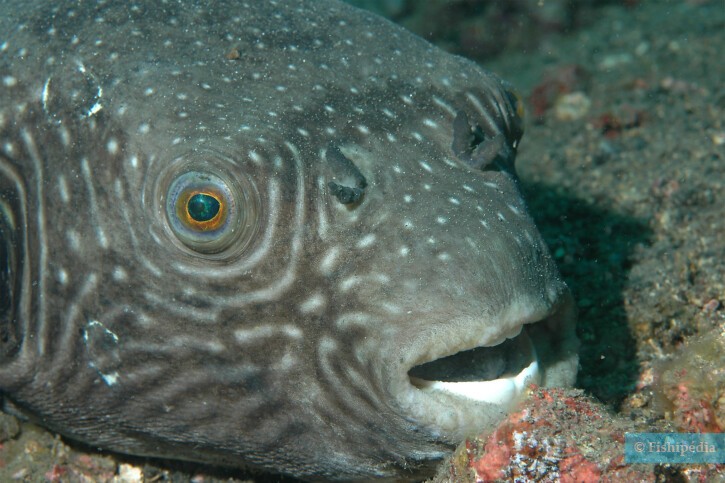
This species can reach a total length of 45 cm. Its stout body is covered with small dermal spines over most of its surface, except around the mouth and the base of the fins. Its typical pattern consists of dark brown reticulated bands running along the body. The eyes are surrounded by incomplete or complete white rings. Like all Tetraodontidae, it has thick skin, fused teeth forming a robust beak, a single small dorsal and anal fin, and the absence of ribs or pelvic fins.
Sexual dimorphism
There is no marked sexual dimorphism in this species.
Behaviour & Life cycle
-
dietcarnivorous
-
Sociabilitysolitary
-
territorialNo
-
Way of livingdiurnal
This species is known to emit sounds easily audible by humans.
The reticulated pufferfish is typically solitary. Adults often remain motionless on muddy bottoms during the day, while juveniles take shelter in mangrove roots and may even venture into the lower reaches of some streams. The species primarily feeds on mollusks, corals, and other benthic invertebrates, but also consumes algae, seagrass, and even mangrove detritus. Its powerful jaws allow it to crush the hard shells and structures of its prey.
Reproduction
-
Reproductionovipare
Arothron reticularis is an oviparous fish. Like other Tetraodontidae, the male excavates a circular nest in the sand where the female lays her eggs. Spawning may be synchronized with lunar cycles, resulting in gatherings. The eggs float or remain attached to the substrate until hatching, which occurs after a few days. The tiny, vulnerable larvae develop in open water before moving to coastal areas. In other species of Tetraodontidae, the presence of maternal toxins protects the young stages from predators, a phenomenon that may also apply to A. reticularis.
Harmless species
Like other pufferfish, Arothron reticularis can be potentially harmful to humans. Its skin, liver, and gonads can accumulate tetrodotoxin, a potent neurotoxin that can be lethal if ingested. The species is not aggressive, but its flesh should not be consumed. When threatened, it can inflate with water to deter predators and become difficult to swallow.
Origin and distribution
Geographic distribution & Conservation
Arothron reticularis is widely distributed in the Indo-West Pacific, from the coasts of India and Sri Lanka to southern Japan, Australia, New Caledonia, and as far as Samoa. It is also found in Indonesia, Papua New Guinea, and certain areas of Micronesia. Its range includes both open sea and estuarine and lagoon environments.
Conservation and international regulations
Where to see this species?


What is its habitat?
Natural environment characteristics
-
Temperature25 - 29 °C
-
Depth1 - 25 m
Biotope presentation
The species frequents sheltered bays, muddy or sandy bottoms, seagrass areas, and shallow coral reefs, at depths ranging from 1 to 20 meters. Juveniles prefer to live in mangroves, often among roots, and may venture into the freshwater of coastal streams.

To go further
Species of the same family
Espèces du même genre
To read on the web

Sources & Contributions
Participation & Validation
The Fishipedia team and specialist contributors are committed to providing high-quality content. However, although the information comes from scientific sources or testimonials from specialists, the cards may contain inaccuracies.

Adrien Falzon
Translation
Translation done with the valuable contribution of our translators, who make this information available to a wider audience. We sincerely thank them for their commitment.

Marine Kassel
Where to see this species?
Scientific partners




Tags
Species of the same family
Same genus