Mediterranean damselfish
| Family | Pomacentridae |
|---|---|
| Genus | Chromis |
| IUCN category (World) | LC |
Introduction
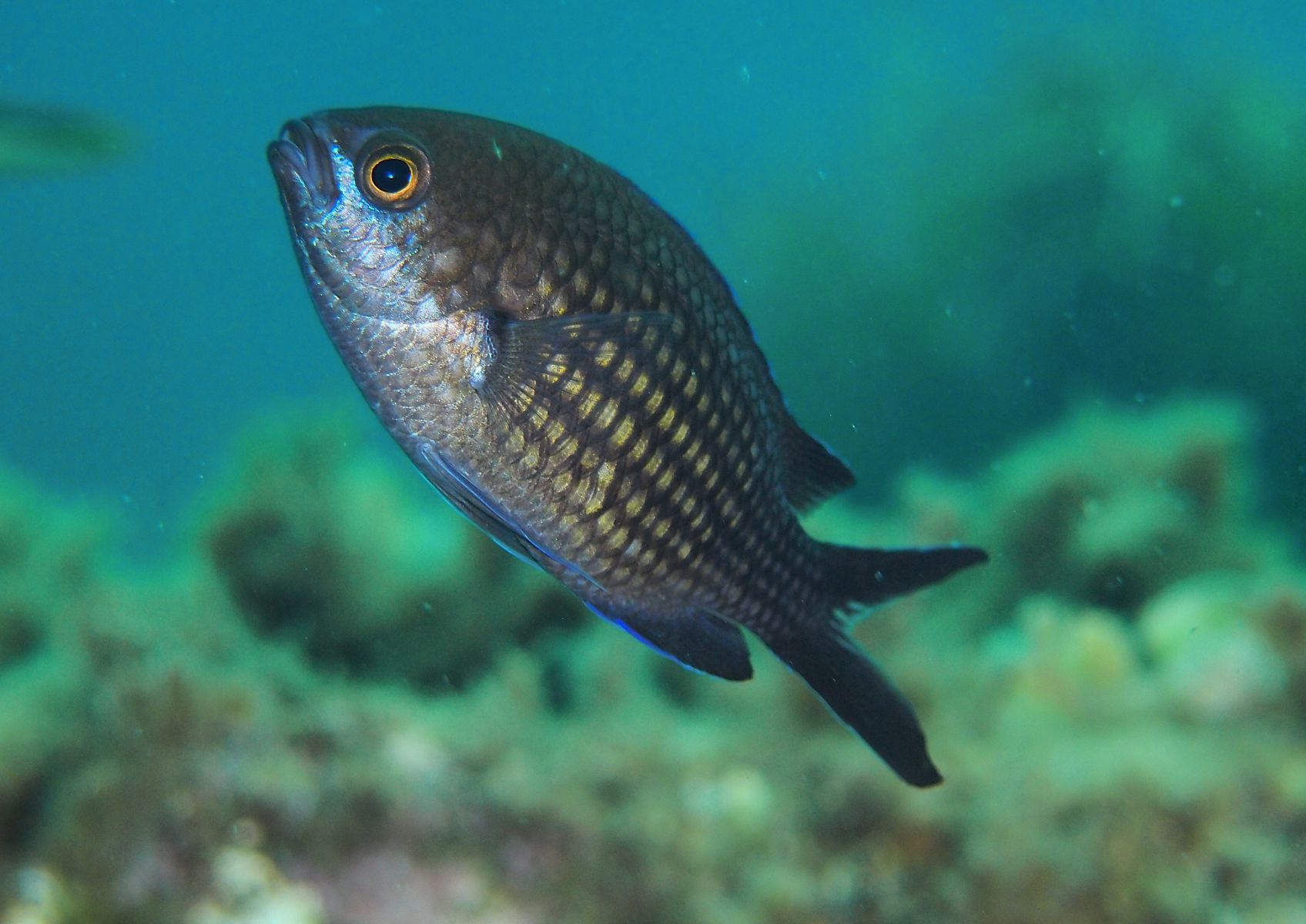
Chromis chromis, commonly known as Mediterranean damselfish, is a saltwater fish widely found in the Mediterranean Sea and the eastern Atlantic Ocean. It is one of the few species in the family that frequent these regions.
Who is it?
Morphology
-
Average size10 cm
-
Maximum size12 cm
-
Longevity4 year
-
Average size10 cm
-
Maximum size12 cm
-
Longevity4 year
How to recognize This fish ?
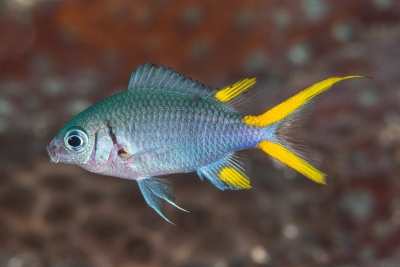
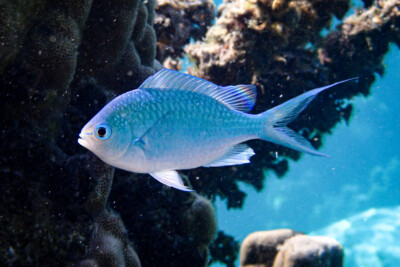
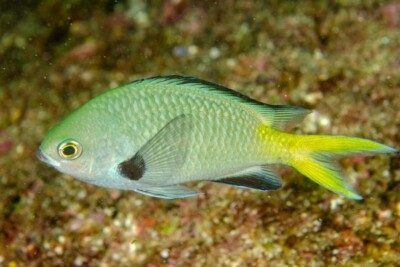
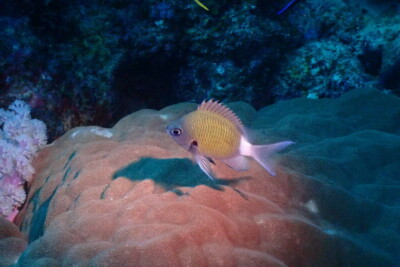
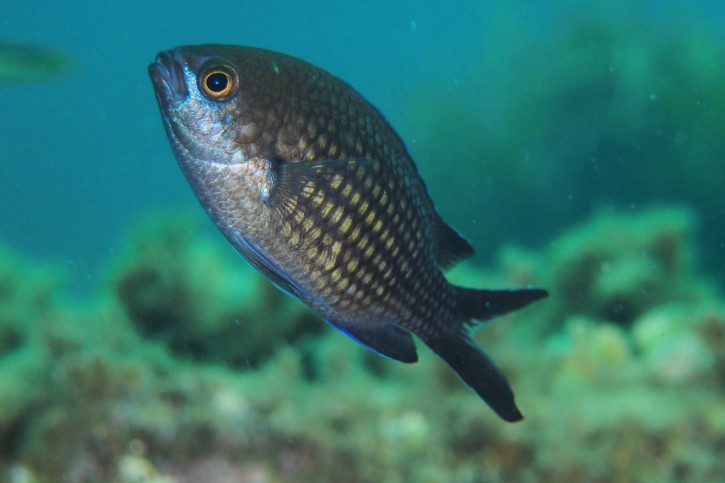
The Mediterranean damselfish is uniformly colored with a predominantly black and grey body. Juveniles are bright blue.
The body is oval, the mouth is protractile. The pectoral and pelvic fins are translucent. The dorsal and anal fins are black with a bluish sheen. The caudal fin is black, homocercal, and forked.
The scales are marked with grey to coppery color. The belly is lighter than the back.
Sexual dimorphism
Dimorphism is not visible in this species.
Behaviour & Life cycle
-
dietomnivorous with carnivorous tendency
-
Sociabilityliving in shoals
-
territorialYes
-
Way of livingdiurnal
Chromis chromis is a schooling fish that resides near reefs. It is a diurnal species with a lively temperament. Males become territorial during the breeding season. Females remain gregarious. Juveniles gather in small schools near cavities where they seek refuge in case of danger.
The Mediterranean damselfish is a carnivorous species that feeds on small benthic or pelagic invertebrates.
Reproduction
-
Reproductionovipare qui pond sur substrat caché
The breeding period extends from late May to early September, as the water warms up. During this period, males establish a territory that they fiercely defend.
Each prepares a nest by cleaning an area between rocks, in seagrass beds, or sand. It then launches from the nest to the female group, making back and forth trips. Once a receptive female is found, she follows the male to the nest to deposit her eggs, which are immediately fertilized. The female then stays for a few days to guard the eggs before abandoning the nest. The male remains throughout the incubation period and defends the eggs until they hatch a week later.
Juveniles are bright blue and remain in a tight school near rocky outcrops. They change color from blue to black at a size of 15 mm. Growth is rapid thereafter, tripling in size by the end of summer.
Harmless species
This species does not pose a particular danger to humans in their natural environment.
Origin and distribution
Geographic distribution & Conservation
The Mediterranean damselfish populations do not appear to be threatened.
Conservation and international regulations
Where to see this species?






What is its habitat?
Natural environment characteristics
-
Temperature14 - 26 °C
-
Depth2 - 40 m
Biotope presentation
The Mediterranean damselfish is most often found at depths ranging from 2 to 40 meters. This species forms schools moving above rocky outcrops or seagrass beds where they hide in case of danger. They can also be observed above large sandy patches.
To go further
Species of the same family
Espèces du même genre
To read on the web


Sources & Contributions
Participation & Validation
The Fishipedia team and specialist contributors are committed to providing high-quality content. However, although the information comes from scientific sources or testimonials from specialists, the cards may contain inaccuracies.

Adrien Falzon
Translation
Translation done with the valuable contribution of our translators, who make this information available to a wider audience. We sincerely thank them for their commitment.

Marine Kassel
Bibliographic references
- GBIF — Chromis chromis
- iNaturalist — Chromis chromis
- Colonial Nesting and the Importance of the Brood Size in Male Parasitic Reproduction of the Mediterranean Damselfish Chromis chromis (Pisces: Pomacentridae) — Marta Picciulin — Laura Verginella — Maurizio Spoto — Enrico A. Ferrero — Environmental Biology of Fishes —
Where to see this species?
Scientific partners





Tags
Species of the same family
Same genus