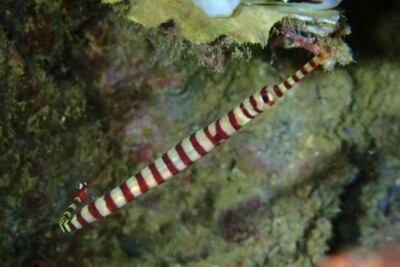
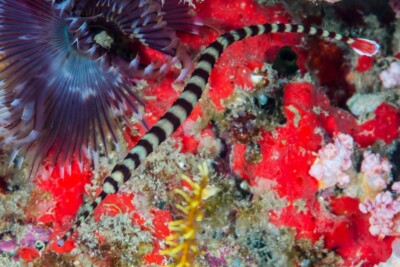
yellowbanded pipefish
| Family | Syngnathidae |
|---|---|
| Genus | Dunckerocampus |
| IUCN category (World) | LC |
Introduction
The yellowbanded pipefish (Dunckerocampus pessuliferus), formerly classified in the genus Doryrhamphus, is a coastal marine pipefish species found in the Western Indo-Pacific.
Known for its active ecological role as a cleaner fish, it lives in association with coral reefs on muddy or sandy slopes.
Although locally threatened by habitat degradation and aquarium trade, the species is classified as 'Least Concern'. Breeding programs in zoos (notably in Germany) have recently succeeded in controlling its captive reproduction, offering a sustainable alternative to wild collection.
Who is it?
Morphology
-
Average size14 cm
-
Maximum size16 cm
-
ShapeUnclassifiable
-
Patternrayure verticale
-
Average size14 cm
-
Maximum size16 cm
-
ShapeUnclassifiable
-
Patternrayure verticale
How to recognize This fish ?
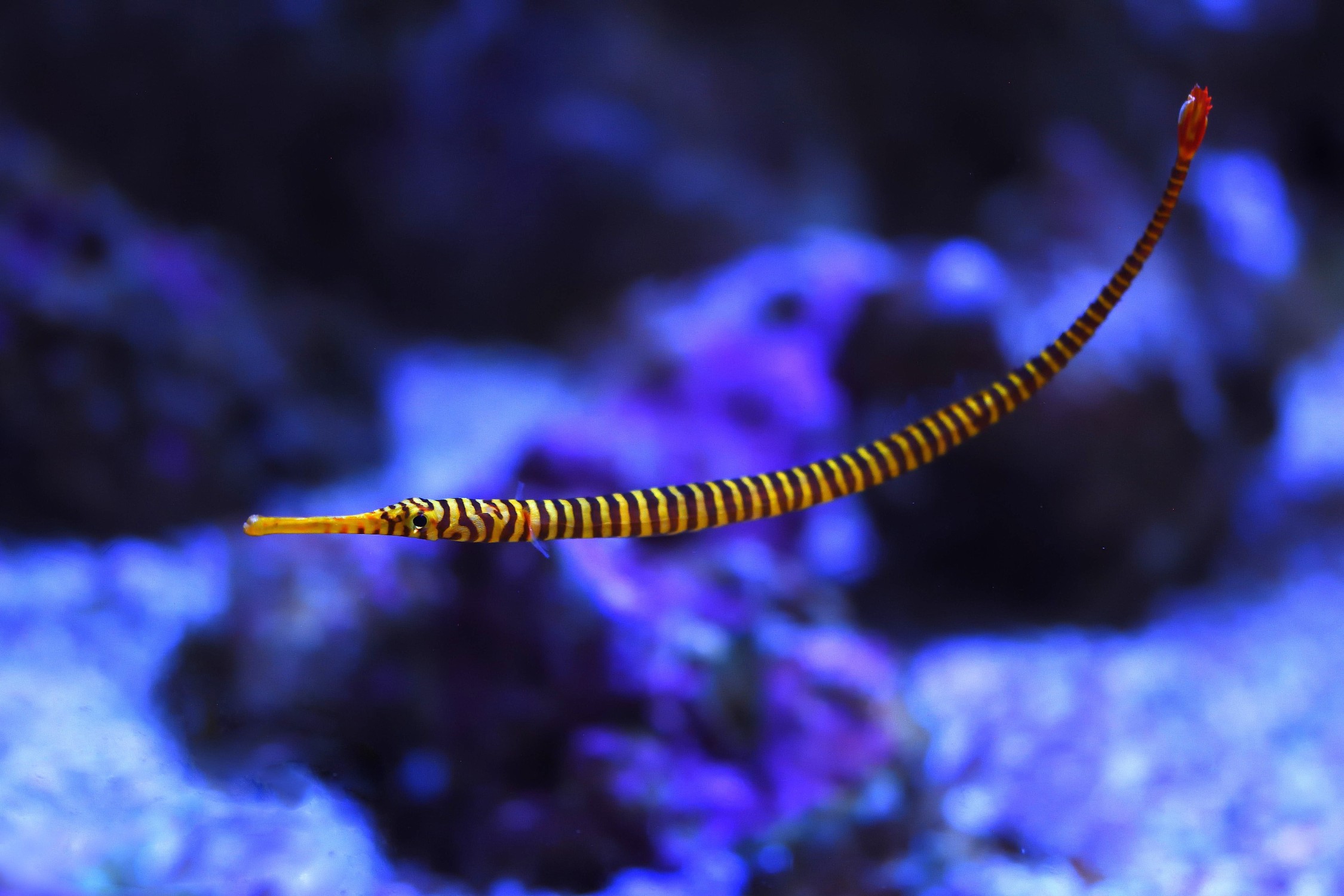
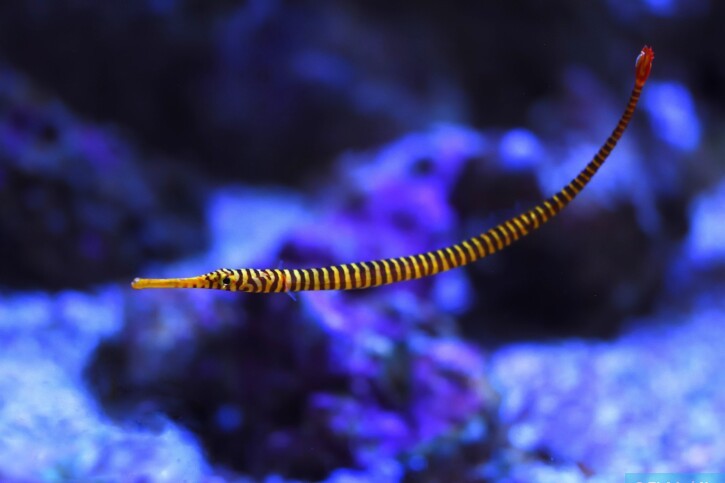
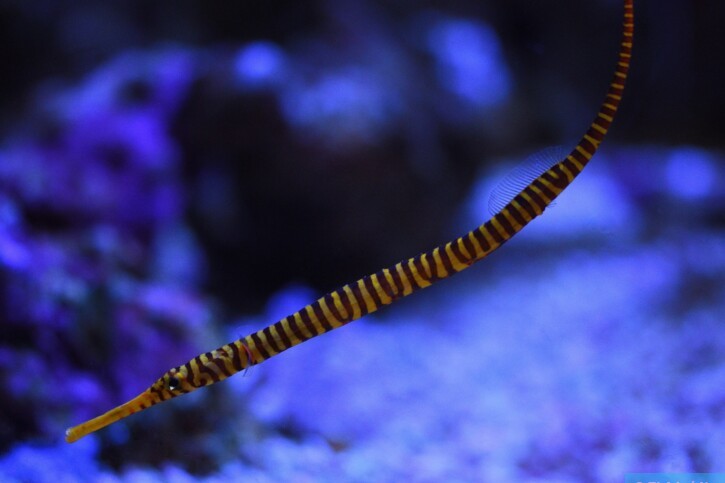
This fish has an elongated and slender eel-like body, typical of the Syngnathidae, and reaches a maximum size of 16 cm.
Its most distinctive feature is its coloration composed of numerous transverse yellow (or orange) and dark (black or dark brown) bands that cover the entire body, from head to tail. The snout is long, thin, and tubular, adapted for catching small prey.
The dorsal fin, located towards the rear, has 30 soft rays, while the anal fin has 4. The body is protected by a series of rigid bony rings that give it a segmented tubular structure.
Behaviour & Life cycle
-
dietcarnivorous
-
Sociabilityliving as a couple or alone
-
territorialYes
-
Way of livingdiurnal
The yellowbanded pipefish is a demersal species, living near the bottom. Adults show a strong preference for muddy substrates and deep, calm waters not subjected to wave action, although they can enter shallow estuaries.
They live solitary or form stable monogamous couples, swimming along the bottom around large isolated corals located on sandy or muddy slopes.
As a specialized carnivore, this fish primarily feeds on small planktonic and benthic crustaceans (copepods, amphipods, isopods). It hunts by ambush, sucking up its prey with its long tubular snout like a pipette. Its diet is supplemented by external parasites collected from client fish during cleaning sessions.
Reproduction
The species is ovoviviparous with exclusive paternal parental care. After courtship, the female deposits her eggs on the male's ventral tail area, where they are incubated in a pouch until hatching. Zoo breeding data indicate that juveniles hatch after 8 days of incubation, at a size of 4-5 mm. The adult color pattern (yellow bands) develops after 3 weeks. Sexual maturity is quickly reached, around 6 months, at a total length of 10.5 to 11 cm. Juveniles are self-sufficient at birth.
Harmless species
This fish poses no threat to humans.
Origin and distribution
Geographic distribution & Conservation
The distribution range covers the Western Indo-Pacific, including the 'Coral Triangle' (Philippines, Indonesia), northwest Australia, Papua New Guinea, and the Solomon Islands. The species is classified as 'Least Concern' as it remains common in its range, although threatened by coral habitat loss, fishing for traditional medicine, and the aquarium trade.
Recent studies (2018) have identified approximately 43 individuals in 9 zoological institutions worldwide (including 5 in Europe), showing a growing interest in its conservation breeding to reduce pressure on wild populations.
Conservation and international regulations
Where to see this species?

What is its habitat?
Natural environment characteristics
-
Temperature26 - 29 °C
-
Depth1 - 36 m
-
FlowSlow
Biotope presentation
The yellowbanded pipefish is restricted to coastal environments, specifically muddy or sandy slopes dotted with isolated coral colonies or sea fans. It is recorded from 1 to 44 meters deep, with a preference for deeper (>15 m) and calm waters. It is also capable of entering estuaries. The presence of isolated 'coral heads' on these soft bottoms is crucial to provide refuge and cleaning stations.

To go further
Species of the same family
Espèces du même genre
To read on the web

Sources & Contributions
Participation & Validation
The Fishipedia team and specialist contributors are committed to providing high-quality content. However, although the information comes from scientific sources or testimonials from specialists, the cards may contain inaccuracies.

Benoit Chartrer
Translation
Translation done with the valuable contribution of our translators, who make this information available to a wider audience. We sincerely thank them for their commitment.
Bibliographic references
Where to see this species?
Scientific partners



Tags
Species of the same family