
Amazon leaffish
| Family | Polycentridae |
|---|---|
| Genus | Monocirrhus |
| IUCN category (World) | LC |
Introduction
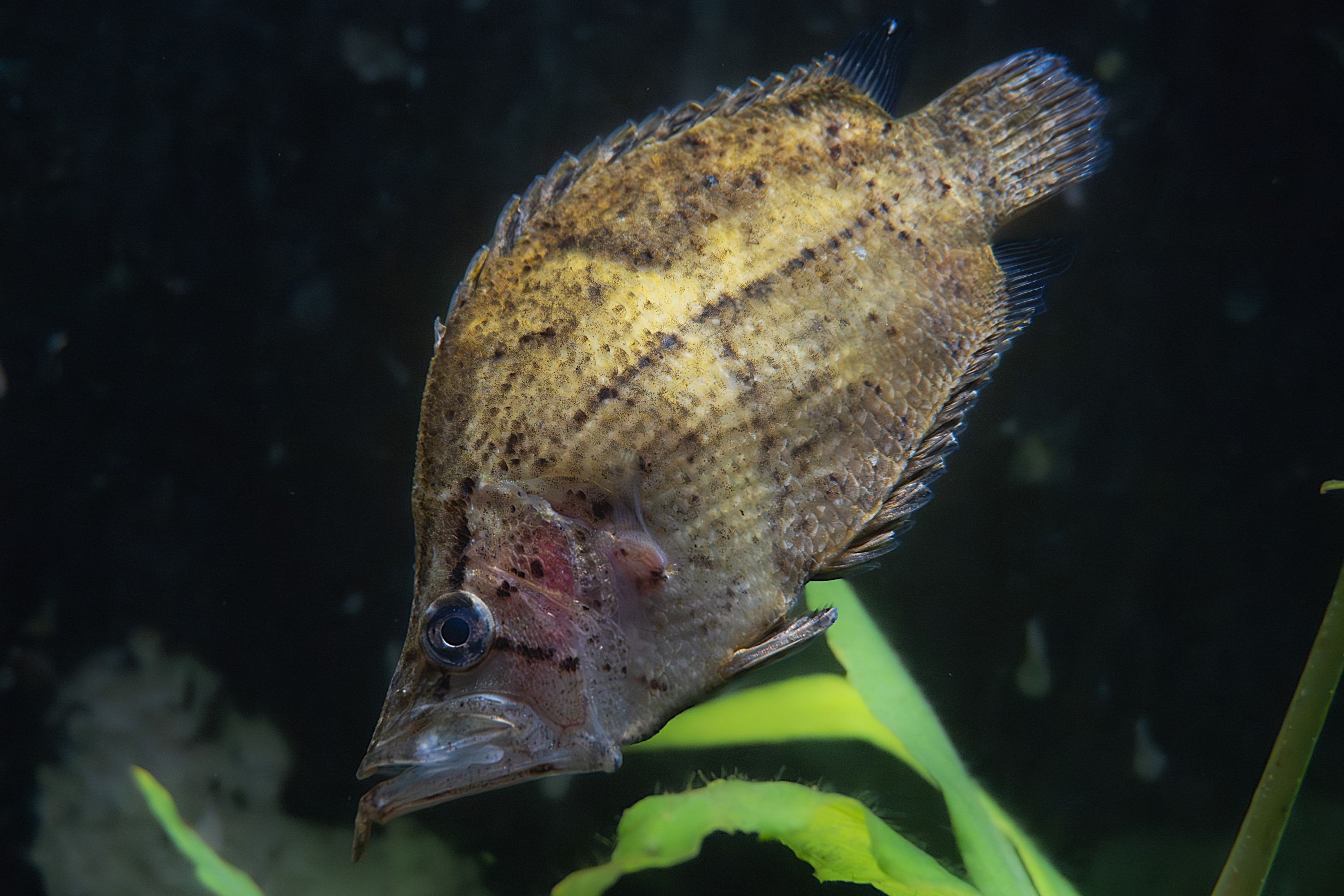
Amazon leaffish, unique representative of the genus Monocirrhus, is a remarkable small predatory fish known for its perfect mimicry with a drifting dead leaf.
It is found in the Amazon and Orinoco basins, with confirmed occurrences in Brazil, Bolivia, Colombia, Peru, and Venezuela. It appears to be absent from Ecuador and the Guyanas.
Although often exported for the international trade in ornamental fish due to its appearance, wild collection is currently not a major threat to the species, which remains widespread although locally uncommon.
Its taxonomy may be revised, as the genus may include more than one cryptic species.
Who is it?
Morphology
-
Average size7 cm
-
Maximum size8 cm
-
Longevity8 year
-
Mimicryleaf
-
Average size7 cm
-
Maximum size8 cm
-
Longevity8 year
-
Mimicryleaf
How to recognize This fish ?
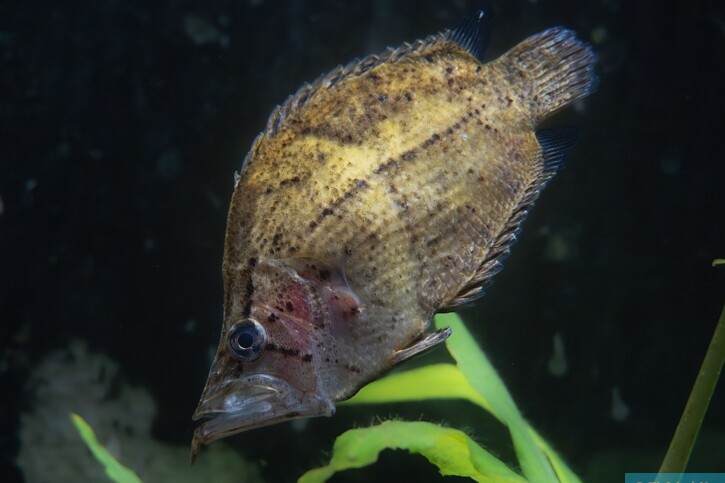
This small fish reaches approximately 80 mm in length. Its body is strongly laterally compressed and its overall morphology perfectly mimics a dead leaf: it has a wide and highly protractile mouth (which can represent 60% of the head length), a chin filament resembling a leaf petiole, and the absence of a lateral line.
Its coloration ranges from yellow-orange to brown, with patterns that enhance camouflage and may intensify during the breeding season. The dorsal and anal fins are long, contributing to the irregular leaf-like silhouette.
In juveniles, development is rapid: by the 7th day post-hatching, the head becomes triangular and the jaws protractile, and by 180 days, they are morphologically identical to adults, already displaying the characteristic filament.
Sexual dimorphism
Males and females reach similar sizes (average observed around 50-52 mm, with maxima of 73 mm for males and 82 mm for females). The main difference lies in reproductive behavior: males guard the eggs and larvae (parental care), while females adopt an aggressive defensive role to ward off intruders during this period. Coloration may also intensify in both sexes during breeding.
Behaviour & Life cycle
-
dietcarnivorous
-
Sociabilitysolitary
-
territorialYes
-
Way of livingdiurnal
The Amazon leaffish is a solitary ambush predator that employs sophisticated mimicry. It drifts slowly or remains stationary, resembling a dead leaf floating on water, to approach its prey undetected. Once in range, it rapidly extends its protractile mouth to suck in its prey (suction mechanism). This technique allows it to capture fast, pelagic fish, especially Characids, which are less vigilant at dusk or night.
Young larvae initially use an active hunting strategy ("S movements") before gradually developing the suction and camouflage techniques of adults around 5-7 days post-hatching. This fish is often seen near the surface among vegetative debris accumulated along the banks.
Reproduction
-
Reproductionovipare qui pond sur substrat découvert
Wild reproduction is poorly documented, but observations in aquariums reveal complex behavior. Courtship is aggressive. After spawning on a consolidated substrate (such as macrophyte leaves), males provide sole parental care for eggs and larvae.
Females remain nearby to defend the territory against intruders. The larvae hatch with a still round morphology, but quickly develop their pectoral and caudal fins (by the 3rd-7th day) for essential hunting movements crucial for their early survival. They remain near the surface throughout development.
Harmless species
The Amazon leaffish is harmless to humans.
Origin and distribution
Geographic distribution & Conservation
The species is widespread throughout the Amazon and Orinoco basins. In Bolivia, it has been confirmed in several locations in the north and west of the country (Madre de Dios basin), although it appears rare. In Brazil, it is found in terra firme affluents like Baré Creek in the Amanã Sustainable Development Reserve.
Although not globally threatened, the species is naturally uncommon and rare in scientific collections, which has long limited knowledge of its natural history. It is sensitive to degradation of its specific habitat (blackwater forest streams).
Conservation and international regulations
Where to see this species?

What is its habitat?
Natural environment characteristics
-
Temperature22 - 28 °C
-
pH (acidity)4 - 6
-
gh (hardness)5 - 8
-
FlowStagnant
Biotope presentation
The Amazon leaffish exclusively inhabits freshwater in well-preserved forests, favoring backwaters and small streams (igarapés). These habitats have extreme physico-chemical parameters: very acidic pH (<5.0), very low conductivity (<25 μS/cm), low sediment and nutrient loads, and high transparency despite the dark tannin-stained color. The current is slow.
It occupies shallow areas near the banks, often at or just below the surface, amidst fallen leaves and macrophytes, using this setting for camouflage. Its presence indicates good quality of these wetland areas.
To go further
To read on the web

Sources & Contributions
Participation & Validation
The Fishipedia team and specialist contributors are committed to providing high-quality content. However, although the information comes from scientific sources or testimonials from specialists, the cards may contain inaccuracies.

Benoit Chartrer
Translation
Translation done with the valuable contribution of our translators, who make this information available to a wider audience. We sincerely thank them for their commitment.
Where to see this species?
Scientific partners




Tags


