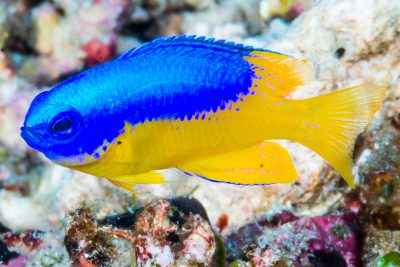
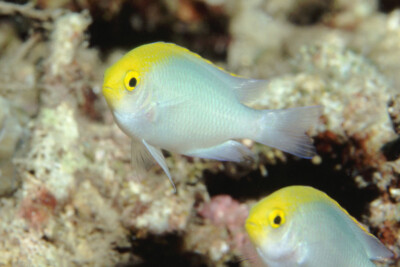
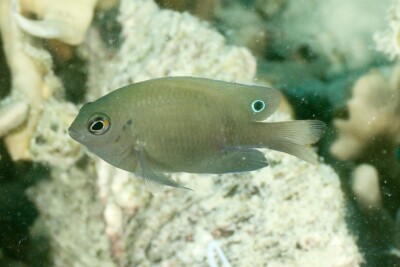
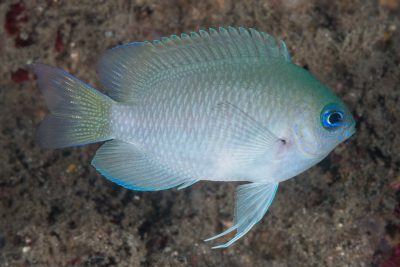
sulphur damsel
| Family | Pomacentridae |
|---|---|
| Genus | Pomacentrus |
| IUCN category (World) | LC |
Introduction
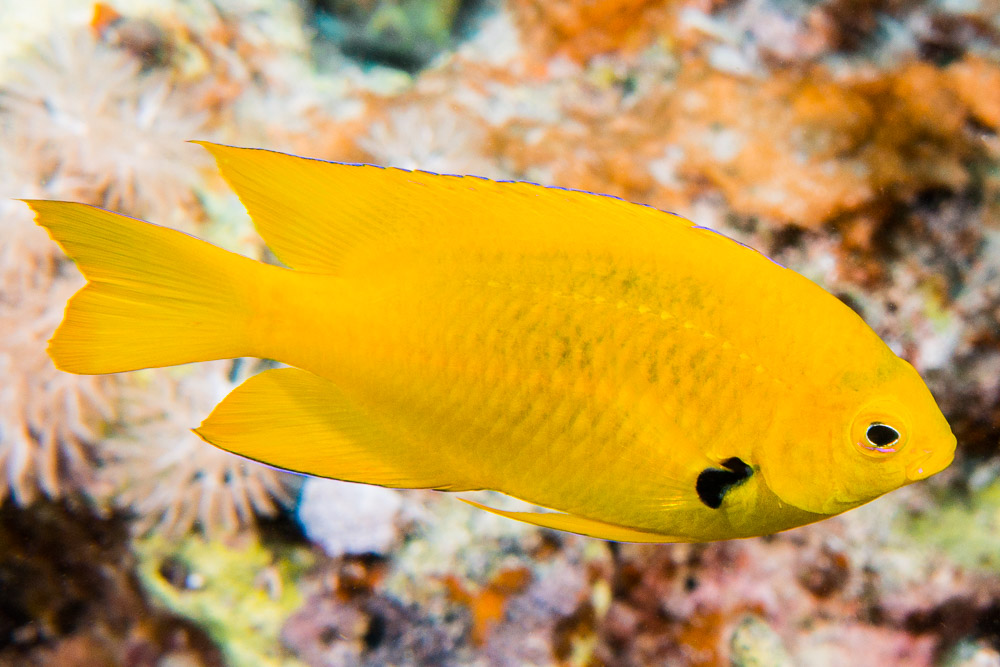
Pomacentrus sulfureus, known as the sulphur damsel, is a fish of the Pomacentridae family and Pomacentrinae subfamily.
This species is found in the western Indian Ocean, from the Red Sea in the south to Mozambique, including Madagascar, Réunion, Mauritius, the Comoros, and the Seychelles. It inhabits coastal coral reefs, preferring areas with high coral cover, even in conditions of high turbidity.
Who is it?
Morphology
-
Average size9 cm
-
Maximum size11 cm
-
Longevity5 year
-
Average size9 cm
-
Maximum size11 cm
-
Longevity5 year
How to recognize This fish ?
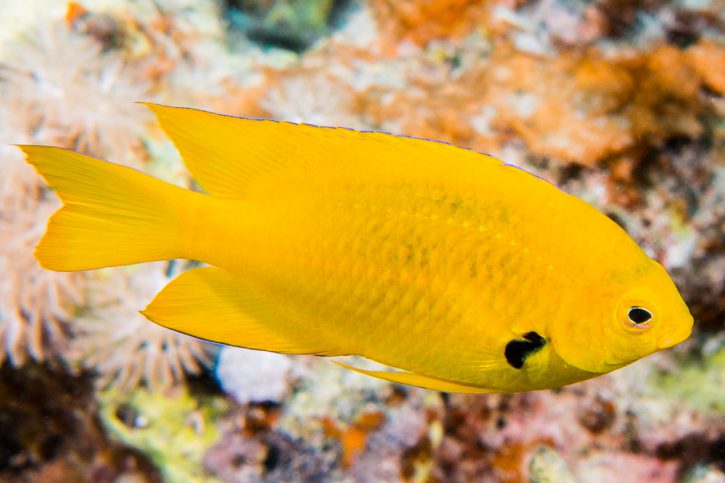
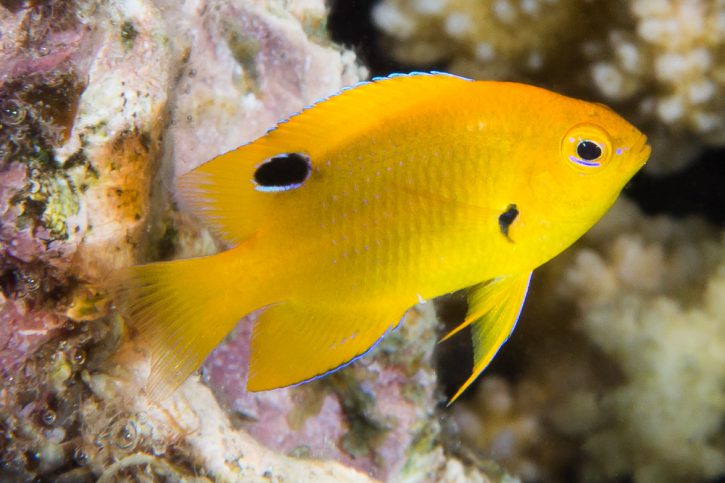
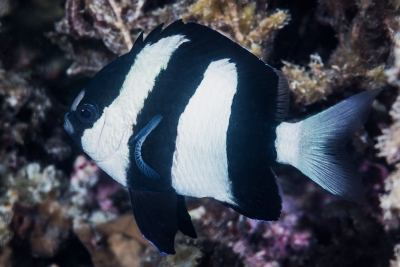
This fish has a laterally compressed fusiform body, characteristic of reef damsels. It reaches a maximum size of 11.0 cm (total length). The dorsal fin is supported by 14 spines, while the anal fin has 2 spines. The species displays notable geographical color variations. The generic name Pomacentrus combines the Greek terms poma (operculum) and kentron (spine), referring to the operculum morphology.
Sexual dimorphism
Behaviour & Life cycle
-
dietomnivorous with carnivorous tendency
-
Sociabilityliving in a group or alone
-
territorialNo
-
Way of livingdiurnal
The sulphur damsel is a sedentary fish that never leaves its reef. Juveniles strictly depend on branchy coral structures for concealment. Adults tolerate less complex decor and prefer substrate diversity. Young individuals stay close to the territory of adult conspecifics, growing under their presence before gaining autonomy. Social organization varies between small groups and territorial solitary individuals depending on the area.
This fish feeds on zooplankton, capturing prey in the water column above the reef by exploiting currents that concentrate plankton over areas of high coral growth.
Reproduction
-
Reproductionovipare qui pond sur substrat découvert
-
Hermaphroditeprotogynous
This species is oviparous and forms distinct pairs during breeding. Demersal eggs adhere to the substrate. The male guards the nest and aerates the eggs until hatching.
Harmless species
This species does not represent any particular threats to humans when encountered in its natural environment.
Origin and distribution
Geographic distribution & Conservation
This species is found in the western Indian Ocean, from the Red Sea and the East African coast (up to 21°S) to Madagascar, Mauritius, the Comoros, and the Seychelles. Its presence in various habitats, including turbid ones, suggests a certain local adaptation ability. Population density fluctuates according to habitat structure, reaching high levels in areas rich in branchy structures favorable to juveniles.
Conservation and international regulations
Where to see this species?

What is its habitat?
Natural environment characteristics
-
Temperature26 - 29 °C
-
Depth1 - 15 m
-
FlowMedium
Biotope presentation
The sulphur damsel frequents coastal coral reefs mainly between 1 and 5 meters deep. It thrives in areas with dense coral growth and tolerates turbidity conditions. The species exclusively occupies the upper zone of the reef.
To go further
Species of the same family
Espèces du même genre
To read on the web


Sources & Contributions
Participation & Validation
The Fishipedia team and specialist contributors are committed to providing high-quality content. However, although the information comes from scientific sources or testimonials from specialists, the cards may contain inaccuracies.

Adrien Falzon

Benoit Chartrer
Translation
Translation done with the valuable contribution of our translators, who make this information available to a wider audience. We sincerely thank them for their commitment.
Benoit Chartrer
Where to see this species?
Scientific partners




Tags
Species of the same family
Same genus