Introduction
The capybara, or capybara, is the largest living rodent in the world, an iconic species of South America distributed east of the Andes, from Colombia and Venezuela to northern Argentina, passing through Brazil, Bolivia, Paraguay, and Uruguay. Although locally common and widespread in floodplains such as the Llanos and the Pantanal, it becomes rare or disappears in densely populated areas of the Amazon and regions subjected to intensive hunting.
Classified as 'Least Concern' by the IUCN on a global scale, the species nevertheless experiences severe local declines and extirpations due to hunting for its meat and leather, as well as habitat fragmentation. Its presence is often tolerated, or even promoted, in large cattle ranches where pasture and water management are beneficial to it.
Who is it?
Morphology
-
Size110 - 130 cm
-
Size110 - 130 cm
How to recognize This mammal ?
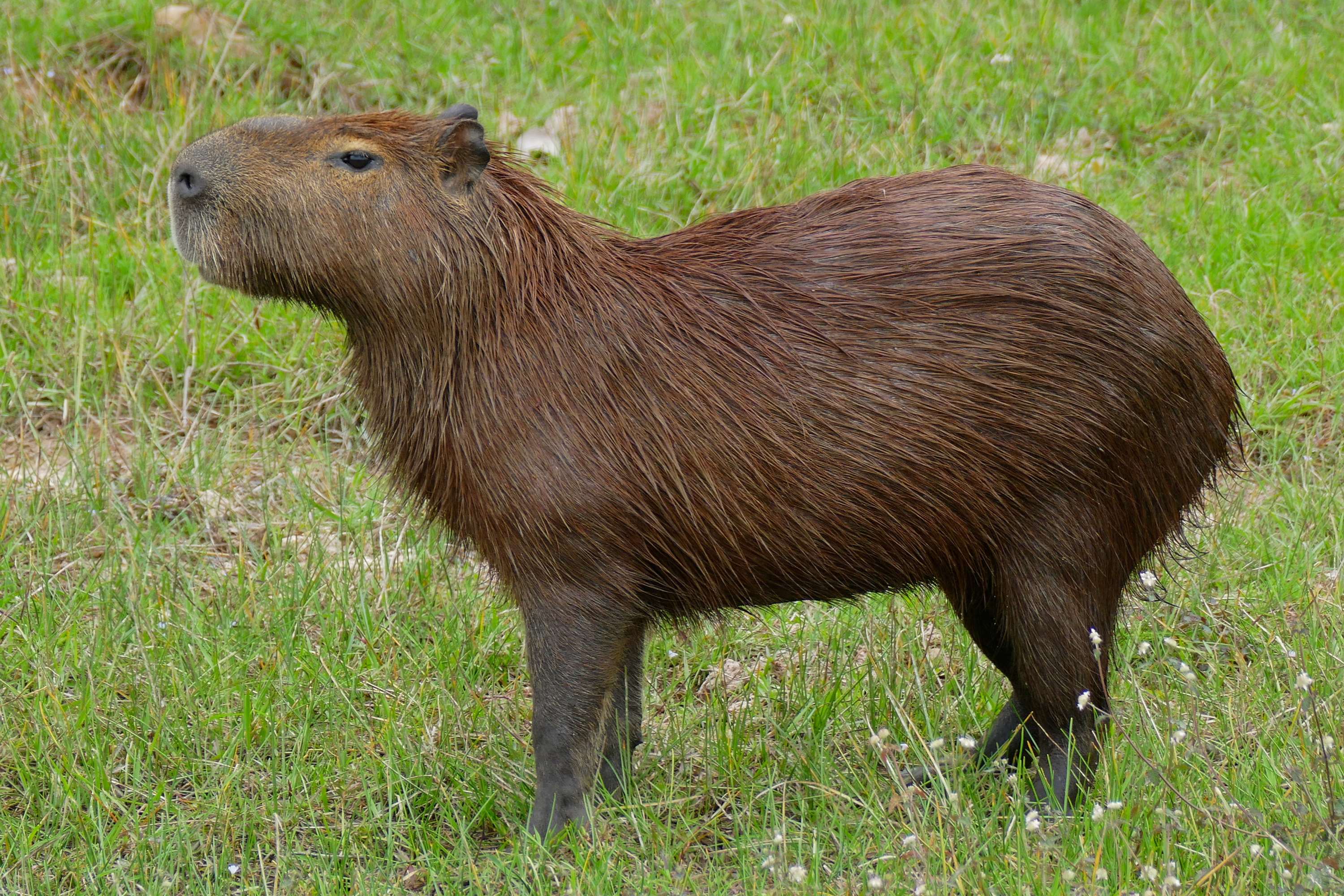
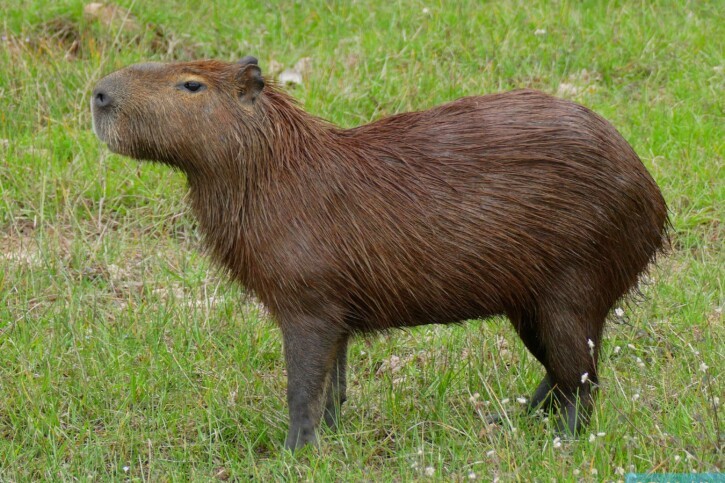
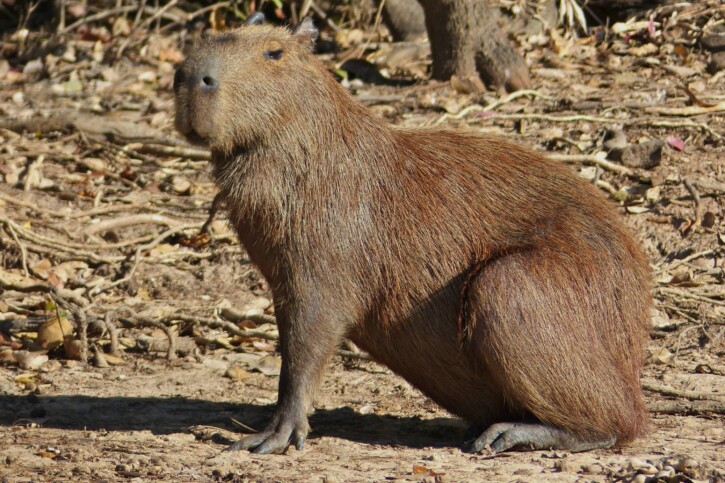
The capybara has a massive and stocky body, devoid of a visible tail (vestigial), with a wide head, a blunt snout, and small round ears. Its fur is coarse, made up of spaced bristles ranging in color from reddish-brown to yellowish-gray, revealing thick skin with sudoriferous glands, a rare feature among rodents.
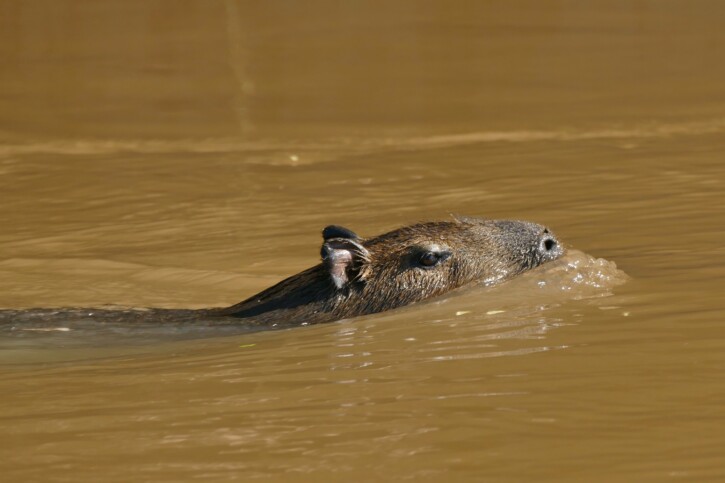
The limbs are short and end in partially webbed toes (four in the front, three in the back) equipped with short and sturdy hooves, adapted for walking in mud and swimming. Sexual dimorphism is evident in size: males are generally heavier (averaging 49 kg in the Llanos, reaching up to 65 kg, with records of 91 kg in Brazil) than females. Males also have a prominent nasal gland (muzzle gland) used for scent marking, absent in females. The dentition includes 20 teeth, with grooved incisors and continuously growing molars (elodonts), adapted for extensive grazing.
Sexual dimorphism
The adult male is bigger than the female.
Behaviour & Life cycle
-
dietherbivorous
-
Sociabilitygregarious
-
territorialYes
-
Way of livingdiurnal
The capybara is a gregarious, diurnal animal (becoming nocturnal or crepuscular under hunting pressure), living in structured family groups. Group size varies considerably depending on the season and habitat quality: from 2 to 10 individuals in the rainy season when resources are dispersed, up to 30 individuals (and sometimes temporary aggregations of hundreds of animals) in the dry season around residual water points.
A typical group includes a dominant male, several adult females and their offspring, as well as some subordinate males. The species is highly dependent on water for thermoregulation (mud baths), mating, and predator evasion. Communication relies on a varied vocal repertoire (barks, whistles, grunts) and scent marking via nasal and anal glands. Movements often occur in single file on well-defined trails linking grazing areas to water points.
The rodent is a strict herbivore and selective grazer, unlike the misconception that it is sometimes a piscivore. Its diet is dominated by grasses (Poaceae). It displays great selectivity, actively choosing plants with high protein content and avoiding fibers that are too coarse when possible. In the Venezuelan Llanos, it favors semi-aquatic species like Hymenachne amplexicaulis and Leersia hexandra, as well as Panicum laxum in wet savannas. In the dry season, when these resources become scarce, it turns to drought-resistant annual grasses (Paratheria prostrata, Sporobolus indicus) and may consume tree bark or aquatic plants like water hyacinths (Eichornia). With its powerful incisors, it can graze grass close to the ground, a technique that puts it in direct competition with domestic livestock. It consumes about 70 g of dry matter per kg of metabolic weight per day. Although isolated cases of fish consumption have been observed in captivity, they are considered anecdotal and not representative of its natural ecology.
Reproduction
-
Reproductionvivipare
The capybara is a seasonal breeder, with a peak in births coinciding with the onset of the rainy season (September-November in the Llanos, February in the Pantanal), although reproduction can occur year-round in favorable habitats. Gestation lasts approximately 150 days (5 months).
Females give birth to an average litter of 4 young (ranging from 1 to 7), which are extremely precocial: with open eyes, complete teeth, and capable of walking and grazing a few hours after birth (average weight of 1.5 kg). Nursing lasts 3 to 4 months, but young begin to consume grass very early on.
Sexual maturity is reached around 1.5 years (at a weight of 30-40 kg). The mating system is polygynous, with a dominant male controlling access to females through grazing and water areas. Females can nurse the group's young interchangeably.
Harmless species
The Capybara poses no direct threat to humans, being herbivorous and generally timid. However, it can come into conflict with agriculture by consuming crops (rice, melon, sugarcane) and competing with livestock for pastures, especially in the dry season. From a health perspective, the species is a reservoir host for several zoonotic pathogens. It is particularly known to carry the bacterium Brucella abortus and the protozoan Trypanosoma evansi (responsible for 'surra' in horses), although the strain carried by the capybara appears less virulent. It also hosts numerous ticks, including Amblyomma cajennense (the Cayenne tick), a vector for spotted fever and Rocky Mountain spotted fever, posing a health risk in human-wildlife contact areas.
Origin and distribution
Geographic distribution & Conservation
The capybara is present in most of South America east of the Andes, including the Orinoco, Amazon, São Francisco, and Plata basins. It is absent from Chile and arid regions.
Although the species is globally classified as 'Least Concern', populations are declining in the center of its range (e.g., Bolivia with densities of 0.4 to 0.59 ind./km²) and it has been locally extirpated in many densely populated or overexploited areas.
The main threat is commercial and subsistence hunting for its meat (highly prized, especially during Lent when it is sometimes authorized by the Church) and leather (over 80,000 skins exported from Argentina between 1976 and 1979).
However, in large extensive livestock properties, populations can be stable or even abundant (up to 15 animals/ha in the Brazilian Pantanal) thanks to the creation of permanent water points and favorable pasture management. Captive breeding programs have helped alleviate pressure on some wild populations.
What is its habitat?
Natural environment characteristics
-
Temperature10 - 30 °C
-
FlowMedium, Slow and Stagnant
Biotope presentation
The capybara is a semi-aquatic species affiliated with wet environments. It occupies a wide variety of lowland habitats (up to 1,300 m) as long as a permanent water source is available: flooded savannas (Llanos, Pantanal), swamps, mangroves, riverbanks, lakes, and ponds. It requires a habitat mosaic including: water for drinking and refuge, dry land areas for resting and birthing, and open pastures for feeding.
It avoids dense and dark forests, preferring open areas or edges. Its density is directly correlated to water quality and proximity: home ranges vary from 10 ha in resource-rich areas to over 200 ha in poor areas. The species is a selective grazer, mainly consuming semi-aquatic grasses and savanna plants, and playing a major ecological role in transferring biomass from aquatic to terrestrial areas.
To go further
To read on the web
Sources & Contributions
Participation & Validation
The Fishipedia team and specialist contributors are committed to providing high-quality content. However, although the information comes from scientific sources or testimonials from specialists, the cards may contain inaccuracies.

Benoit Chartrer
Translation
Translation done with the valuable contribution of our translators, who make this information available to a wider audience. We sincerely thank them for their commitment.