Introduction
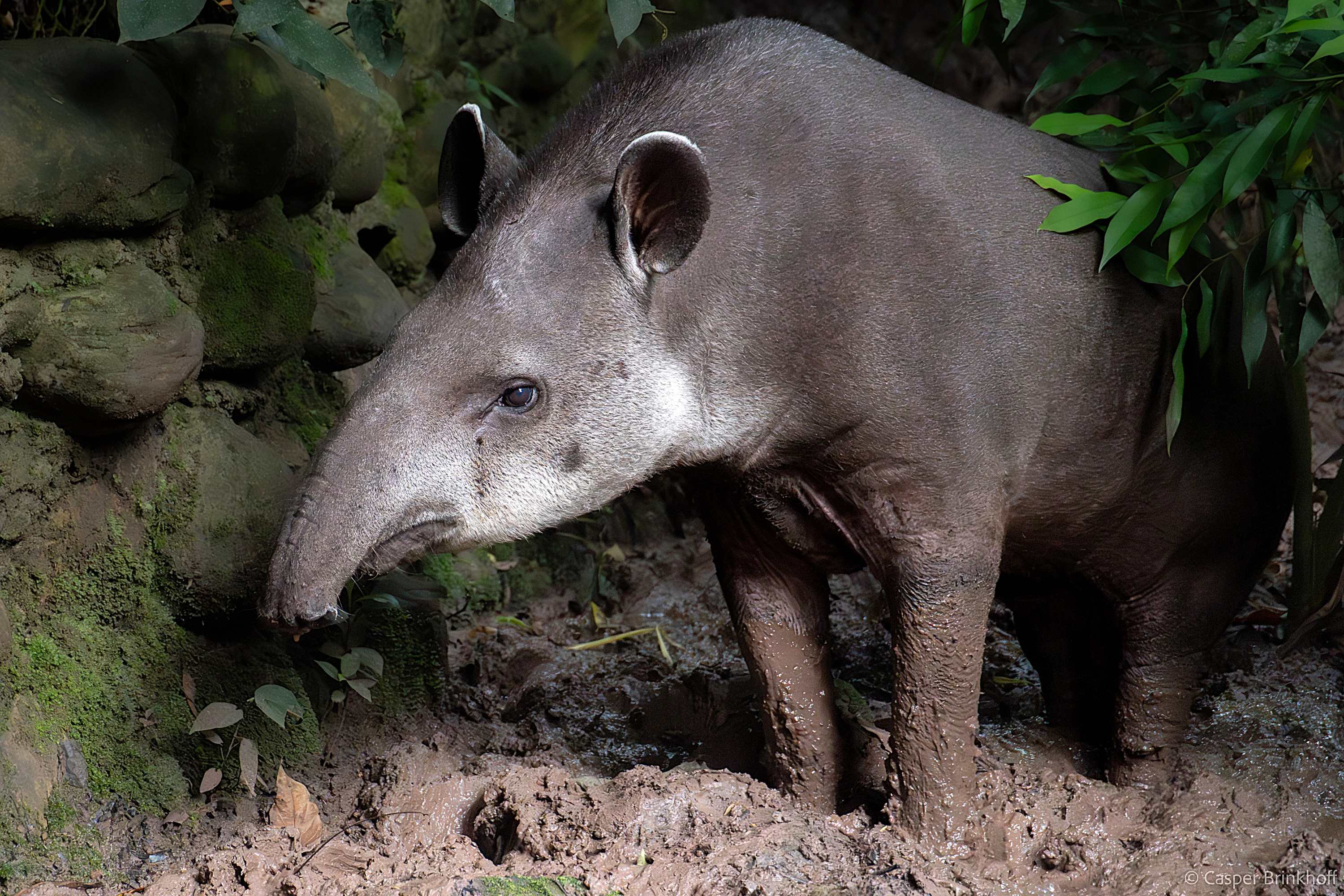
Tapirus terrestris, commonly known as lowland tapir, is the largest terrestrial mammal in South America, weighing up to 250 kg. Historically, its range extended over 4,000 km long and 1.5 million km² east of the Andes, covering a large part of Argentina, Bolivia, Brazil, Colombia, Ecuador, French Guiana, Guyana, Paraguay, Peru, Suriname, and Venezuela.
The species inhabited various biomes such as the Chaco, the Pantanal, the Cerrado, the Llanos, the Caatinga, and the Amazon and Orinoco forests. However, populations have been severely reduced and are often limited to forest and wetland biomes. The species has been extirpated from the Caatinga, dry inter-Andean valleys, and about 50% of its original distribution in Argentina.
Who is it?
Morphology
-
Size180 - 250 cm
-
Size180 - 250 cm
How to recognize This mammal ?
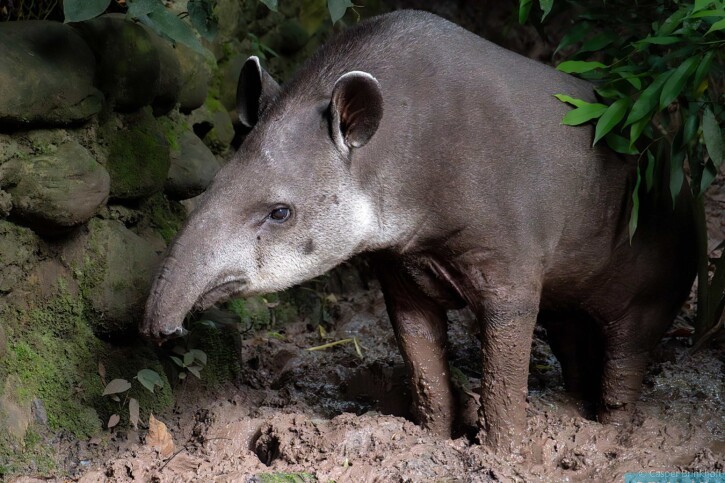
This species is distinguished by its imposing mass, reaching up to 250 kg, with a total length usually ranging between 1.8 and 2.5 meters and a shoulder height of 77 to 108 cm. Its body is stocky and cylindrical, covered with short, uniform fur, ranging from dark brown to greyish, appearing lighter on the belly.
The head is extended by a short, flexible, prehensile trunk, formed by the fusion of the nose and upper lip, which it uses to grasp vegetation. The ears are oval, erect, and bordered by a thin white edge, often the only distinguishing feature of the species. The tail is very short, measuring only 5 to 10 cm. The animal has four toes on the front limbs and three on the hind limbs, adapted for walking on soft and marshy ground. It is an excellent swimmer, using water as a refuge from predators.
Sexual dimorphism
Females have a pair of inguinal mammary glands and a genital slit located near the anus, while males have a retractable penis in a preputial sheath.
Behaviour & Life cycle
-
dietherbivorous
-
Sociabilityliving as a couple or alone
-
territorialYes
-
Way of livingdiurnal
The Brazilian Tapir is mainly solitary and crepuscular, although its activity can extend to the entire night or day in protected areas with low human pressure. It is highly dependent on water, frequently visiting marshes, rivers, and natural salt licks. These water points are crucial for thermoregulation and obtaining essential minerals.
The tapir is a frugivorous herbivore with a highly varied diet ('catholic'), consuming over 200 plant species: fruits, leaves, branches, barks, and aquatic vegetation. It also ingests mineral-enriched soils (geophagy) and has a posterior intestinal fermentation allowing it to process low-quality foods. It plays a major ecological role in seed dispersal, especially for the Mauritia flexuosa palm in 'aguajales'. Regarding territoriality, individuals defend their vital domains, especially males, through olfactory markings (urine, feces) and maintaining well-defined paths.
Although generally peaceful, males can display aggression towards their conspecifics in cases of territory overlap or competition for a female, manifesting as charges and bites. In danger, the primary reflex is to flee to water or dense thickets.
Reproduction
-
Reproductionvivipare
Reproduction is characterized by a slow pace, making population renewal challenging in the face of threats. Sexual maturity is reached around 3 to 4 years. The mating season is not strictly defined and can occur year-round, although it often coincides with the rainy season in some regions to optimize food availability during weaning. Gestation is long, around 13 months (390 to 395 days), typically resulting in the birth of a single offspring.
The newborn weighs about 5 to 7 kg and has a distinctive coat: dark brown adorned with white-cream spots and stripes, effective camouflage in the dim light of the understory which gradually fades by the age of 6 months to reveal the adult's uniform coat. The mother raises her offspring alone. The young is weaned around 6 to 8 months but often remains with the mother until the birth of the next offspring, for about 18 to 24 months. The interval between two births is long, up to 3 years. This low reproductive rate exposes the species to a high risk of rapid decline in the face of hunting pressure or significant habitat loss.
Harmless species
Its defense behavior against predators consists of fleeing and seeking refuge in water. Negative interactions with humans are mainly suffered by the animal: it is hunted for its meat, chased by dogs, competes with livestock, and is frequently involved in road collisions.
Origin and distribution
Geographic distribution & Conservation
The population of Tapirus terrestris is declining throughout its range. The species has disappeared from the Caatinga, temperate pampas, dry inter-Andean valleys, and about 50% of its historical territory in Argentina. In the Cerrado, the distribution has reduced to a few small populations in protected areas, with those in the Pantanal rapidly declining. The main threats are habitat loss due to deforestation, hunting for meat, vehicle collisions (road-kill), and competition with domestic livestock.
Hunting is a critical threat, especially along new roads, settlement colonies, and agricultural fronts in the Amazon. In French Guiana, tapirs are regularly hunted and commercially sold. In the Atlantic Forest, there are reportedly only 2,665 to 15,992 individuals in 48 confirmed populations, occupying only 1.78% of their original range. Demographic models suggest that many of these populations are non-viable long-term without intervention.
Where to see this species?

What is its habitat?
Natural environment characteristics
-
Temperature22 - 28 °C
Biotope presentation
The lowland tapir inhabits humid swamp forests, dry and wet shrublands, grasslands, and a wide variety of lowland wet areas in South America. The most important habitats tend to be wet or seasonally flooded areas.
The species is often associated with 'aguajales' (Mauritia flexuosa palm swamps) and natural salt licks. While the species can adapt to almost all habitats on the continent, including mangroves and alpine summits, and can use disturbed forests or agricultural lands, its persistence is constrained by hunting and roads that isolate populations.

To go further
To read on the web
Sources & Contributions
Participation & Validation
The Fishipedia team and specialist contributors are committed to providing high-quality content. However, although the information comes from scientific sources or testimonials from specialists, the cards may contain inaccuracies.

Benoit Chartrer
Translation
Translation done with the valuable contribution of our translators, who make this information available to a wider audience. We sincerely thank them for their commitment.
Where to see this species?
Scientific partners