mugger crocodile
| Family | Crocodylidae |
|---|---|
| Genus | Crocodylus |
| IUCN category (World) | VU |
Introduction
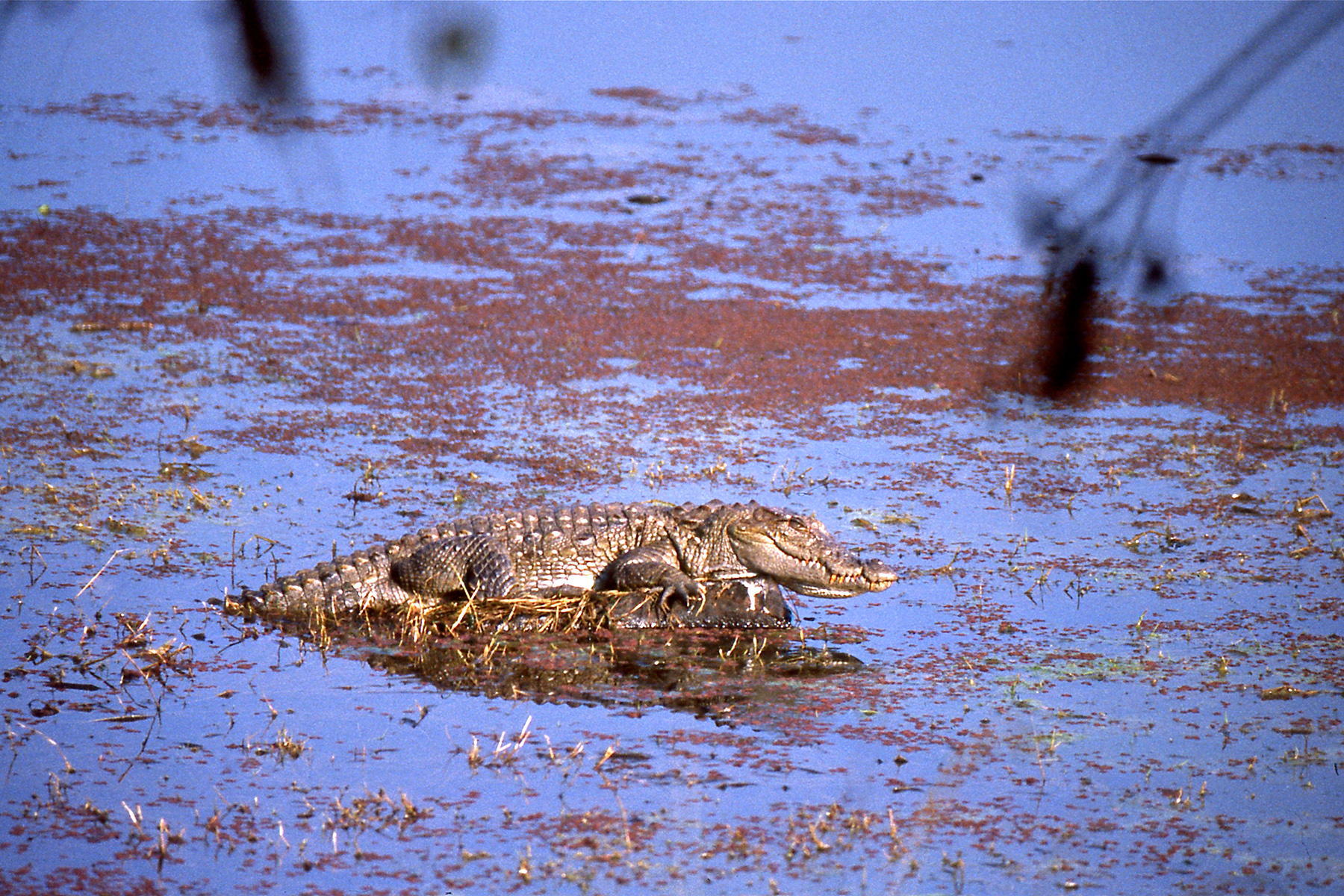
The mugger crocodile, commonly known as mugger crocodile, is a medium-sized crocodilian endemic to the Indian subcontinent and the Middle East, found in India, Sri Lanka, Nepal, Pakistan, Iran, and possibly in neighboring areas.
Historically more widely distributed, it has undergone an estimated 30% decline over the last three generations (75 years) due to habitat destruction, poaching, and conflicts with humans, leading to its extinction in the wild in Bangladesh, Myanmar, and Bhutan.
Classified as 'Vulnerable' by the IUCN, the current global population is estimated between 5,400 and 7,100 non-juvenile individuals. Although populations are stable or slightly increasing in its strongholds of India and Sri Lanka thanks to protection and reintroduction programs, they remain severely fragmented, isolated from each other, and no single subpopulation exceeds 1,000 mature individuals. The lack of a coordinated national conservation plan in most countries within its range remains a major challenge.
Who is it?
Morphology
-
Size400 - 500 cm
-
Motifhorizontal stripes
-
Size400 - 500 cm
-
Motifhorizontal stripes
How to recognize This reptile ?
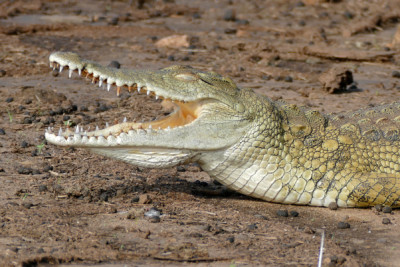
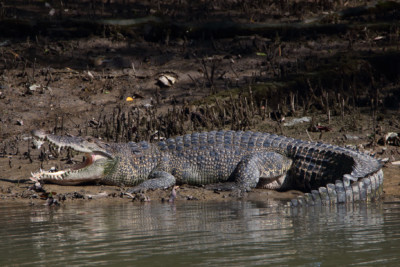
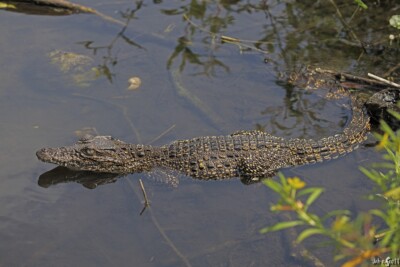
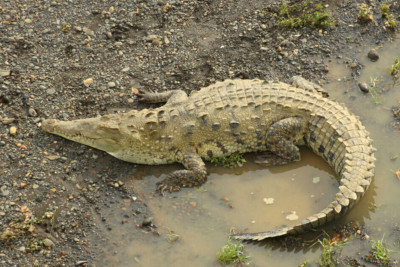
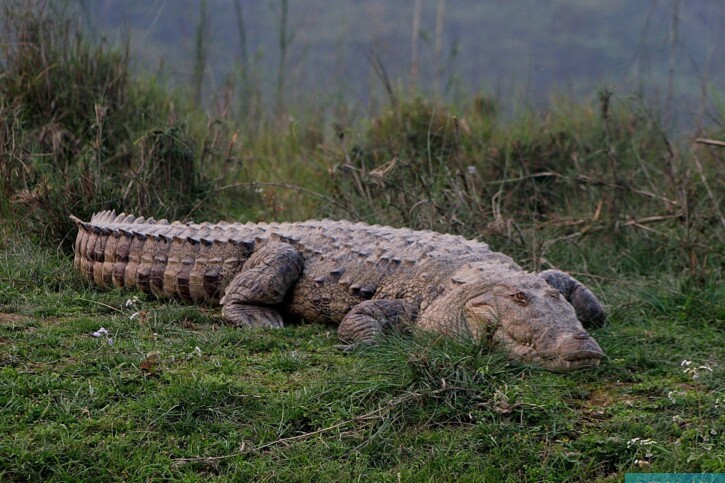
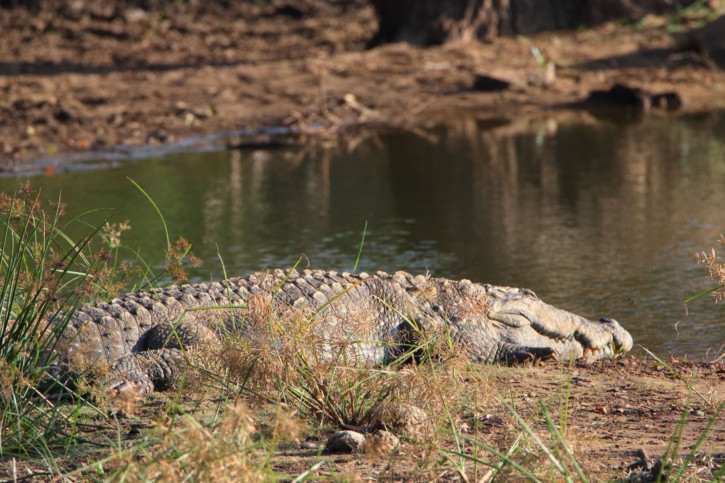
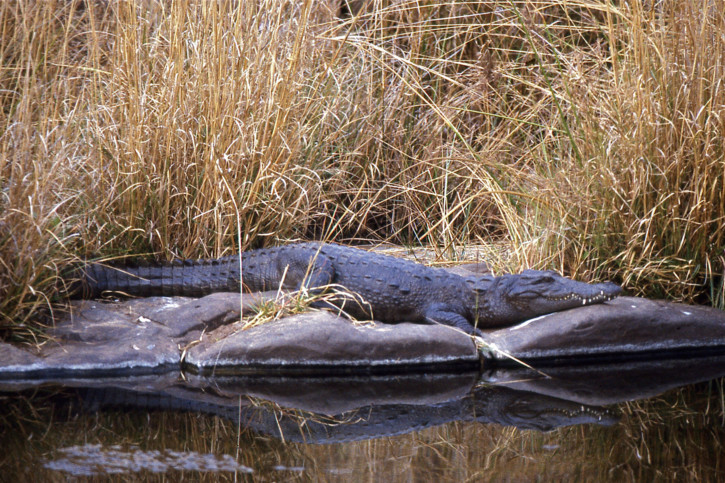
The mugger crocodile is a robust reptile with the widest snout of all current members of the Crocodylus genus. This distinct morphology sets it apart from narrow-snouted species such as the gharial. Its coloration ranges from olive brown to black, often with dark bands or spots on the sides and tail in juveniles, which tend to fade with age to a more uniform dark hue. Adults typically reach 4 to 5 meters in length (recorded maximum). Its skin is thick and armored, with well-developed osteoderms (bony plates) on the back and neck. A behavioral peculiarity related to its morphology is its ability to dig deep burrows in riverbanks, used as thermal refuges.
Sexual dimorphism
Sexual dimorphism is mainly manifested by size, with males becoming significantly larger and heavier than females as adults. Sexual maturity is reached when females reach around 1.8 to 2 meters in length. Behaviorally, males are more territorial and can defend nesting sites or basking areas, although the social structure is less hierarchical than in other crocodilians.
Behaviour & Life cycle
-
Sociabilityliving in a group or alone
-
Way of livingdiurnal
-
VenomousNo
-
Dietpredator
The mugger crocodile is a remarkably adaptable species, able to live in a variety of habitats ranging from rivers to lakes, reservoirs, irrigation canals, village ponds ('tanks' in Sri Lanka), and even brackish coastal lagoons and estuaries. It is known for its burrowing behavior: it digs burrows in riverbanks, which it uses to escape extreme temperatures (heat > 38°C or cold < 5°C) and to shelter during the dry season. These burrows can be shared by several individuals (sometimes two nearby burrows used by a group in Iran).
The species is capable of overland movements over long distances, sometimes crossing roads (where some are killed in Iran) or dry areas to reach other water points, a behavior observed in India (Gir), Sri Lanka, and Iran. In northern India and Nepal, the mugger sometimes occupies marginal habitats for the gharial, but competition can occur for sandbanks and nesting sites when the two species are sympatric. In these cases, the mugger often uses rocks in the middle of the current or muddy banks to thermoregulate.
The mugger crocodile is an opportunistic and generalist predator. Its diet includes fish, amphibians, reptiles (including other smaller crocodiles), birds, and mammals coming to drink.
It is also known to consume carrion and, in some regions, human waste or domestic livestock. Its powerful bite and robust dentition allow it to crush hard prey, unlike specialized fish-eating species. It plays a role as a cleaner in its ecosystem.
Reproduction
-
Reproductionovipare
-
Clutch size0 - 0 eggs
The mugger crocodile is a species that nests in burrows or holes dug in the ground, unlike species that build vegetation mounds. Egg-laying occurs during the dry season. Females dig a nest, sometimes at the entrance or even inside their own burrow, and deposit 25 to 30 eggs.
Incubation is relatively short, lasting from 55 to 75 days, and hatchings often coincide with the beginning of the rainy season. The female provides nest guarding and may assist the hatchlings. In captivity, some females can produce two clutches per year, but this has not been confirmed in the wild. Sexual maturity is reached around 10-15 years.
Life-threatening species
-
VenomousNo
-
BiteYes
The mugger crocodile is considered dangerous to humans. Conflict incidents are on the rise, especially in India and Sri Lanka, due to human encroachment on its habitat and the growth of crocodile populations. Fatal attacks and predation on livestock are regularly reported. The species is sometimes seen as a nuisance by fishermen (who kill individuals caught in nets) and farmers. However, in some cultures, it is revered or feared superstitiously. Conflict mitigation programs and education of local communities are identified as priorities.
Origin and distribution
Geographic distribution & Conservation
The current distribution range of the mugger crocodile is fragmented and disjointed.
India: Main stronghold with approximately 2,500 to 3,500 wild individuals (revised estimates), present in over 10 states. The population in the Chambal National Sanctuary has increased (from 105 to 226 individuals in 16 years). However, thousands of individuals are held in captivity (over 2,000 at the Madras Crocodile Bank), where egg production has been halted or eggs destroyed due to overpopulation of the centers. Reintroduction programs are being considered but lack post-release monitoring.
Sri Lanka: Counts approximately 1,500 to 2,500 individuals, the majority in national parks (Wilpattu, Yala, Bundala). Populations there are increasing, leading to human-crocodile conflicts. Pakistan: About 600 individuals in the Sindh province, but populations are considered vulnerable and declining due to droughts and dams. The species has disappeared from Punjab. Over 150 individuals are in captivity.
Iran: A small population of 200 to 300 individuals persists in the Sistan and Baluchestan province (Sarbaz, Kajou, Nahang rivers), appearing more widely distributed than expected.
Nepal: A few hundred individuals (estimated at 200 in 1993) in isolated rivers, threatened by dams and fishing.
Extinctions and reintroductions: The species is extinct in the wild in Bangladesh (a few captives, reintroduction projects with individuals from India), Myanmar (last sighting in 1867), and Bhutan (vanished in the 1960s, unmonitored release attempts).
Classified as 'Vulnerable', the mugger crocodile benefits from legal protection (CITES Appendix I), but threats persist: habitat destruction, drowning in fishing nets (major threat), marginal poaching (skin, meat, medicine), and escalating conflicts. The lack of an integrated conservation plan and systematic population monitoring are critical gaps. Eco-tourism and sustainable use are seen as potential conservation tools.
Conservation and international regulations
What is its habitat?
Natural environment characteristics
-
Temperature10 - 35 °C
-
FlowSlow
Biotope presentation
The mugger crocodile is a highly adaptable freshwater species, ranging up to 420 m in altitude. It occupies slow-flowing rivers, natural lakes, artificial reservoirs, irrigation canals, and ponds. It can also tolerate brackish waters of coastal lagoons and estuaries. Its presence is often associated with the availability of suitable bank environments for burrowing and exposed areas for thermoregulation.
It survives in semi-arid environments thanks to its ability to aestivate in burrows during periods of drought or intense cold. Protecting these habitats against siltation, drying, and pollution is crucial.
To go further
Espèces du même genre
To read on the web
Sources & Contributions
Participation & Validation
The Fishipedia team and specialist contributors are committed to providing high-quality content. However, although the information comes from scientific sources or testimonials from specialists, the cards may contain inaccuracies.

Benoit Chartrer
Translation
Translation done with the valuable contribution of our translators, who make this information available to a wider audience. We sincerely thank them for their commitment.
Benoit Chartrer
Scientific partners



Tags
Same genus