Introduction
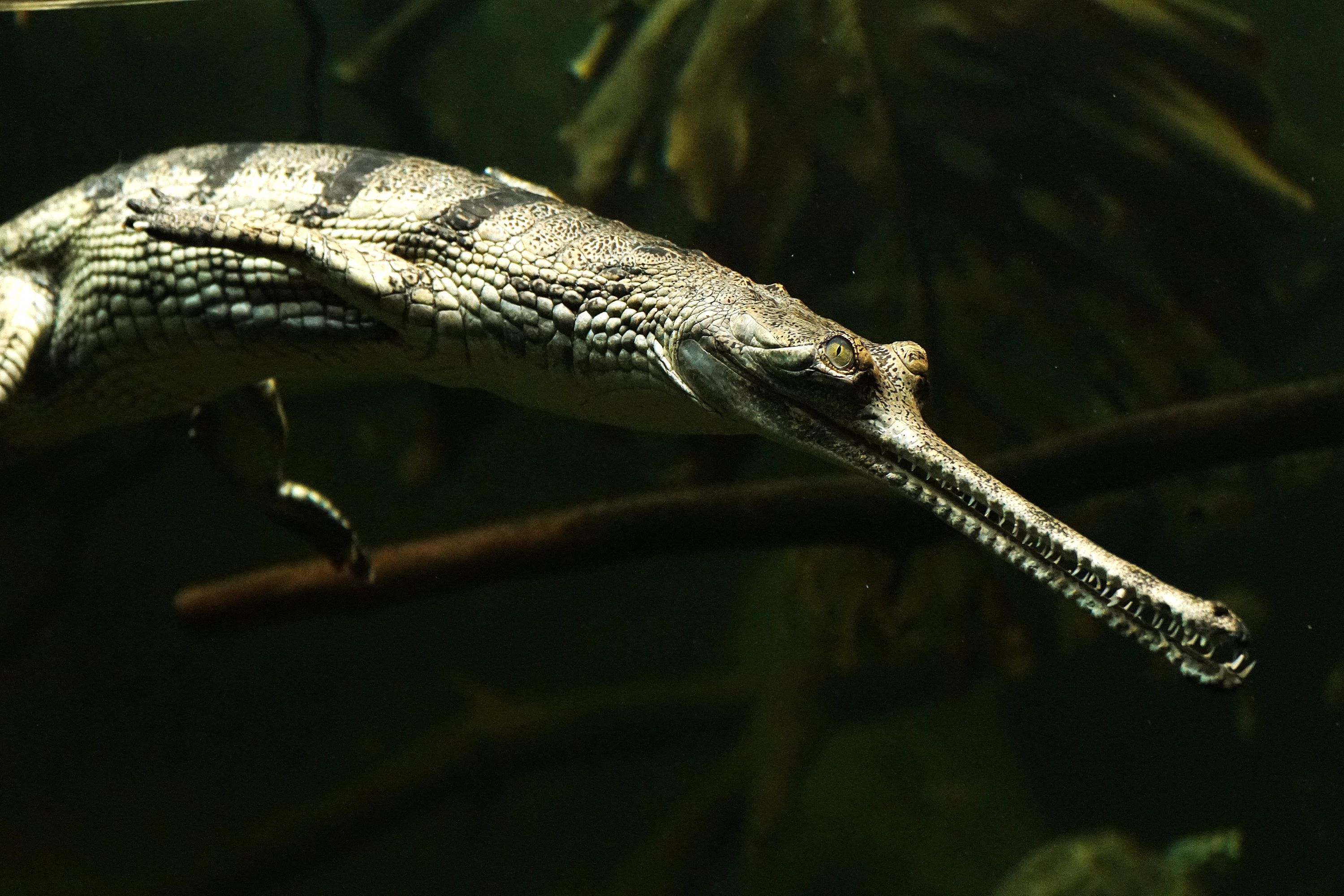
The Gharial, also known as the Indian gharial, is an iconic and highly specialized aquatic crocodilian, endemic to the major river systems of South Asia. Historically abundant in the basins of the Indus, Ganges, Brahmaputra, Mahanadi, and possibly the Irrawaddy, covering over 20,000 km of rivers, the species has experienced a catastrophic decline of over 96% since the 1940s.
Classified as 'Critically Endangered' by the IUCN, it now only survives in around fifteen fragmented locations, mainly in India and Nepal. The global adult population is estimated at only 650 individuals (range 300-900), with approximately 77% (about 500 adults) concentrated in the National Chambal Sanctuary in India, the only site where the population is considered functional and self-sustaining. Without intensive conservation interventions (habitat protection, captive breeding), the species would likely have disappeared.
Who is it?
Morphology
-
Size400 - 500 cm
-
Size400 - 500 cm
How to recognize This reptile ?
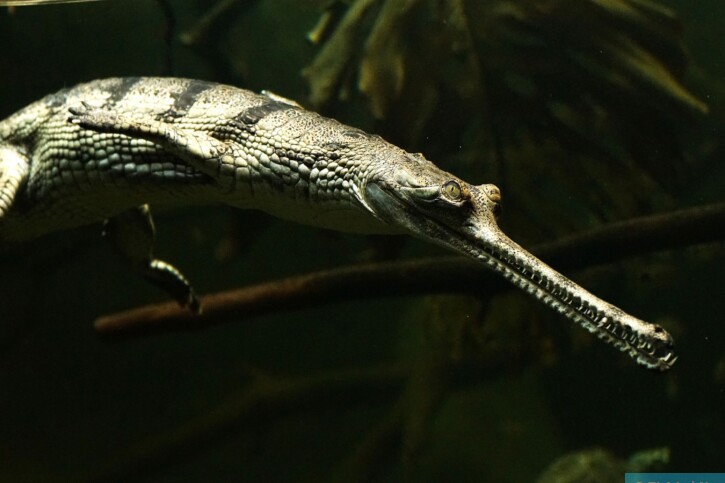
The gharial is the longest and most aquatic of current crocodilians, characterized by an extremely narrow and elongated snout, lined with numerous sharp interlocking teeth, perfectly adapted for catching fish.
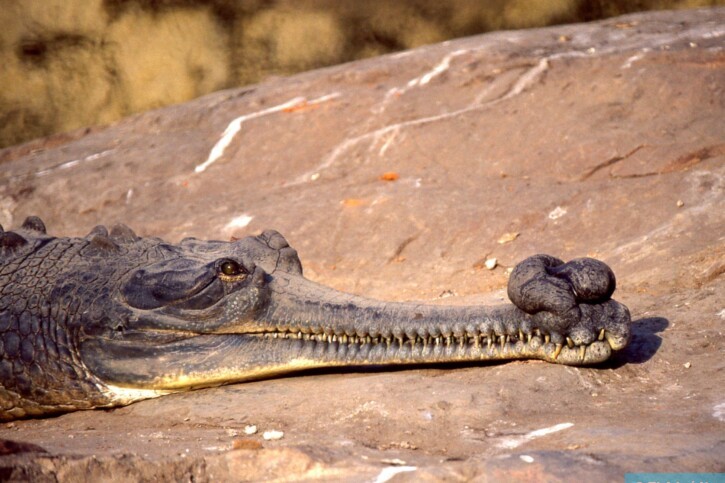
Its most distinctive feature is the presence, in mature males, of a spherical nasal growth called 'ghara' (pot in Hindi) at the tip of the snout. This structure, absent in females and young individuals, serves as a resonator for vocalizations, a dominance signal, and may play a role in bubble production during courtship displays. Adults typically reach lengths of 4 to 5 meters (males being larger), with a streamlined body and a powerful tail compressed laterally for efficient swimming.
Its legs are relatively weak and adapted for aquatic propulsion rather than terrestrial walking, making ground movement difficult for adults.
Sexual dimorphism
Sexual dimorphism is marked by the exclusive presence of the 'ghara' in adult males, which develops at sexual maturity (around 15 years or 3.5-4 meters in length). Males are also significantly larger and heavier than females. Behaviorally, a single dominant male guards the nurseries of newborns from multiple nests, while females, although they individually guard their nests until hatching, then gather to collectively monitor the juveniles. The scarcity of mature males in some subpopulations (e.g., Chitwan with fewer than 5 males) is a critical limiting factor for reproduction.
Behaviour & Life cycle
-
Sociabilitygregarious
-
Way of livingdiurnal
-
VenomousNo
-
Dietpredator
The gharial is a gregarious and diurnal species, spending most of its time in the water, where it is an agile and enduring swimmer. It undertakes significant seasonal migrations (up to 200 km, or even 1,000 km for released individuals) between feeding, breeding, and refuge areas, following the monsoon regime.
In the dry season, it congregates in deep pools and exposed sandbanks to thermoregulate (basking). The breeding season (February-March) sees the formation of complex social groups: dominant males court females and defend nesting territories. After mating (March-April) and hatching (May-June), a unique social behavior is observed: the newborns from multiple nests gather in 'creches' that can include hundreds of individuals, actively guarded by the mother and often by a large dominant male for 1 to 2 months. This extended parental care is crucial for the survival of juveniles against predators.
This crocodilian is a strict and specialized fish-eater. Unlike its cousins, which are generalist predators, its anatomy (slender snout, teeth unsuitable for pulling large terrestrial prey) confines it almost exclusively to a diet of fish. It hunts by ambush or slow swimming, capturing its prey with rapid lateral movements of the snout.
Adults consume a wide variety of fish, including invasive exotic species like Tilapia (Oreochromis spp), which have become dominant in some polluted areas of the Yamuna and Chambal rivers.
Although isolated observations have mentioned the consumption of birds or small mammals, and gastroliths (stomach stones) have been found (perhaps for digestion or buoyancy), the consumption of terrestrial prey is considered accidental or negligible. Juveniles feed on small fish, aquatic insects, and crustaceans. This dietary specialization makes the species extremely vulnerable to overfishing and fish stock depletion in rivers.
Reproduction
-
Reproductionovipare
-
Clutch size0 - 0 eggs
Reproduction is seasonal, synchronized with the monsoon cycle. Mating occurs in February-March in deep waters. Females lay eggs between March and April on exposed sandbanks, digging deep nests where they lay an average of 40 eggs (ranging from 20 to 95). Incubation lasts 60 to 75 days, dependent on sand temperature. Hatching occurs from late May to mid-June. Females assist newborns in exiting the nest by responding to their calls, but do not carry them to the water; the young make their own way there. Immediately after, creches form. Sexual maturity is reached late, around 15 years for males and slightly earlier for females. Natural recruitment rates are low in the wild due to nest predation (monitor lizards, dogs, humans) and high juvenile mortality (nearly 99% in Corbett, for example), making breeding and release programs ('head-starting') essential to maintain current populations, although their long-term effectiveness is debated.
Harmless species
The gharial poses no threat to humans. Its narrow snout and fine teeth are unsuitable for attacking large prey or gripping large mammals firmly. There is no confirmed case of a gharial attacking humans.
Origin and distribution
Geographic distribution & Conservation
Historically present from Pakistan (Indus) to Myanmar (Irrawaddy), the Gharial has been exterminated from almost all of its original range. It is now extinct in Pakistan, Bhutan, Myanmar, and probably Bangladesh (some possible isolated individuals). It persists in only 14 locations in India and Nepal.
Functional population: The Chambal National Sanctuary (India) harbors ~500 adults and produces >85% of global nests. It is the only site with a viable population dynamics.
Declining or non-viable populations: Katerniaghat (India), Chitwan and Babai (Nepal), Gandak (India/Nepal), Corbett (India). These sites suffer from poaching, nest disturbance, lack of males, or fragmentation by dams.
Minor sites: Some individuals remain in rivers like Son, Ken, Mahanadi, or Brahmaputra, but without recent confirmed reproduction. The species has declined by over 96% in 75 years (3 generations). Current threats include dam construction (fragmentation, flow alteration), sand mining (nesting site destruction), net fishing (accidental drowning), pollution (implicated in the massive mortality event in 2007-2008 on the Chambal), and water exploitation for irrigation.
Conservation and international regulations
What is its habitat?
Natural environment characteristics
-
Temperature15 - 30 °C
-
FlowStrong and Medium
Biotope presentation
The gharial is confined to the large perennial rivers of alluvial plains, below 500 m altitude. It requires deep waters with moderate to fast currents, pools for refuge in the dry season, and especially extensive exposed sandbanks in the dry season for thermoregulation and nesting.
It avoids brackish waters and coastal areas. Historically, it occupied main channels and major tributaries. Today, fragmentation by dams has transformed some lotic habitats (fast-flowing waters) into lentic habitats (reservoirs), which are suboptimal for the species (e.g., Corbett, Katerniaghat). Water quality and prey availability (fish) are determining factors. The species is sensitive to anthropogenic disturbances on banks (agriculture, material extraction), which destroy nesting sites.
To go further
To read on the web
Sources & Contributions
Participation & Validation
The Fishipedia team and specialist contributors are committed to providing high-quality content. However, although the information comes from scientific sources or testimonials from specialists, the cards may contain inaccuracies.

Benoit Chartrer
Translation
Translation done with the valuable contribution of our translators, who make this information available to a wider audience. We sincerely thank them for their commitment.
Benoit Chartrer