
Yellow-spotted Amazon River Turtle
| Family | Podocnemididae |
|---|---|
| Genus | Podocnemis |
| IUCN category (World) | VU |
Introduction
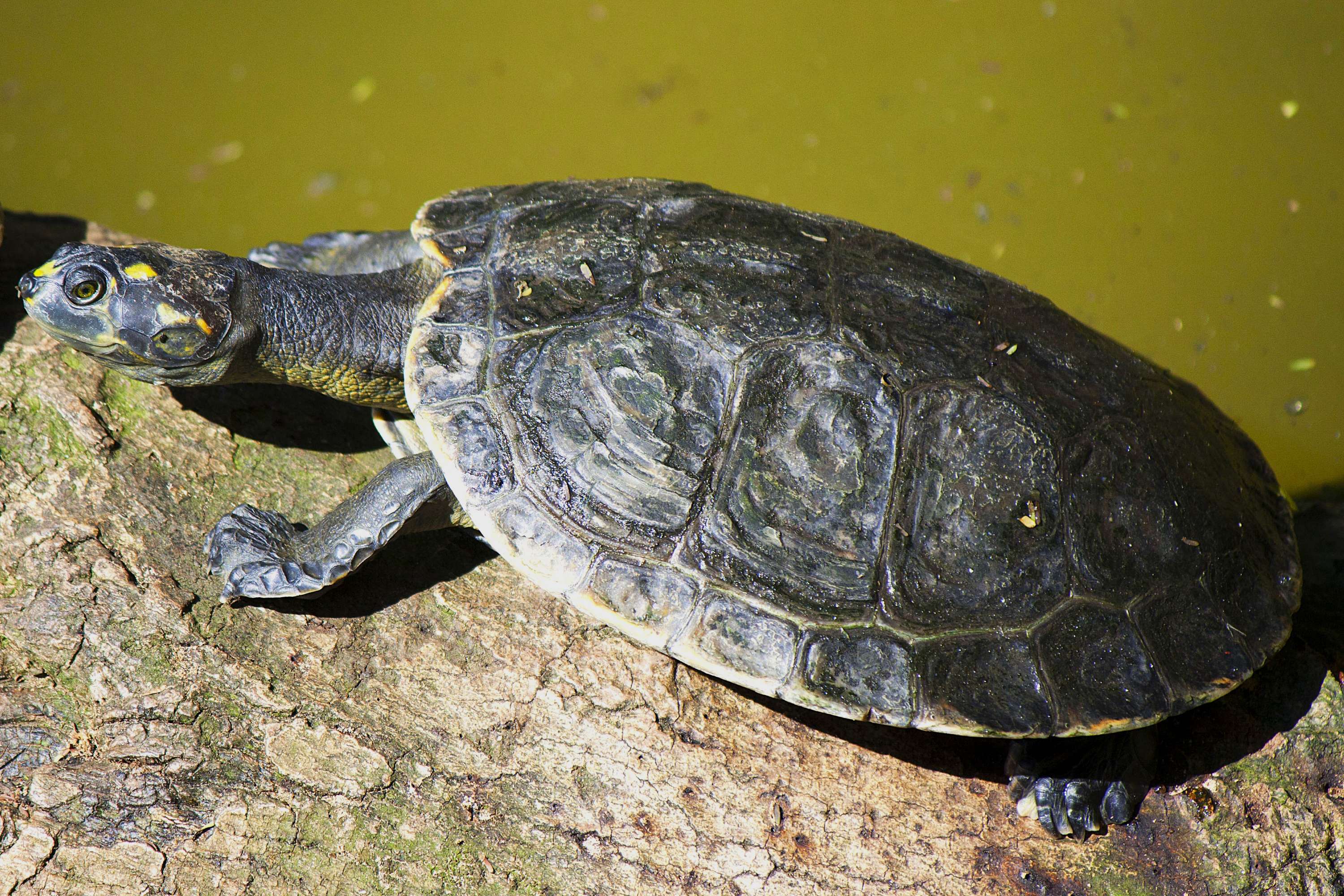
Podocnemis unifilis, commonly known as Yellow-spotted Amazon River Turtle, and locally tracajá (Brésil) is a freshwater turtle native to South America.
Aside from the Amazonian region, it is found in French Guiana, in a small area restricted to the eastern rivers of the territory. The species is experiencing a continuous decline in its mature individuals, classified as locally threatened due to intense egg and adult harvesting, as well as habitat fragmentation.
Who is it?
Morphology
-
Type
-
Size35 - 50 cm
-
Motiftasks
-
Mimicryplants
-
Type
-
Size35 - 50 cm
-
Motiftasks
-
Mimicryplants
How to recognize This reptile ?
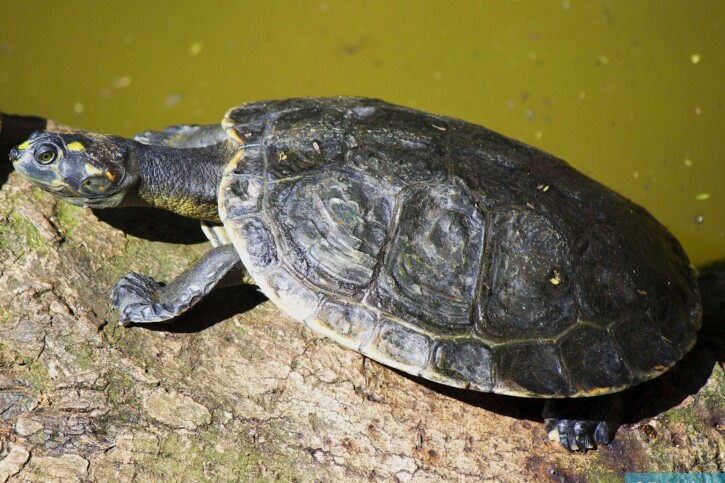
This species is distinguished by an oval, black or brown shell with a low central keel on the second and third vertebral scutes. The shell of juveniles is highly convex with the highest point towards the rear, while that of adults is moderately convex.
The plastron is light gray-beige in newborns and becomes gray as they grow. The head is characterized by paired frontal scales meeting on a distinct midline groove. Juveniles and subadults have a black head adorned with bright yellow spots, including a rounded spot on each lateral margin of the interparietal scale, a feature that gives the species its name.
Sexual dimorphism
Males are smaller, reaching a maximum shell length of approximately 33.5 cm, compared to 50 cm for females. The males' shells are also narrower. At the head level, males usually retain the yellow spots in adulthood and have a greenish iris, while females lose these spots to adopt a rusty-brown head color and have a blackish iris.
The males' tails are longer and thicker, with a more distally located vent and a deeper anal notch.
Behaviour & Life cycle
-
Sociabilityliving in small groups
-
Way of livingdiurnal
-
VenomousNo
-
Dietgrazer
This turtle species is mainly herbivorous. Its diet consists of plants, including fruits, stems, leaves, seeds, and algae.
Sex-specific dietary specialization has been observed: females consume more fruits and seeds, while males prefer herb stems. The species is capable of temporarily colonizing small shaded forest streams, although it mainly frequents large riverbeds.
It can coexist with other turtle species when each one's dietary specializations permit it.
Reproduction
-
Reproductionovipare
-
Clutch size0 - 0 eggs
The nesting season varies by location, synchronized with decreasing water levels. In French Guiana, nesting occurs primarily at the beginning of the dry season.
Females nest once or twice per season, laying between 35 and 40 eggs. The sex of the hatchlings is determined by the incubation temperature. Hatching success is influenced by the geological characteristics of the nesting site, particularly the sediment grain size and river level dynamics. Nesting sites, often rare and located on sandy beaches, are crucial for the species' survival.
Harmless species
This species poses no risk to humans.
Origin and distribution
Geographic distribution & Conservation
The range of Yellow-spotted Amazon River Turtle covers the entire Amazon basin (Colombia, Ecuador, Peru, Bolivia, Venezuela, Brazil) and the Caribbean drainages of the Guianas. In French Guiana, its presence is limited to the major riverbeds of the Oyapock, Approuague, and Comté rivers, as well as the flooded savannas of the Kaw-Roura Marshes Natural Reserve.
The species is experiencing a continuous decline in its populations throughout its range. In the Amazon, the primary threat is the massive consumption and trade of adults, juveniles, and eggs, as well as mercury contamination from gold mining in the Madeira and Tapajos river basins.
In French Guiana, the pressure is equally strong: nesting sites on the Approuague are annually exploited by local populations and Brazilian traders, while on the Oyapock, eggs are collected and adults are hunted with guns. The species also faces accidental captures in fishing nets. Hydroelectric dam projects, especially on the Approuague, pose an additional threat to nesting site destruction.
Conservation and international regulations
Where to see this species?

What is its habitat?
Natural environment characteristics
-
Temperature20 - 28 °C
-
FlowMedium, Slow and Stagnant
Biotope presentation
This turtle inhabits a variety of freshwater habitats, including large rivers, lakes, marshes, and lagoons. It is present in all three types of Amazonian rivers: white, clear, and black waters. In French Guiana, it favors major riverbeds but can occasionally venture into small forest streams. The availability of sandy beaches exposed during the dry season is a limiting factor for its reproduction.
To go further
To read on the web
Sources & Contributions
Participation & Validation
The Fishipedia team and specialist contributors are committed to providing high-quality content. However, although the information comes from scientific sources or testimonials from specialists, the cards may contain inaccuracies.

Benoit Chartrer
Translation
Translation done with the valuable contribution of our translators, who make this information available to a wider audience. We sincerely thank them for their commitment.
Where to see this species?
Scientific partners




Tags


