Introduction
Chrysaora pacifica, commonly known as the Japanese sea nettle or Pacific sea nettle, is a scyphozoan of the Pelagiidae family. Long confused with the Atlantic species Dactylometra quinquecirrha (now Chrysaora quinquecirrha) or its close relative Chrysaora melanaster, its identity has been formally re-established for Korean and Japanese populations through recent morphological and molecular analyses.
Endemic to the Northwest Pacific, it is particularly abundant in the coastal waters of South Korea and Japan from May to September. Characterized by its 32 radial stripes and 40 stinging tentacles, it is a major pelagic predator and a problematic species for human activities due to the severity of its stings.
Who is it?
Morphology
-
Size20 - 25 cm
-
Size20 - 25 cm
How to recognize This cnidarian ?
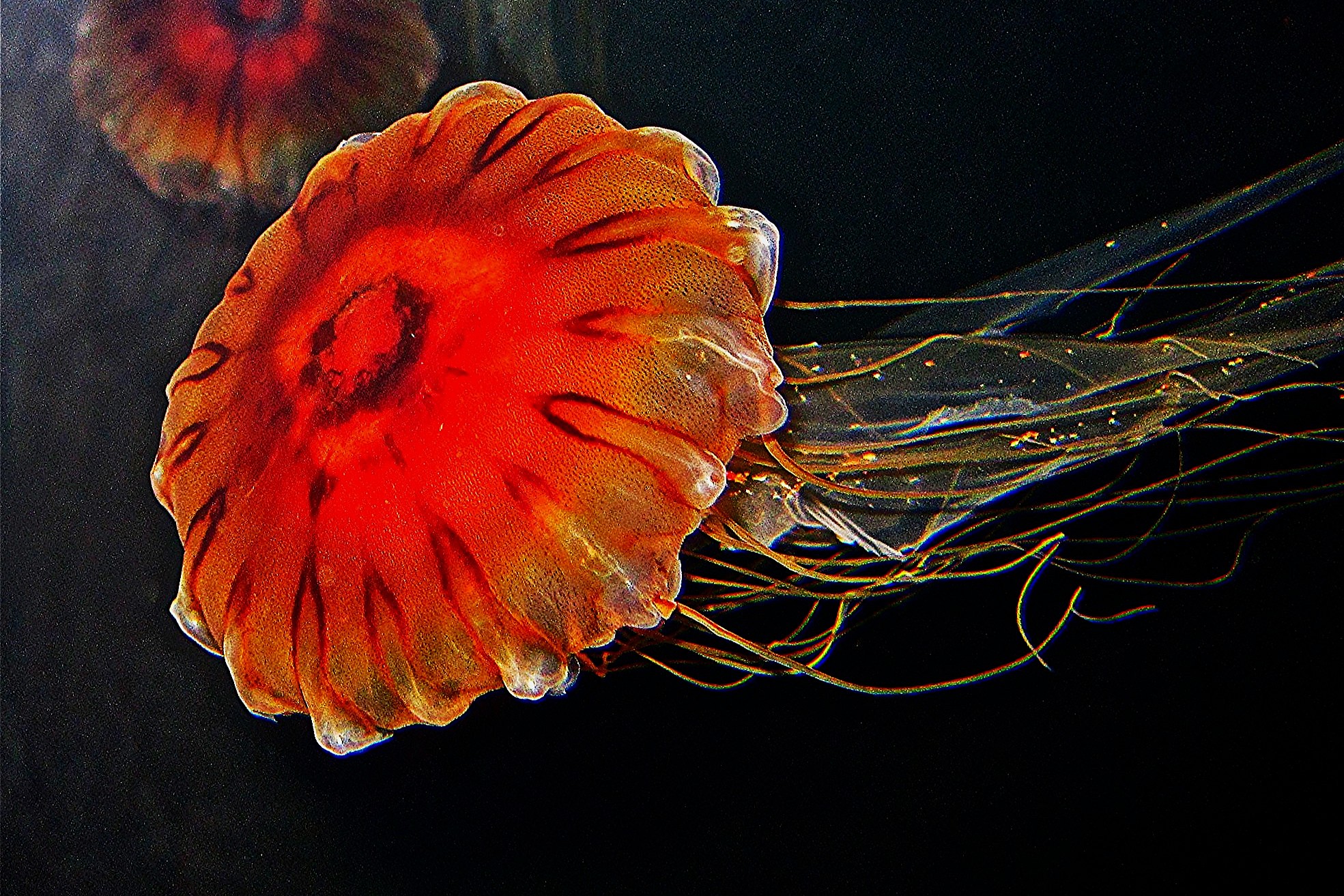
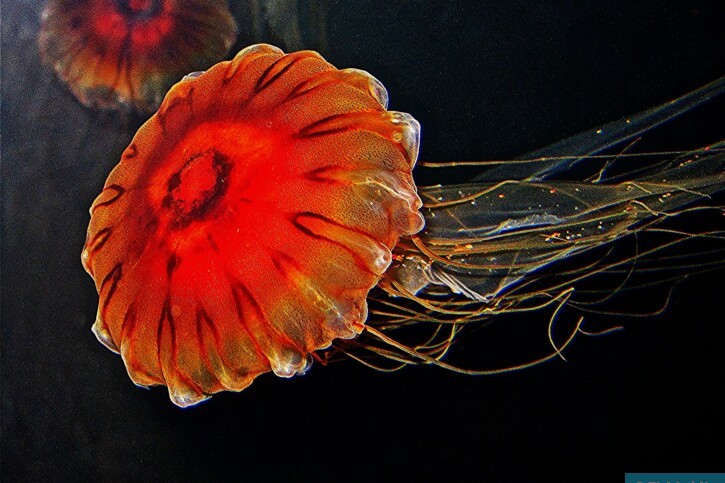
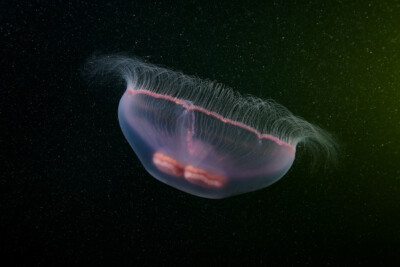
The umbrella of Chrysaora pacifica is almost hemispherical, divided into eight sectors, with a flexible and translucent mesoglea, thicker in the center.
Its maximum size reaches about 20 cm in diameter, with collected specimens generally ranging between 15 and 21 cm, which distinguishes it from C. melanaster which can exceed 30 cm.
The exumbrella (upper surface) is finely granulated and adorned with 32 brown radial stripes radiating from the center, sometimes of the "sunburst" type. The subumbrella (lower surface) does not show the characteristic black streaks of C. melanaster.
The species has four delicate oral arms, wrinkled in appearance like a curtain (hence its Korean name Keoteun-wonyang-haepari), measuring two to three times the length of the umbrella's diameter. These arms are covered with numerous stinging warts (nematocysts).
The capture system includes 40 filamentous tentacles, orange-brown in color, exceptionally elastic and capable of reaching two to three times the diameter of the umbrella in living specimens.
Behaviour & Life cycle
-
Sociabilityliving in colonies
-
Dietnot specified
-
Way of livingdiurnal
Coastal pelagic species, Chrysaora pacifica makes regular seasonal appearances, mainly from spring to summer (May to September) in Korean and Japanese waters. It is capable of actively swimming but remains largely dependent on currents for horizontal movements. Wild polyps have been identified in Sagami Bay, Japan, confirming the presence of a benthic phase in its cycle.
The species is known to form dense aggregations near the coasts during its peak abundance period, increasing the risks of encounters with human activities (swimming, fishing). A carnivorous predator, this species actively captures zooplankton and small pelagic organisms with its vast network of 40 stinging tentacles. Its specialized oral arms then allow for the manipulation and ingestion of prey. Its morphology and belonging to the genus Chrysaora indicate effective predation on fish larvae, planktonic crustaceans, and potentially other smaller jellyfish.
Reproduction
-
Reproductionovipare
Like all Scyphozoans, C. pacifica exhibits an alternation of generations. The sexual phase (jellyfish) releases gametes that give rise to a planula larva. This larva attaches to form a polyp (scyphistome), a stage that has been observed in the wild in Sagami Bay.
The polyp reproduces asexually through strobilation to release young jellyfish (ephyrae). The species is gonochoric (separate sexes). The confirmed presence of wild polyps suggests a well-established life cycle in its North Pacific distribution range.
Risks for humans
-
VenomousYes
Chrysaora pacifica is considered a dangerous species in Korea and Japan. Its sting is severe and causes significant pain in bathers and fishermen. The tentacles, filled with powerful nematocysts, can trigger intense skin reactions. Handling is strongly discouraged. The species is monitored during the summer season due to its impact on tourism and maritime activities.
Origin and distribution
Geographic distribution & Conservation
The authentic distribution range of Chrysaora pacifica is restricted to the Northwest Pacific: coastal waters of Japan (notably Sagami Bay) and South Korea (southern and eastern coasts, Gyeongnam provinces). The taxonomy of the species was clarified by Lee et al. (2016): Korean specimens, previously misidentified as Dactylometra quinquecirrha (an Atlantic species), do belong to C. pacifica.
Conservation and international regulations
Where to see this species?

What is its habitat?
Natural environment characteristics
-
Temperature10 - 25 °C
-
Depth0 - 200 m
Biotope presentation
A subtropical species, C. pacifica frequents the coastal waters of the North Pacific continental shelf. It is mainly observed in the littoral zones of Korea and Japan. Its presence is seasonal, linked to temperature and food availability cycles from spring to summer.
To go further
To read on the web
Sources & Contributions
Participation & Validation
The Fishipedia team and specialist contributors are committed to providing high-quality content. However, although the information comes from scientific sources or testimonials from specialists, the cards may contain inaccuracies.

Benoit Chartrer
Translation
Translation done with the valuable contribution of our translators, who make this information available to a wider audience. We sincerely thank them for their commitment.
Where to see this species?
Scientific partners