yellowfin surgeonfish
| Family | Acanthuridae |
|---|---|
| Genus | Acanthurus |
| IUCN category (World) | LC |
Introduction
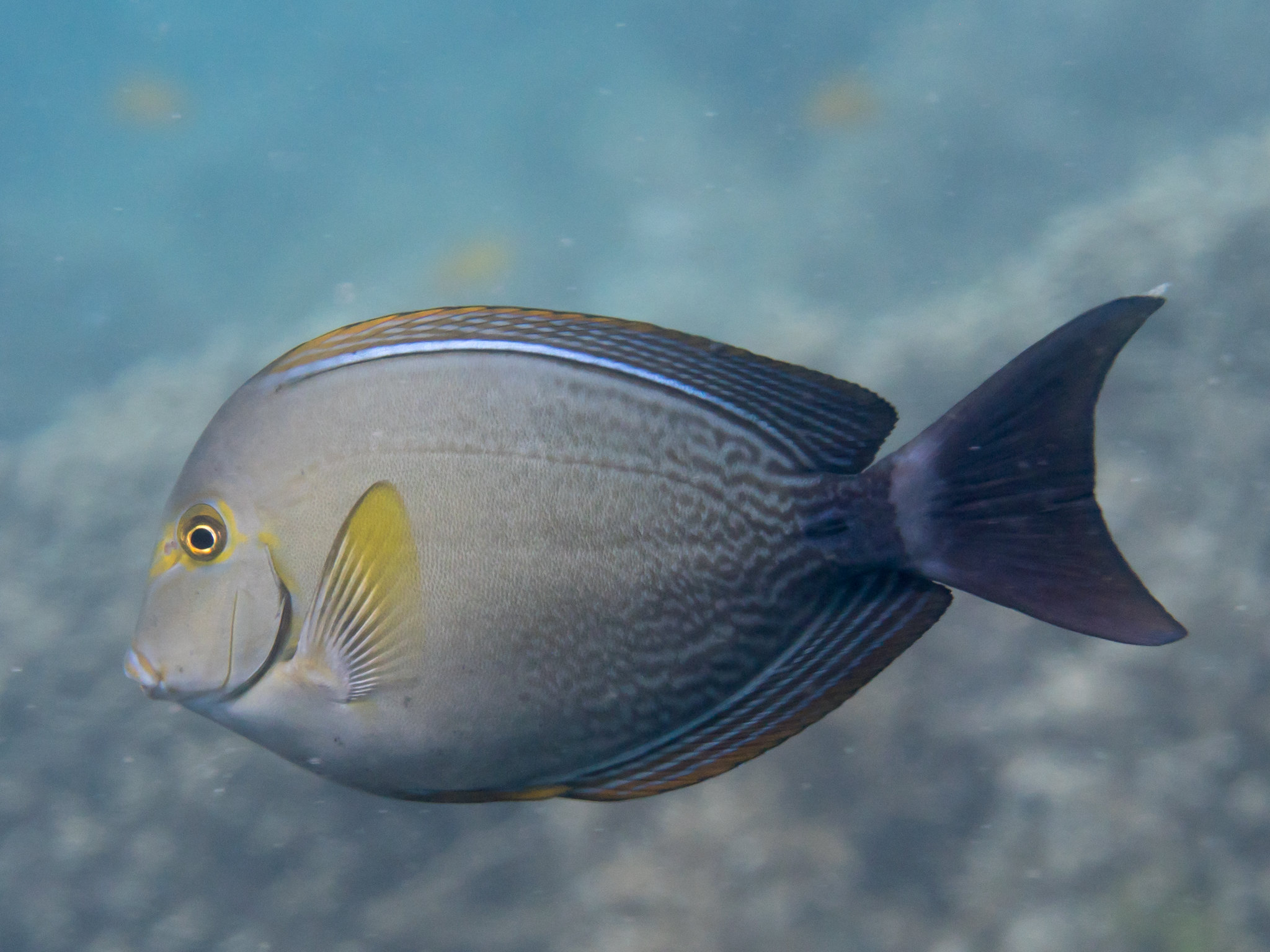
Acanthurus xanthopterus, commonly known as yellowfin surgeonfish, is one of the largest members of the Acanthuridae family, reaching up to 70 cm in length. It is widespread in the tropical waters of the Indo-Pacific and the eastern Pacific, where it inhabits various reef and lagoon habitats.
Who is it?
Morphology
-
Type
-
Average size50 cm
-
Maximum size70 cm
-
ShapeOvoid
-
Type
-
Average size50 cm
-
Maximum size70 cm
-
ShapeOvoid
How to recognize This fish ?
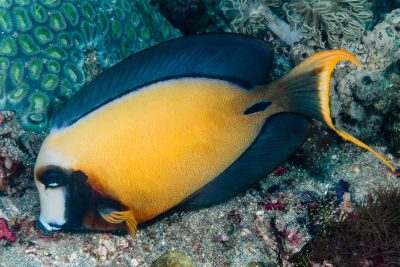
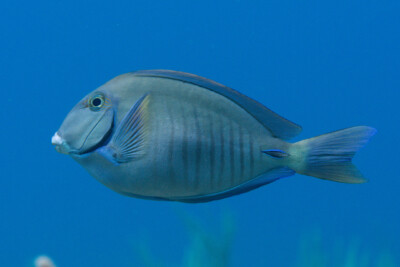
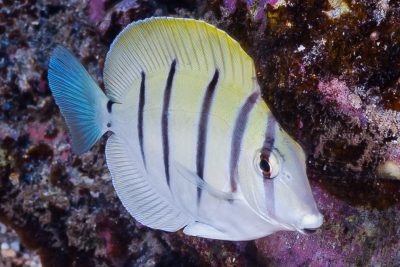
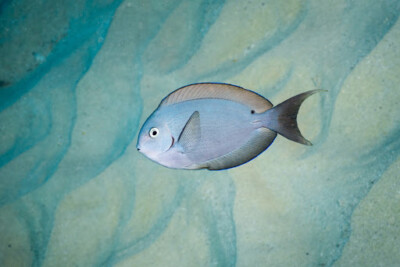
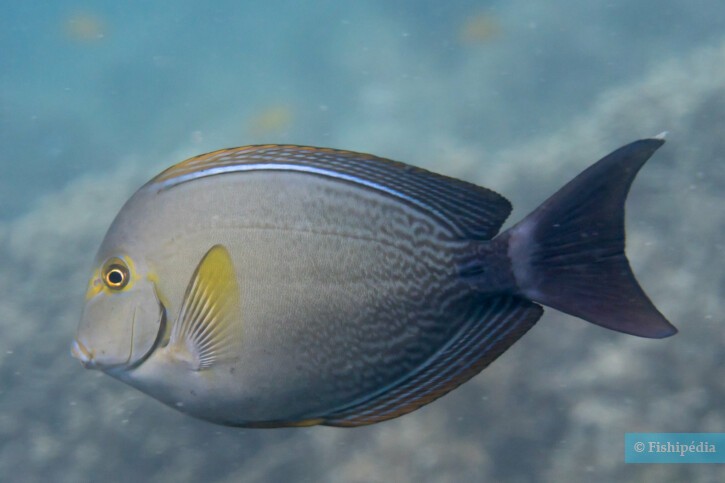
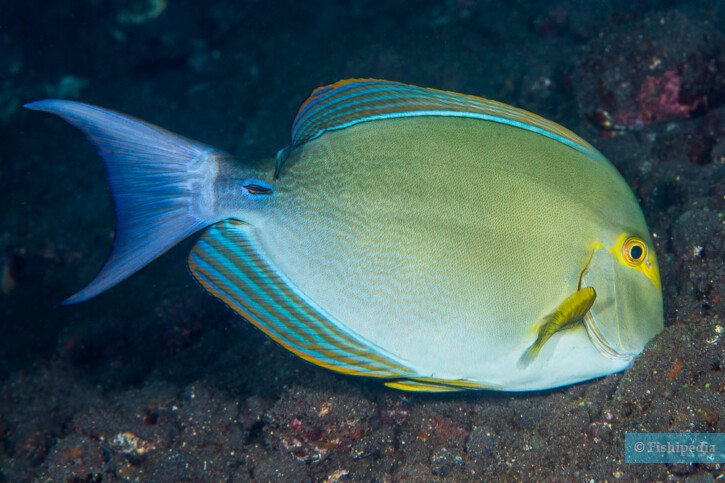
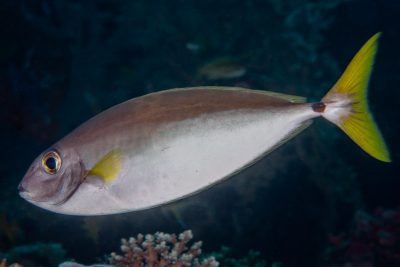
The laterally compressed body is gray with a yellowish area in front of the eye. The pectoral fin has a yellow outer third, while the dorsal and anal fins are grayish-yellow at the base and dull yellow on the periphery. The caudal fin is purple with a whitish base. It has 8–9 dorsal spines, 25–27 soft dorsal rays, 3 anal spines, and 23–25 soft anal rays. The common size is around 50 cm, with a maximum of 70 cm and a lifespan of up to 34 years.
Sexual dimorphism
In Acanthuridae, sexes are separate but do not show obvious sexual dimorphism. However, males display courtship colors during reproduction.
Behaviour & Life cycle
-
dietomnivorous
-
Sociabilityliving in shoals
-
territorialYes
-
Way of livingdiurnal
A benthopelagic species, the yellowfin surgeonfish is solitary, found in small groups or schools. It is classified as a grazer/detritivore, feeding on algae, diatoms, detritus, hydroids, and fish remains. It is also known to consume feces of pelagic fish such as carangids.
Reproduction
-
Reproductionovipare qui pond en eau libre
Acanthurus xanthopterus reproduces by forming spawning aggregations, observed in locations like Palau between January and May, during new and full moons, as well as on the Great Barrier Reef. The eggs and larvae are pelagic, promoting wide dispersal.
Harmless species
This species does not represent any particular threats to humans when encountered in its natural environment.
Origin and distribution
Geographic distribution & Conservation
The species is widely distributed in the Indo-Pacific, from East Africa to Hawaii and French Polynesia, south to Japan and the Great Barrier Reef. In the eastern Pacific, it is found from the Gulf of California to Panama, as well as in the Galápagos and Clipperton Islands.
Where to see this species?






What is its habitat?
Natural environment characteristics
-
Temperature24 - 28 °C
-
Depth1 - 100 m
Biotope presentation
It is found in lagoons, sheltered bays, and sandy slopes adjacent to reefs, typically beyond 10–15 m, up to 90 m deep. Juveniles inhabit shallow, protected, turbid coastal areas, while adults prefer outer reef zones or sandy-rocky bottoms.
To go further
Species of the same family
Espèces du même genre
To read on the web


Sources & Contributions
Participation & Validation
The Fishipedia team and specialist contributors are committed to providing high-quality content. However, although the information comes from scientific sources or testimonials from specialists, the cards may contain inaccuracies.

Benoit Chartrer
Translation
Translation done with the valuable contribution of our translators, who make this information available to a wider audience. We sincerely thank them for their commitment.

Marine Kassel
Where to see this species?
Scientific partners




Tags
#Acanthuridae
#Acanthurus
#barrière de corail
#Surgeonfish
#Bay of Bengal
#Great Barrier Reef
#East China Sea
#Philippine Sea
#Indonesian seas
#western Indian Ocean
#Galapagos
#Tropical Eastern Pacific
#Western Tropical Pacific Ocean
#Bali
#Lombok
#Maldives
#Nusa Penida
#Palawan Island
#French Polynesia
#Rajat Ampat
#Sipadan
Species of the same family
Same genus