Introduction
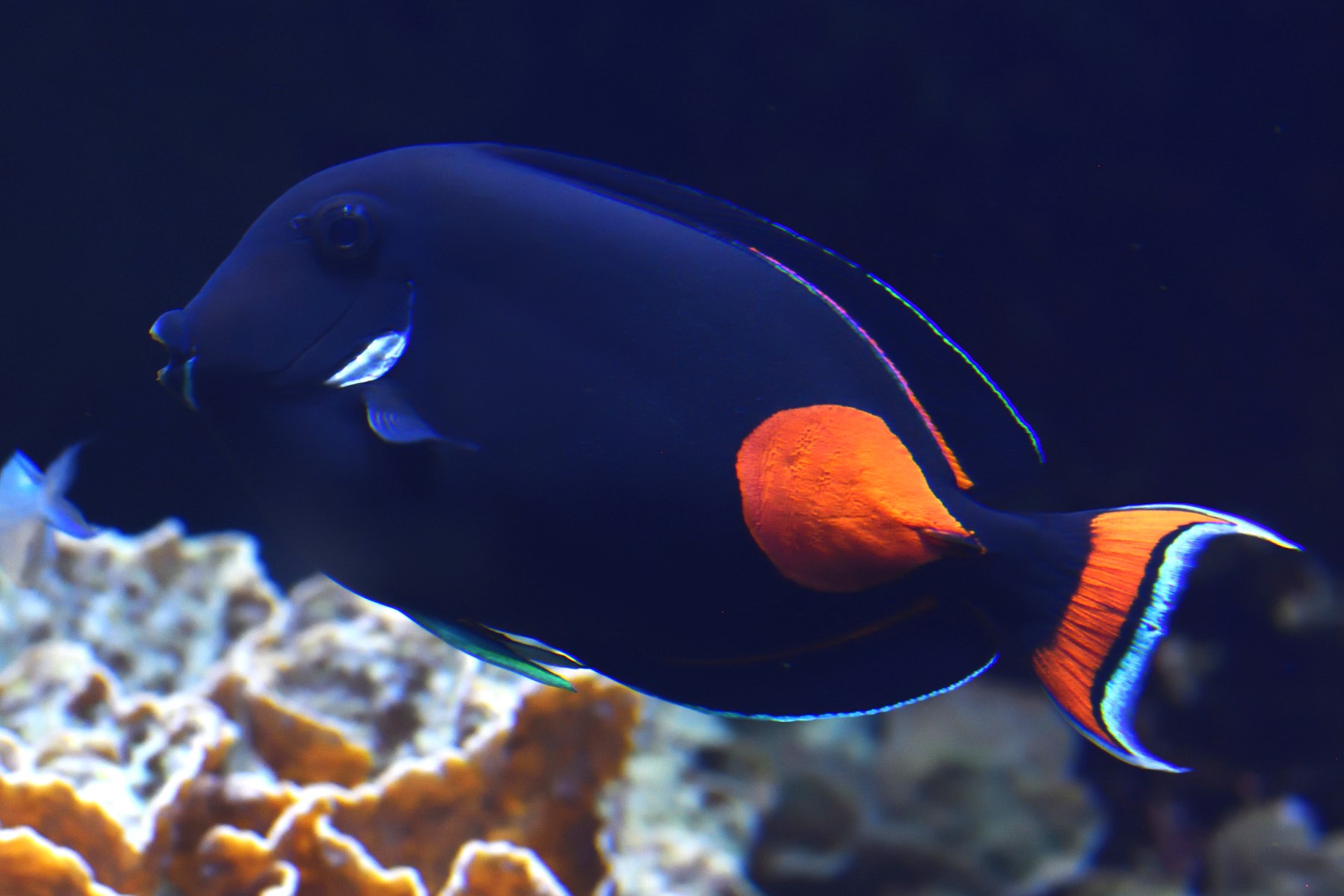
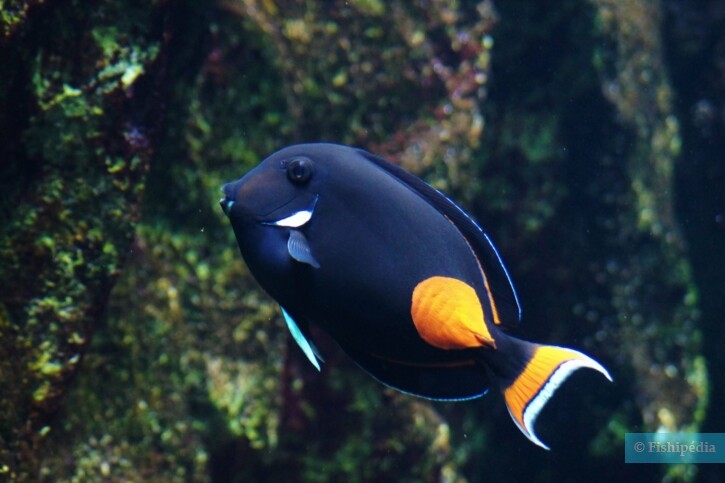
The Achilles Tang (Acanthurus achilles) is an iconic reef fish of the tropical Pacific. Recognizable by its dark silhouette marked by a large orange drop-shaped spot on the caudal peduncle, it is particularly sought after in the aquarium trade and is also consumed in certain regions.
Who is it?
Morphology
-
Type
-
Average size24 cm
-
Maximum size25 cm
-
ShapeOvoid
-
Patterntasks
-
Type
-
Average size24 cm
-
Maximum size25 cm
-
ShapeOvoid
-
Patterntasks
How to recognize This fish ?
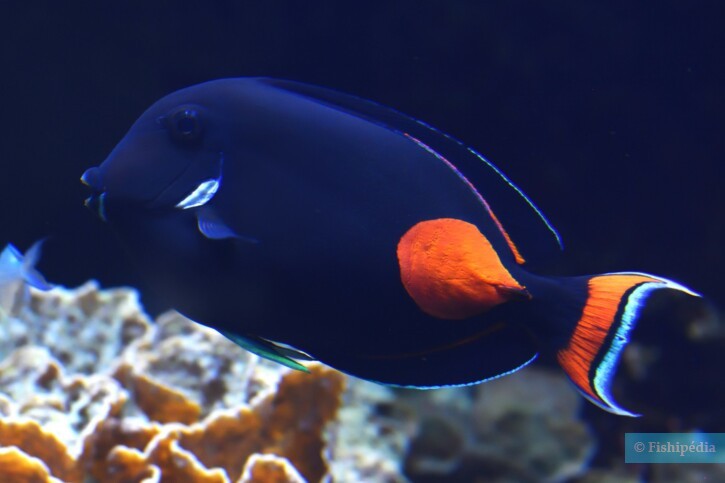
This fish reaches a maximum size of 24 cm. Its body is very dark brown to black, laterally compressed, with a small mouth and elongated snout. The most visible characteristic is a large horizontal orange drop-shaped spot, extending to the lyre-shaped caudal fin, orange and white. A white mark is present on the operculum and pelvic fins. The dorsal and anal fins have an outer white edging and a base highlighted by a double white and orange edging.
As with all Acanthurids, an erectile spine is found on each side of the caudal peduncle. It can inflict deep cuts and may be venomous.
Sexual dimorphism
There is no pronounced sexual dimorphism in this species. During the mating season, however, males display more contrasting colors for courtship.
Behaviour & Life cycle
-
dietomnivorous with alguivorous tendency
-
Sociabilityliving in small groups
-
territorialYes
-
Way of livingdiurnal
A gregarious species, the Achilles Tang mostly lives in groups organized by a strict hierarchy. It feeds primarily on filamentous algae and small fleshy algae, grazing energetically in turbulent areas.
It is a very active, territorial, and aggressive fish, particularly towards its congeners and species with a similar temperament.
Reproduction
-
Reproductionovipare qui pond en eau libre
The achilles tang is oviparous and monogamous. Reproduction takes place in open water, with eggs immediately dispersed by currents. Larvae develop in the water column before metamorphosing around 6 cm, at which stage they join shallow reefs. Juveniles gather in calm shallow areas.
Hybridization cases with Acanthurus nigricans have been reported.
Harmless species
This fish is not dangerous in behavior, but its caudal spines can cause deep wounds. They are sometimes considered venomous. The handling of captured individuals should therefore be done with caution.
Origin and distribution
Geographic distribution & Conservation
The species is found in the central and eastern Pacific, from the oceanic islands of Oceania to Hawaii and Pitcairn Islands. It is also observed in Wake, Marcus, and Mariana Islands, as well as in the Eastern Pacific, from the south of Baja California (Mexico) to oceanic islands like Clipperton. It is absent from Australia.
It is abundant in certain areas like French Polynesia and Hawaii but rare in the Mariana Islands. Locally, it may be intensively exploited for the aquarium trade.
Conservation and international regulations
Where to see this species?



What is its habitat?
Natural environment characteristics
-
Temperature22 - 28 °C
-
Depth0 - 5 m
-
FlowStrong and Medium
Biotope presentation
The achilles tang frequents clear reef areas exposed to strong currents and swell, generally at depths of less than 5 m. It is found along the outer slopes of reefs or on rocky shores battered by waves.
A benthopelagic species, it lives in habitats with high hydrodynamic energy, where it grazes on algae on hard substrates.
To go further
Species of the same family
Espèces du même genre
To read on the web


Sources & Contributions
Participation & Validation
The Fishipedia team and specialist contributors are committed to providing high-quality content. However, although the information comes from scientific sources or testimonials from specialists, the cards may contain inaccuracies.

Adrien Falzon

Benoit Chartrer
Translation
Translation done with the valuable contribution of our translators, who make this information available to a wider audience. We sincerely thank them for their commitment.

Marine Kassel
Where to see this species?
Scientific partners





Tags
Species of the same family
Same genus