Introduction
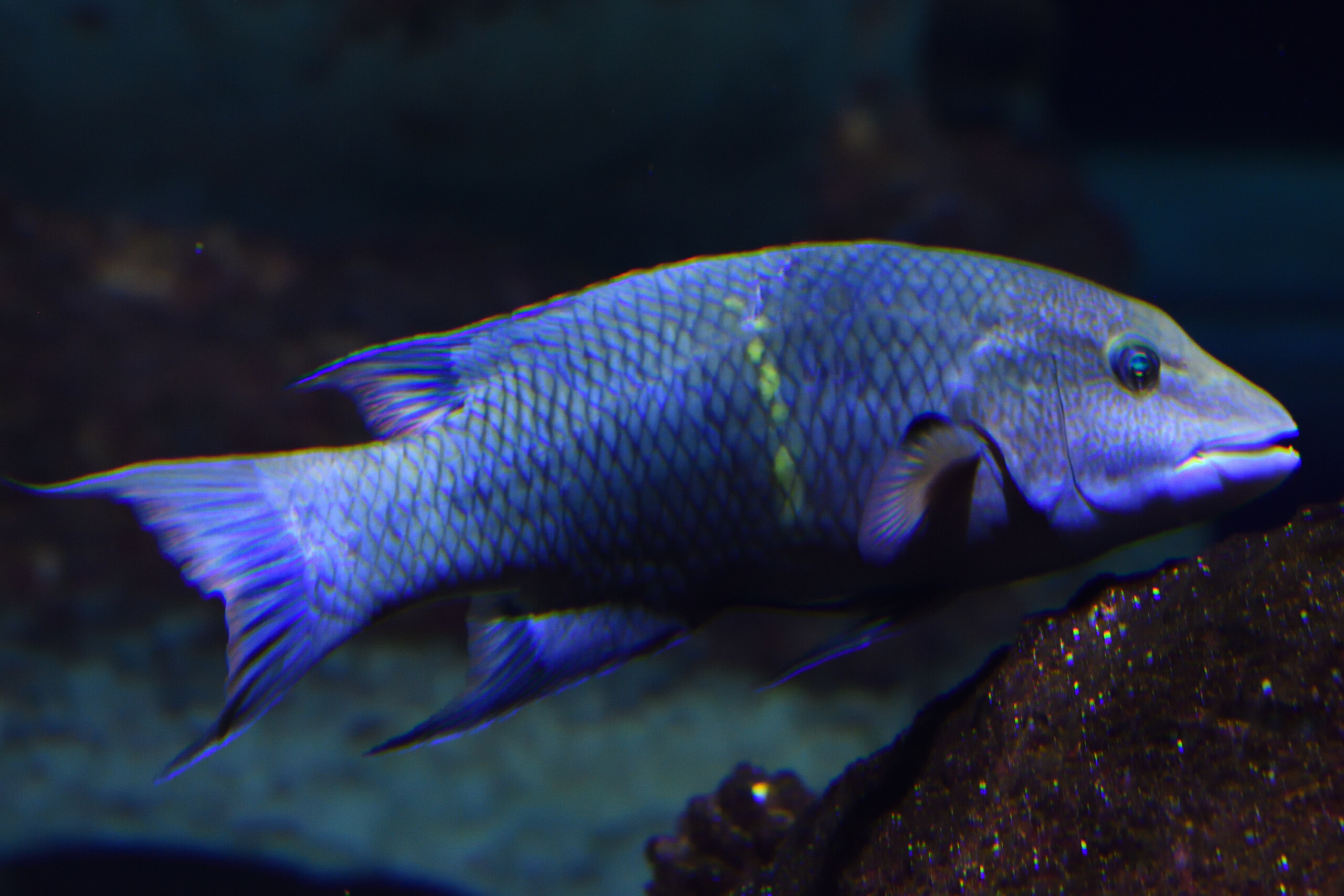
Bodianus diplotaenia, commonly known as the Mexican hogfish, is a tropical reef fish native to the eastern Pacific Ocean.
This species inhabits rocky or coral areas. During the night, these fish gather in cracks and crevices of rocks and caves to sleep. Mexican hogfish can sometimes be found in estuaries and coastal lagoons.
Who is it?
Morphology
-
Type
-
Average size45 cm
-
Maximum size76 cm
-
Patternrayure verticale
-
Type
-
Average size45 cm
-
Maximum size76 cm
-
Patternrayure verticale
How to recognize This fish ?
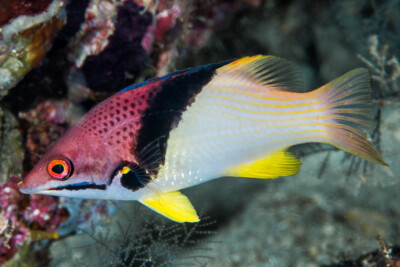
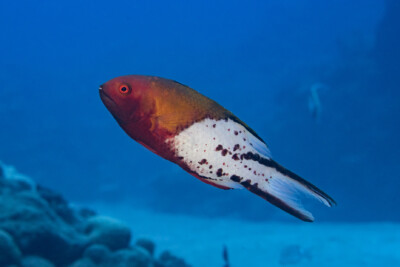
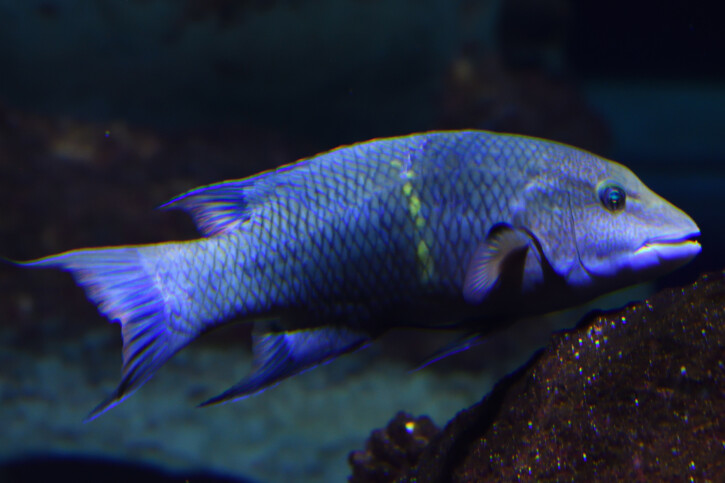
The Mexican hogfish averages 45 cm in length, with dominant males reaching up to 76 cm. The body is moderately deep and compressed, with a relatively large and pointed head. Their teeth are large, canine-like, and slightly curved.
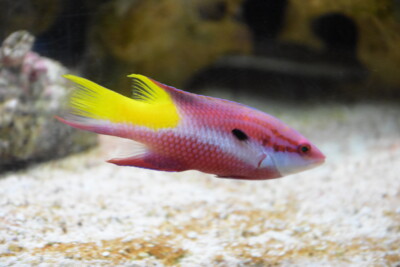
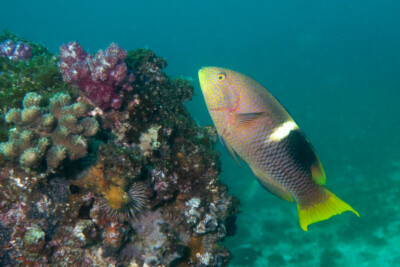
This fish changes coloration throughout its life. Juveniles are reddish-brown, females are blue with a black vertical stripe, and as females transition to males, the black patterns turn yellow.
Sexual dimorphism
The adult male is larger than the female, which undergoes sex reversal.
Behaviour & Life cycle
-
dietcarnivorous
-
Sociabilityliving in a group or alone
-
territorialYes
-
Way of livingdiurnal
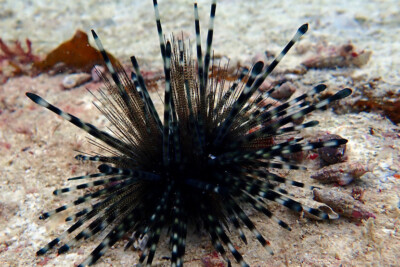
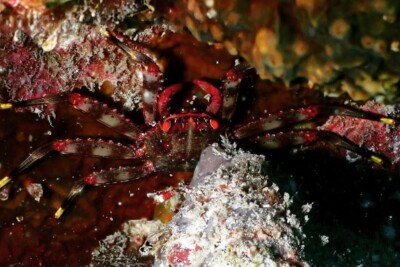
The Mexican hogfish is a solitary or group-living fish. At night, they gather in cracks and crevices of rocks and caves to sleep. Males defend temporary breeding territories. They are carnivorous feeders, consuming crabs, brittle stars, mollusks, and sea urchins.
Reproduction
-
Reproductionovipare
-
Hermaphroditeprotogynous
The Mexican hogfish is an oviparous fish with distinct sexes during reproduction. They are born female, with individuals changing sex to become males as they grow, displaying a protogynous hermaphroditism.
Harmless species
This species poses no particular danger to humans when encountered in its natural environment.
Origin and distribution
Geographic distribution & Conservation
The Mexican hogfish can be found along the coasts of the Eastern Pacific: Isla Guadalupe, throughout the Gulf of California to Chile, including Cocos Island, Malpelo, Revillagigedo Islands, and the Galápagos Islands.
Conservation and international regulations
Where to see this species?

What is its habitat?
Natural environment characteristics
-
Depth5 - 75 m
Biotope presentation
The Mexican hogfish is typically found at depths between 5 and 18m, but can also inhabit other depths. Adults reside in rocky or coral areas, occasionally on sandy bottoms with abundant marine plants. They are present in reef crevices and small cavities.
To go further
Species of the same family

Espèces du même genre
To read on the web

Sources & Contributions
Participation & Validation
The Fishipedia team and specialist contributors are committed to providing high-quality content. However, although the information comes from scientific sources or testimonials from specialists, the cards may contain inaccuracies.

Aurélien Calas
Translation
Translation done with the valuable contribution of our translators, who make this information available to a wider audience. We sincerely thank them for their commitment.

Marine Kassel
Bibliographic references
- GBIF — Bodianus diplotaenia
- iNaturalist — Bodianus diplotaenia
- Phylogeny and biogeography of hogfishes and allies (Bodianus, Labridae) — Francesco Santini — Michael E. Alfaro — Laurie Sorenson — Elsevier Ltd —
Where to see this species?
Scientific partners



Tags
Species of the same family
Same genus