Introduction
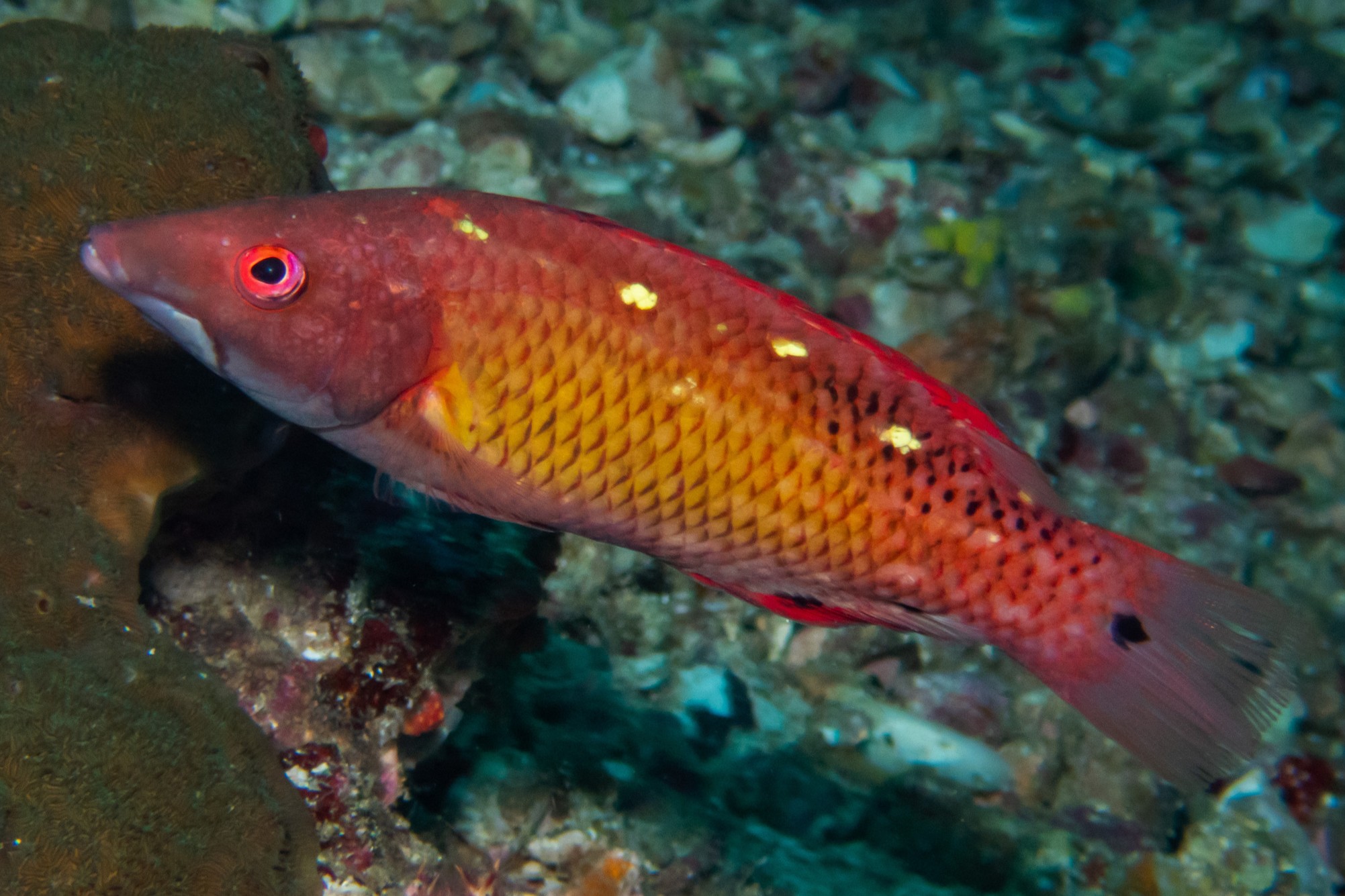
The Diana's hogfish (Bodianus diana) is a marine fish of the Labridae family, widely distributed in the western Indian Ocean. It is the most abundant species of the genus Bodianus in this region, particularly in the Mozambique Channel.
Although sought after by aquarium fish collectors for its moderate size and behavior, no capture data indicates any threat to its populations.
Who is it?
Morphology
-
Type
-
Average size14 cm
-
Maximum size16.9 cm
-
Patterntasks
-
Type
-
Average size14 cm
-
Maximum size16.9 cm
-
Patterntasks
How to recognize This fish ?
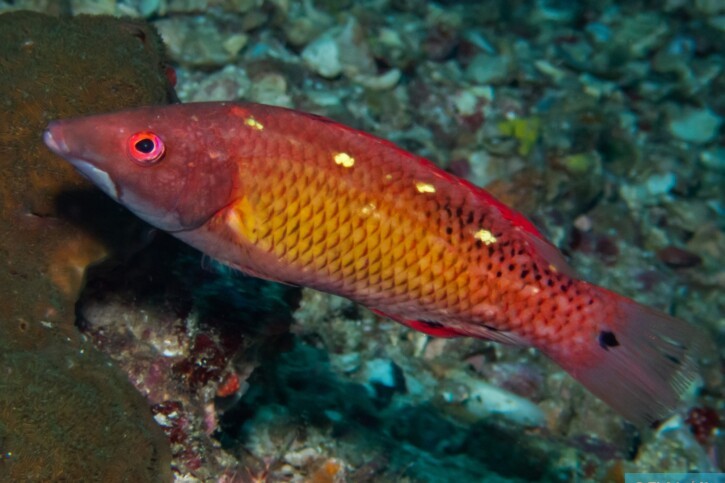
Of moderate size, Diana's hogfish reaches about 17 cm in standard length. Its laterally compressed body is armed with prominent canine-like teeth, typical of benthic predators.
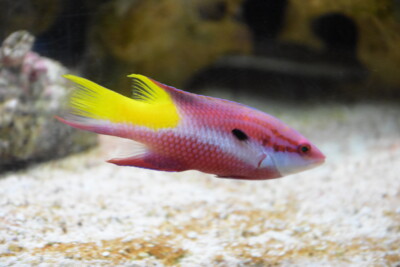
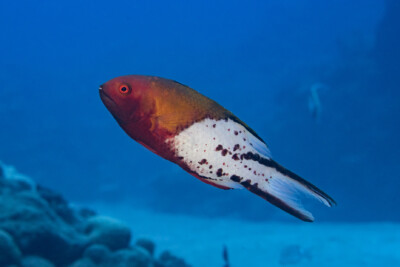
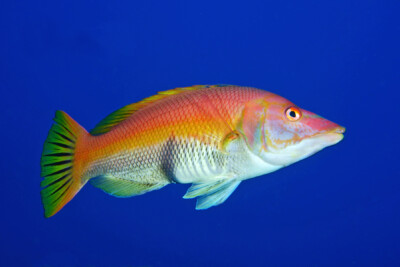
The species exhibits marked ontogenetic color dimorphism. The juvenile displays high-contrast coloration: a slightly reddish black body covered with white spots. As adults, this juvenile coloration fades into a more uniform pink to orange coloration, sometimes enhanced with a fine light lanceolate line on the flanks. The head and fins are of matching hues, blending with the coral substrate.
Sexual dimorphism
The adult male is larger than the female.
Behaviour & Life cycle
-
dietcarnivorous
-
Sociabilitysolitary
-
territorialYes
-
Way of livingdiurnal
Restricted to coral reefs, Diana's hogfish plays a major ecological role as a cleaner fish, a function primarily carried out by juveniles. Unlike sedentary cleaner gobies, the juvenile is mobile: actively patrolling over several meters, sometimes rising a meter above the seabed to solicit neighboring fish. They establish cleaning stations under overhangs, cave ceilings, or sheltered spots among gorgonians and corals.
Adults, less involved in this symbiosis, move in pairs or small mobile groups, swimming in the water column near the reefs.
This benthic carnivore primarily feeds on invertebrates such as crustaceans and mollusks, dislodging them from crevices with its robust teeth.
Juveniles' diet is supplemented by specific cleaning activity: they consume ectoparasites (copepods, isopods) extracted from the skin, gills, and oral cavity of other fish species. This opportunistic behavior provides them with a constant source of protein-rich food while providing a health service to the reef community.
Reproduction
-
Reproductionovipare
Reproduction follows the classic pattern of pelagic reef species: during favorable periods, couples release their gametes into the open water. The eggs, and subsequent larvae, drift with ocean currents, evading reef predators. After a pelagic phase, the larvae metamorphose and settle on the seabed to adopt a benthic lifestyle and the characteristic cleaning behavior of juveniles.
Harmless species
Diana's hogfish is harmless to humans.
Origin and distribution
Geographic distribution & Conservation
The distribution range of Diana's hogfish spans the entire western Indian Ocean, from the Red Sea and the Gulf of Aden to KwaZulu-Natal (South Africa). It is ubiquitous in the Comoros, Seychelles, Mauritius, Reunion, Maldives, Sri Lanka, and up to the Cocos Islands. Although locally captured for the ornamental trade, the species remains very common and faces no systemic threats. Its ability to inhabit various reef habitats, including slightly degraded areas, enhances its resilience to moderate anthropogenic pressures.
Conservation and international regulations
What is its habitat?
Natural environment characteristics
-
Temperature25 - 29 °C
-
Depth6 - 50 m
Biotope presentation
This hogfish is strictly associated with live coral reefs. It mainly inhabits the zone from 9 to 30 meters deep, although it can descend to 50 meters at some isolated atolls.
Juveniles show ecological preference for shaded and protected areas: cave ceilings, rocky overhangs, and branches of gorgonians or black corals (Antipatharia), which provide them refuge from predators and serve as cleaning stations. Adults frequent exposed outer slopes with currents and reef crests.
To go further
Species of the same family
Espèces du même genre
To read on the web


Sources & Contributions
Participation & Validation
The Fishipedia team and specialist contributors are committed to providing high-quality content. However, although the information comes from scientific sources or testimonials from specialists, the cards may contain inaccuracies.

Adrien Falzon
Translation
Translation done with the valuable contribution of our translators, who make this information available to a wider audience. We sincerely thank them for their commitment.
Scientific partners




Tags
Species of the same family
Same genus