blacktail butterflyfish
| Family | Chaetodontidae |
|---|---|
| Genus | Chaetodon |
| IUCN category (World) | LC |
Introduction
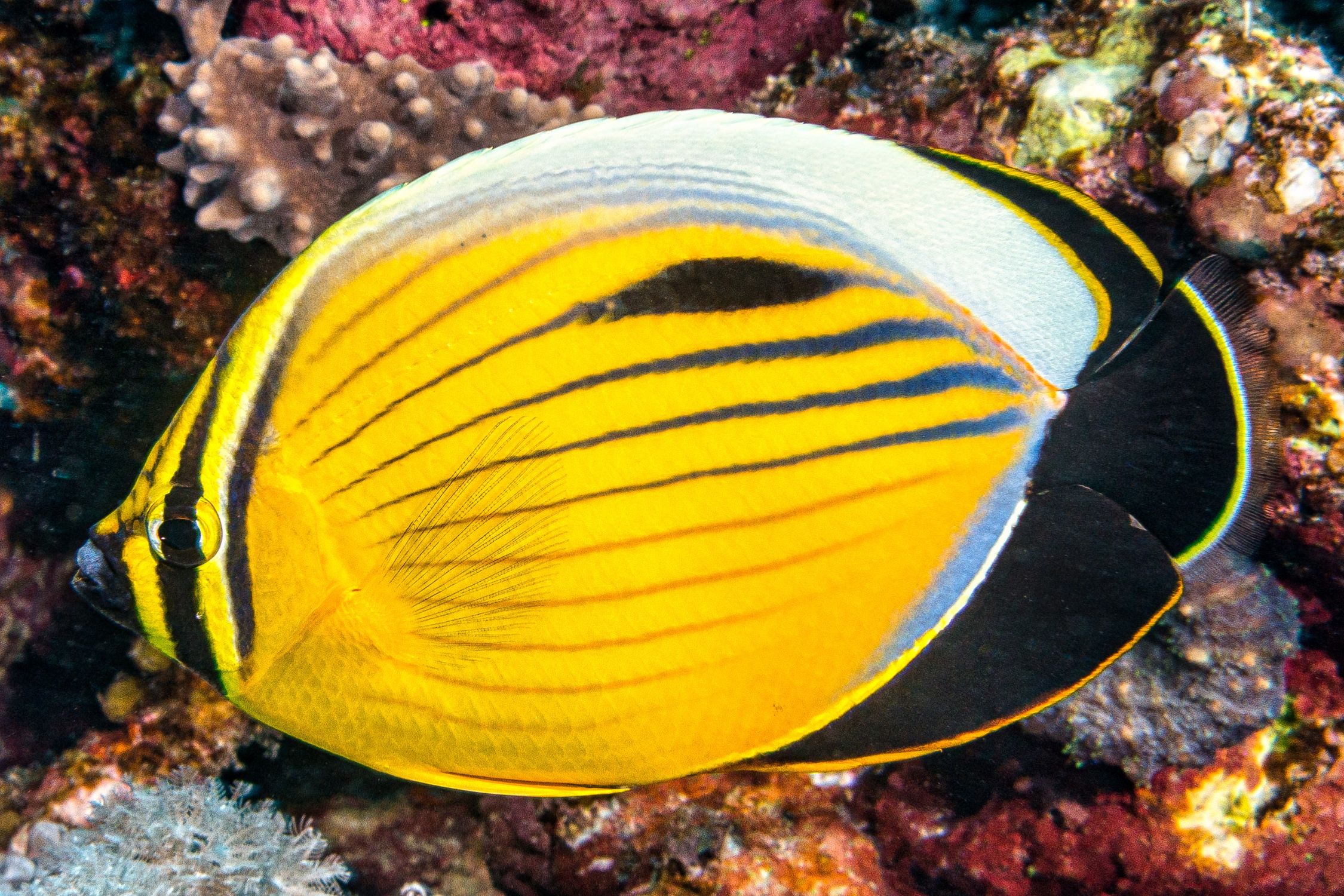
The blacktail butterflyfish inhabits the clear coral reefs of the Red Sea and the Gulf of Aden up to 20 meters deep. This obligate corallivore, recognizable by its black tail and dark lines, lives solitarily or in pairs. Its survival depends on the presence of Acropora and Porites corals.
Who is it?
Morphology
-
Average size10 cm
-
Maximum size12 cm
-
ShapeCircular
-
Patterndiagonal stripes
-
Average size10 cm
-
Maximum size12 cm
-
ShapeCircular
-
Patterndiagonal stripes
How to recognize This fish ?
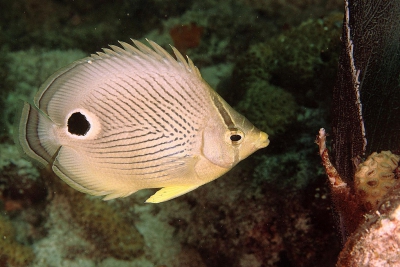
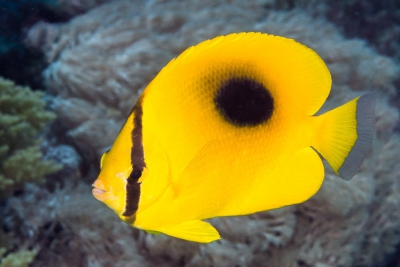
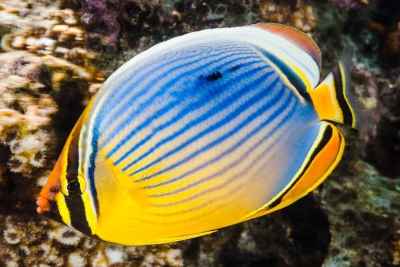
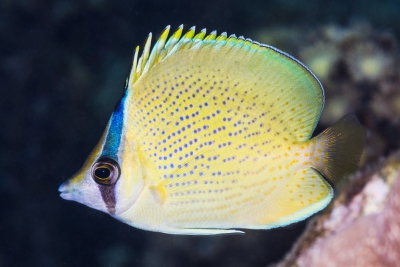
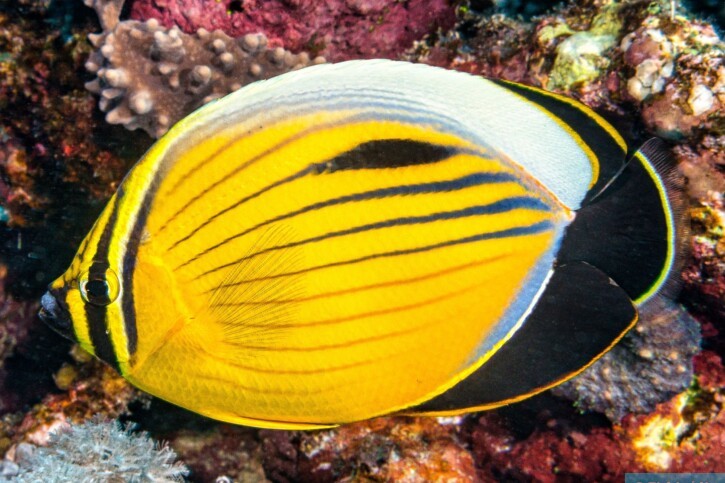
The body, laterally compressed and oval in shape, reaches a standard length of 110 mm (up to 12 cm total length). The coloration is characterized by an orange-yellow base with dark longitudinal lines, denser on the upper half, while the ventral region turns to pure orange.
The head features a black chin and two diagonal bands: a wide band crossing the eye and a finer one along the edge of the preoperculum. The dorsal fin, white, displays a black triangle bordered in yellow on its posterior margin.
The anal and caudal fins are black, the latter being rounded and adorned with a thin proximal yellow band followed by a distal transparent band. The pectoral and pelvic fins are yellow.
Behaviour & Life cycle
-
dietcorallivore
-
Sociabilityliving as a couple or alone
-
territorialNo
-
Way of livingdiurnal
The blacktail butterflyfish is territorial and is usually observed solitarily or in pairs. Juveniles exhibit specific behavior by exclusively inhabiting coral heads until reaching sexual maturity.
This species closely depends on the structural complexity of the reef and the abundance of corals to maintain its feeding territories. Faced with massive bleaching or food loss, the animal may alter its strict territorial behavior to undertake food search excursions, demonstrating plasticity in response to environmental stress.
This fish is an obligate corallivore, feeding mainly on coral polyps, with a marked preference for the Acropora, Pocillopora, and Porites genera. Additionally, it consumes gastropod eggs and anemones. Its feeding rate and spatial distribution directly correlate with the available living coral cover.
Reproduction
-
Reproductionovipare qui pond en eau libre
The species is oviparous and forms distinct pairs for reproduction. Fertilization is external, and the pelagic eggs are released into the water column. Sexual maturity coincides with the moment when juveniles leave their coral heads to enter larger reef areas.
Harmless species
This species does not represent any particular threats to humans when encountered in its natural environment.
Origin and distribution

Geographic distribution & Conservation
The native range covers the Red Sea, the Gulf of Aden, and extends eastward to the coast of Oman in the Arabian Sea. The IUCN status is "Least Concern" as the population appears vast and stable in its original range. However, this classification should not mask the species' sensitivity to the loss of living coral cover, which constitutes its major threat. Its long-term survival directly depends on the preservation of healthy coral reefs.
Conservation and international regulations
Where to see this species?

What is its habitat?
Natural environment characteristics
-
Temperature24 - 28 °C
-
Depth1 - 20 m
Biotope presentation
This species frequents coral-rich reefs and lagoons, requiring clear waters. It is present from the surface to about 20 meters deep. The species naturally avoids degraded or turbid areas unless major ecological constraints force it to adapt its diet.

To go further
Species of the same family
threeband pennantfish
Chaetodontidae
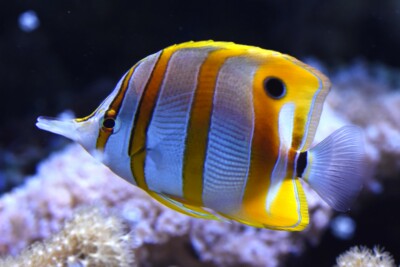
copperband butterflyfish
Chaetodontidae
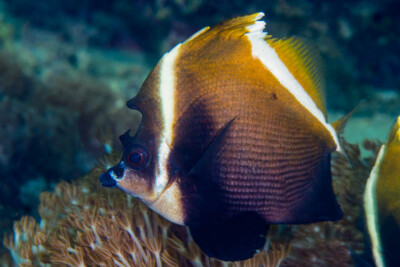
hunchbacked coralfish
Chaetodontidae
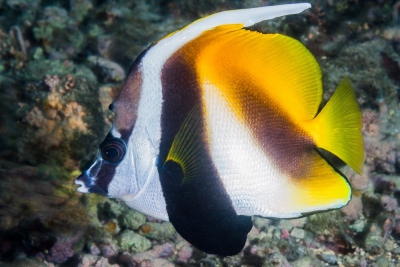
unicorn pennant coralfish
Chaetodontidae
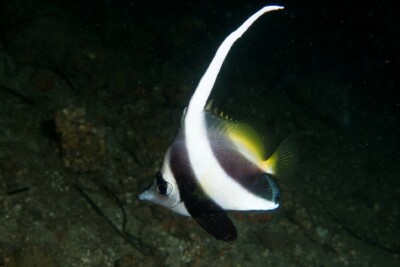
pennant coralfish
Chaetodontidae
long-nose butterflyfish
Chaetodontidae
red sea bannerfish
Chaetodontidae
high-fin butterflyfish
Chaetodontidae
Espèces du même genre
To read on the web


Sources & Contributions
Participation & Validation
The Fishipedia team and specialist contributors are committed to providing high-quality content. However, although the information comes from scientific sources or testimonials from specialists, the cards may contain inaccuracies.

Benoit Chartrer
Translation
Translation done with the valuable contribution of our translators, who make this information available to a wider audience. We sincerely thank them for their commitment.
Where to see this species?
Scientific partners




Species of the same family
threeband pennantfish
Chaetodontidae
copperband butterflyfish
Chaetodontidae
hunchbacked coralfish
Chaetodontidae
unicorn pennant coralfish
Chaetodontidae
pennant coralfish
Chaetodontidae
long-nose butterflyfish
Chaetodontidae
red sea bannerfish
Chaetodontidae
high-fin butterflyfish
Chaetodontidae
Same genus