
copperband butterflyfish
- Chaetodon rostratus
Chaetodon rostratus
- Chaetodon rostratus
| Family | Chaetodontidae |
|---|---|
| Genus | Chelmon |
| IUCN category (World) | LC |
Introduction
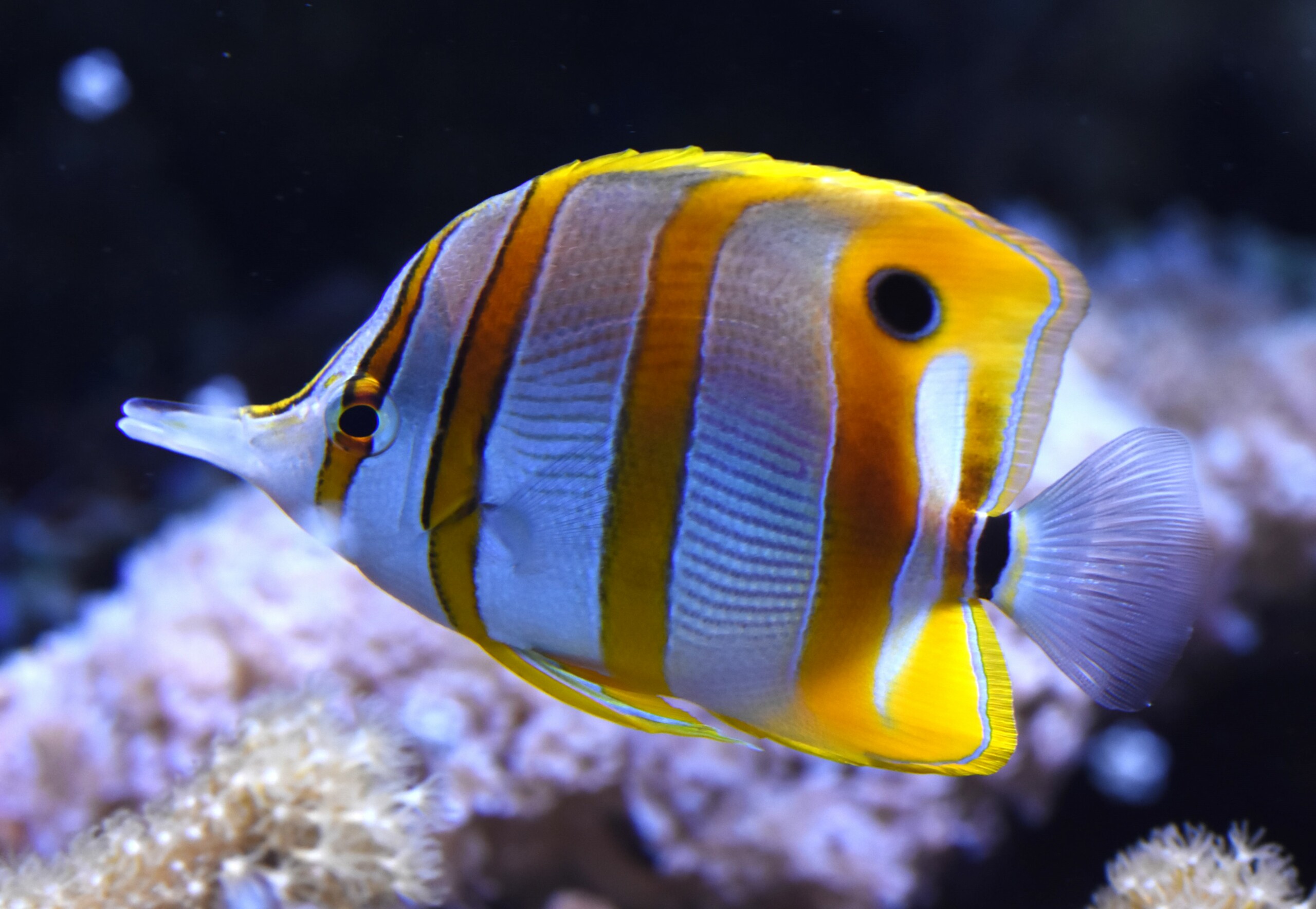
Copperband butterflyfish uses its elongated beak to hunt small prey between coral branches.
This species is regularly showcased to the public in public aquariums. Aside from its colors and atypical behavior, it is used as a cleaner to regulate populations of small anemones attacking corals.
Who is it?
Morphology
-
Average size15 cm
-
Maximum size20 cm
-
Longevity10 year
-
Patternvertical stripes
-
Average size15 cm
-
Maximum size20 cm
-
Longevity10 year
-
Patternvertical stripes
How to recognize This fish ?
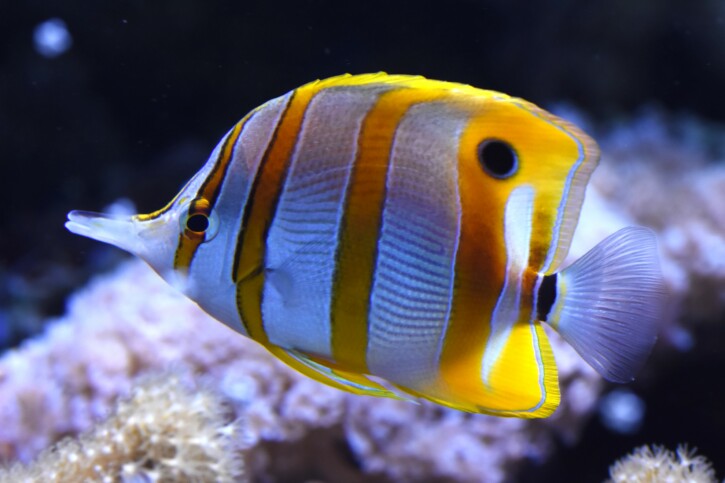
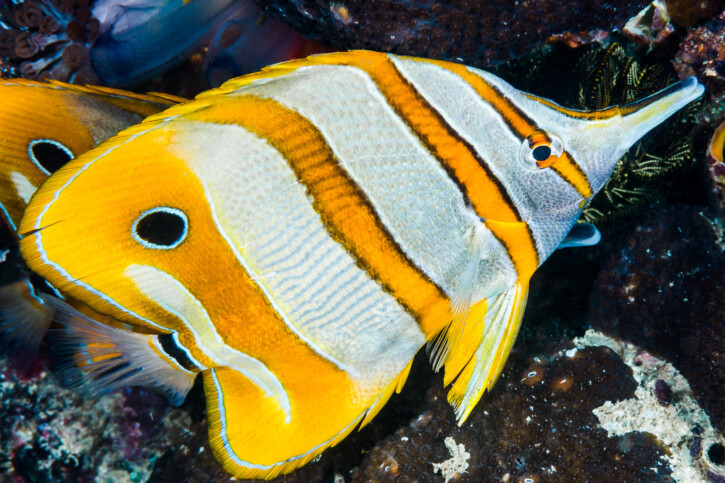
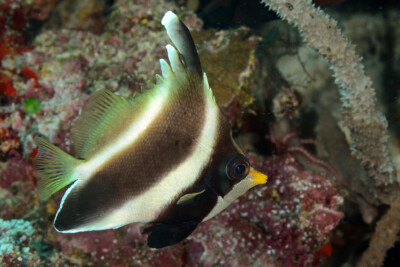
Chelmon rostratus measures between 15 and 20 cm. It is easily identifiable by its characteristic vertical yellowish stripes. The first, the thinnest, crosses the eye. The second is located at the front of the pectoral fins, the third, wider, is in the center of the body.
The rear of the body is entirely yellowish to orangish, with a white elongated spot on the flank in front of the caudal fin. At the base of the latter, there is a dark band surrounded by a white and bluish border.
Similar to its congener Chelmon muelleri, this species has a black spot surrounded by white at the back of the body. This spot mimicking an eye is used to deceive potential predators.
Sexual dimorphism
The dimorphism is very subtle. The males have a small bump on the snout and a more pronounced inclination than the females.
Behaviour & Life cycle
-
dietcarnivorous
-
Sociabilityliving as a couple or alone
-
territorialYes
-
Way of livingdiurnal
Chelmon rostratus is a fish that lives either in pairs or solitarily and naturally resides near the bottom. Sometimes slightly territorial, these butterflyfish hunt benthic organisms in coral-rich reef areas.
Reproduction
-
Reproductionovipare qui pond en eau libre
Chelmon rostratus is an oviparous fish that spawns in pairs in open water. Sexual maturity is reached at a size of 12 cm. Formed pairs lay an average of 55,000 eggs in the early morning two days in a row. The eggs hatch after 24 hours, and the larvae are then pelagic. By day 60, the individuals resemble adults and return to the reef.
Harmless species
This species does not pose a particular danger to humans if encountered in its natural habitat.
Origin and distribution
Geographic distribution & Conservation
This species is found in tropical reefs of the western Pacific Ocean, from the Andaman Sea to the Ryukyu Islands.
Conservation and international regulations
Where to see this species?




What is its habitat?
Natural environment characteristics
-
Temperature25 - 29 °C
-
Depth1 - 25 m
Biotope presentation
Copperband butterflyfish is most often found at depths less than 25m. However, it is not uncommon to find this species at other depths. It preferably frequents rocky coasts and coral reefs. It is also recorded in muddy reefs and estuaries.
Main recommendations for fishkeeping
Deontology
In order to preserve wildlife, if you acquire this animal, it must not be released into the wild. See also, the Fishipedia charter.
Fishipedia supports the practice of responsible and environmentally friendly aquarium keeping. We encourage maintenance if it is motivated by a desire to understand the biological functioning of living things and if it is done with respect for animal life.
We believe that aquaristics is an opening to the discovery of aquatic environments, especially freshwater, and that this knowledge is necessary to better protect and respect these environments. Logically, we refute the compulsive purchase of animals that would not find a sufficient and / or adapted place in the host aquarium.
Our recommendations
-
Min volume400 liters
-
Population min1
-
Temperature25 - 29 °C
-
pH (acidity)8.2 - 8.4
Characteristics
-
Difficulty breedingvery difficult
-
Robustnesssensible
-
Behaviourslightly aggressive
-
Availabilitystandard
General reminders
It is strongly advised to read the complete dedicated file and to get information on the feedbacks of maintenance of the envisaged animal, this to avoid any potential conflict whose end result is generally the death of the individual (or the other inhabitants). It is important not to overload your aquarium to limit pollution. This will make maintenance easier.
General reminder on maintenance datas
Le démarrage d'un aquarium est une partie primordiale pour l'équilibre et le bien-être des poissons. Lorsque l'on met en eau un aquarium, l'eau passe naturellement par un cycle biologique : le cycle de l'azote. Celui-ci dure environ trois semaines. Tous les 2 jours, nous vous conseillons de tester votre eau jusqu'à ce que le taux de nitrite soit à zéro pendant plusieurs jours d'affilée.
Pour accélérer ce cycle, vous pouvez utiliser un activateur de bactéries comme JBL Denitrol. Cette solution riche en bactéries vivantes et enzymes permet une mise en place rapide du cycle de l'azote. Les poissons peuvent alors être introduits plus rapidement.
Il est important de tester l'eau de son aquarium régulièrement pour maintenir un environnement sain pour les poissons et les autres habitants. Les tests d'eau permettent de mesurer les niveaux de différents paramètres tels que le pH, la dureté totale, ainsi que les taux de nitrates, de nitrites et d'ammoniaque.
Pour réaliser ces tests, vous pouvez utiliser des produits d'analyse spécialisés tels que JBL ProScan qui permet de réaliser un diagnostic de l'eau directement via un smartphone. Il existe également des coffrets de tests plus classiques de bandelettes, comme JBL PROAQUATEST.
En cas d’usage de l’eau du robinet, vous pouvez utiliser un conditionneur d’eau de type Biotopol de JBL pour éliminer les substances nocives comme le chlore, le cuivre, le plomb et le zinc. Une eau trop dure ou trop calcaire peut être inadaptée à de nombreuses espèces tropicales d’eau douce. Si nécessaire, vous pouvez la couper avec de l’eau osmosée ou de pluie filtrée afin d’obtenir une dureté plus adaptée aux besoins de vos poissons et de vos plantes. Les conditionneurs d'eau garantissent une meilleure santé aux poissons et une meilleure croissance des plantes.
Chlorine and chloramine are dangerous for the health of animals. Used to disinfect water, these agents are present in significant quantities in tap water. We recommend using an anti-chlorine agent every time you change the water. In addition to chlorine, treatments and medicines sold for aquarium use sometimes contain dangerous heavy metals in high doses.
Specific needs for the copperband butterflyfish
The copperband butterflyfish is a marine species which lives naturally at a temperature between 25 °C and 29 °C. The copperband butterflyfish is sensitive to abrupt changes in parameters as well as to chemicals. Its acclimation in an aquarium must be done with special care to prevent it from developing diseases or weaknesses. Nitrate levels should remain below 25mg/L. To keep the water clean and unpolluted, plan on changing 20% to 30% of the water volume each month. In seawater, it is also possible to remove nitrates using one of the following methods: Jaubert, denitrator on sulfur, biopeletts, vodka method.
The copperband butterflyfish is a species whose maintenance is rather reserved for informed aquarists . It can only be successfully carried out by carrying out a minimum of documentation work. Special husbandry conditions can easily lead to the death of the species or other animals.
Formal incompatibilities
Cohabitation & Environment
In a community aquarium context, this species should be kept in a minimum volume of 400 liters.
The copperband butterflyfish may show signs of aggression. In general, this species should not be mixed with large territorial species or other overly aggressive species, in order to avoid possible stress or even injury.
However, it can coexist with other species with a peaceful temperament and with some slightly territorial neighbors, as far as the volume of the aquarium allows. It is important to avoid that two territorial species share the same living area in an aquarium of insufficient volume. During the breeding season, this species defends its territory with more virulence. This behavior can weaken its shy neighbors.
Tips for feeding
The copperband butterflyfish is carnivorous.
This species can eat dry food (flakes, pellets), fresh food and frozen food. To avoid deficiencies, it is recommended to vary the types of food.
Feed animals in moderation to maintain good water quality. Meals should be eaten within 2–3 minutes, served in several small portions rather than a single large ration.
Uneaten food quickly decomposes, releasing ammonia, nitrites, and nitrates, which disturb the aquarium’s biological balance.
Make sure each species can access food properly, slower or bottom-dwelling individuals may require targeted feeding.Reproduction protocol
-
Spawning cleaningNo
-
egg-laying protectionNo
-
Fry protectionNo
Hybridization risks
In general, it is advised not to mix several species of the same genus or different varieties of the same species, to avoid the risks of hybridization.
These animals might interest you

To go further
Species of the same family
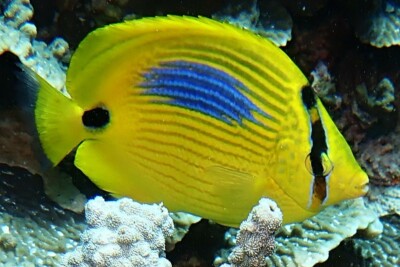
blueblotch butterflyfish
Chaetodontidae
lined butterflyfish
Chaetodontidae
black-backed butterflyfish
Chaetodontidae
triangulate butterflyfish
Chaetodontidae
raccoon butterflyfish
Chaetodontidae
oval-spot butterflyfish
Chaetodontidae
blackburn's butterflyfish
Chaetodontidae
criss-cross butterflyfish
Chaetodontidae
To read on the web

Partner websites






Sources & Contributions
Participation & Validation
The Fishipedia team and specialist contributors are committed to providing high-quality content. However, although the information comes from scientific sources or testimonials from specialists, the cards may contain inaccuracies.

Adrien Falzon

Benoit Chartrer
Translation
Translation done with the valuable contribution of our translators, who make this information available to a wider audience. We sincerely thank them for their commitment.

Marine Kassel
Bibliographic references
- GBIF — Chelmon rostratus
- iNaturalist — Chelmon rostratus
- Successfully Aquacultures the Copperband Butterflyfish, Chelmon rostratus — Dr. Cortney — Katie McCord — Morgan Bronson — Audrey Beany — Peter Woodward — John Marcellus — Rising Tide Conservation —
- Capture de proies chez les poissons-papillons à longue mâchoire (Chaetodontidae): la base fonctionnelle de nouvelles habitudes alimentaires — Lara A Ferry-Graham — Peter C Wainwright — David R Bellwood — Elsevier Ltd —
- La structure communautaire des poissons des récifs coralliens — G. R. C. Anderson — A. H. Ehrlich — P. R. Ehrlich — J. D. Roughgarden — B. C. Russellet — F. H. Talbot — The University of Chicago Press journals —
Where to see this species?
Scientific partners



Tags
Species of the same family
blueblotch butterflyfish
Chaetodontidae
lined butterflyfish
Chaetodontidae
black-backed butterflyfish
Chaetodontidae
triangulate butterflyfish
Chaetodontidae
raccoon butterflyfish
Chaetodontidae
oval-spot butterflyfish
Chaetodontidae
blackburn's butterflyfish
Chaetodontidae
criss-cross butterflyfish
Chaetodontidae


