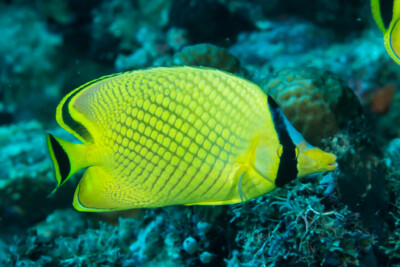
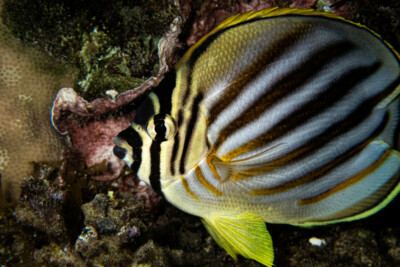
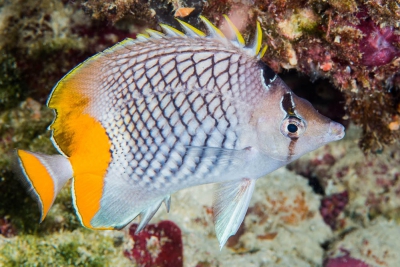
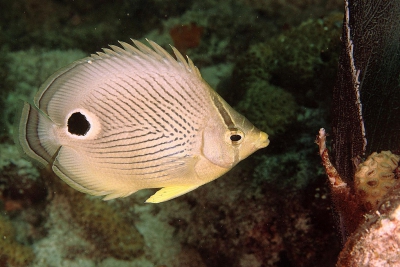
raccoon butterflyfish
| Family | Chaetodontidae |
|---|---|
| Genus | Chaetodon |
| IUCN category (World) | LC |
Introduction
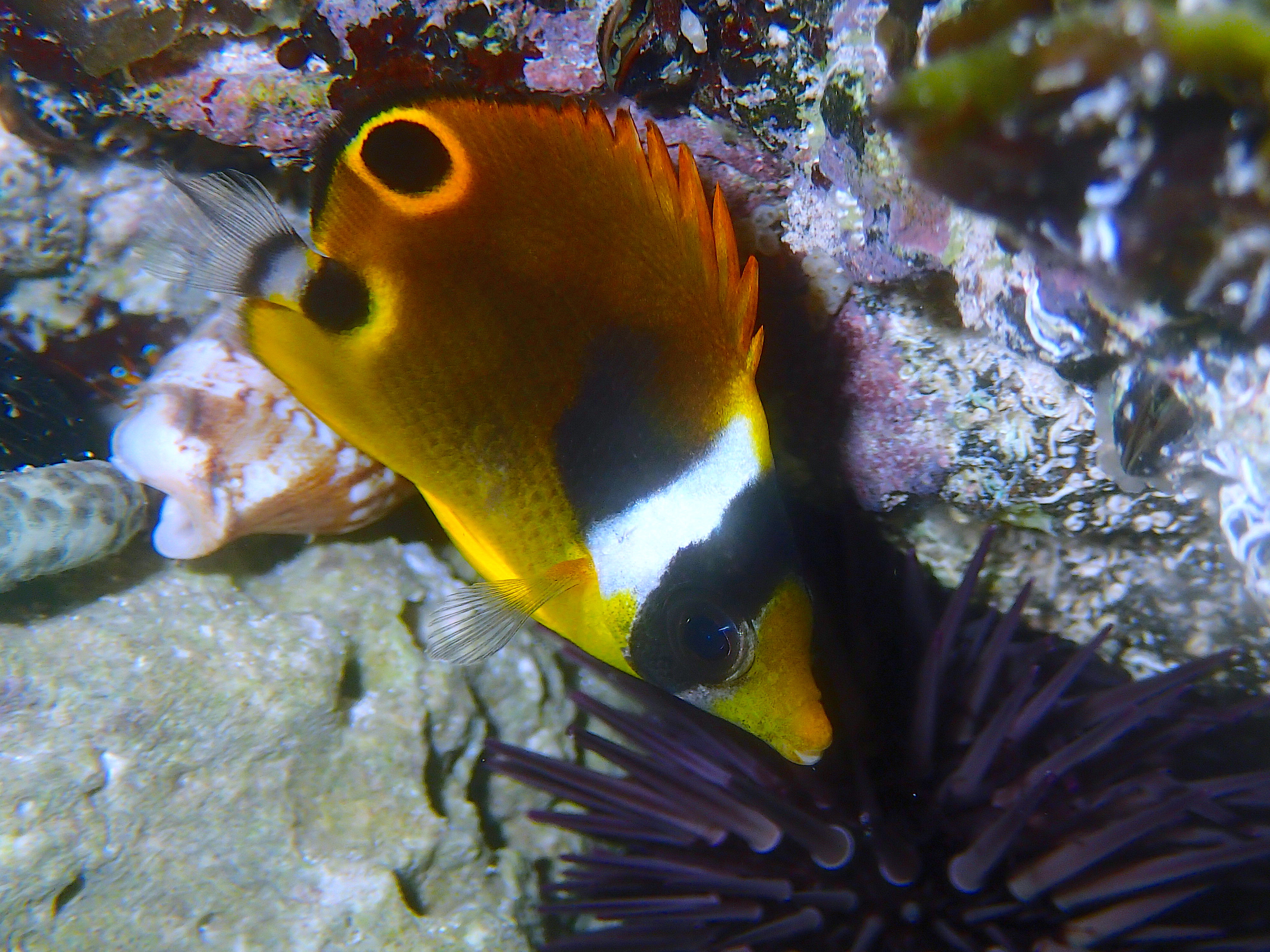
The raccoon butterflyfish (Chaetodon lunula) is a common species on coral reefs, found from the east of Africa (excluding the Red Sea) to the west of the Pacific Ocean, passing through Indonesia. Usually seen in pairs, it can also form large schools or associate with other butterflyfish.
Who is it?
Morphology
-
Average size17 cm
-
Maximum size20 cm
-
Longevity9 year
-
ShapeCircular
-
Patterndiagonal stripes
-
Average size17 cm
-
Maximum size20 cm
-
Longevity9 year
-
ShapeCircular
-
Patterndiagonal stripes
How to recognize This fish ?
Chaetodon lunula, like all butterflyfish, has a laterally compressed, disc-shaped body. Its snout is slightly pointed. It averages about fifteen centimeters in length, but some individuals can grow up to 20 cm.
As adults, the raccoon butterflyfish is bicolored with mainly yellow and brown patterns. It has a large black band over the eye followed by a white band, then several oblique black bands reaching the base of the dorsal fin. This species is also covered in fine black diagonal stripes. The peduncle of the caudal fin is black, and the fins are yellow.
Juveniles are also bicolored, mainly yellow and brown. Like the adults, they have a large black band over the eye followed by a white band. They have a black spot surrounded by a yellow border on the rear of the dorsal fin, which disappears in adulthood. The caudal fin is transparent with a black peduncle, and the pectoral fins are also transparent.
Sexual dimorphism
There are no visible differences between males and females in this species.
Behaviour & Life cycle
-
dietomnivorous with carnivorous tendency
-
Sociabilityliving as a couple or in a group
-
territorialNo
-
Way of livingdiurnal
The raccoon butterflyfish is a fish that lives in pairs or groups and naturally resides near the bottom. It has a rather lively temperament, constantly swimming among rocks and corals in search of food. Adults feed on nudibranchs, tube worms, algae, and coral polyps.
In general, it is an independent fish that does not pay much attention to other species.
Reproduction
-
Reproductionovipare qui pond en eau libre
The raccoon butterflyfish mostly lives in pairs, and reproduction is monogamous. During reproduction, the pair ascends to the surface and releases their gametes simultaneously. Occasionally, opportunistic males take advantage of this opportunity to release their sperm at the same time. Once fertilized, the eggs are carried away by the current. They hatch quickly, and the larvae are pelagic.
Harmless species
This species poses no specific danger to humans when encountered in its natural environment.
Origin and distribution
Geographic distribution & Conservation
This species is widely distributed in the Indo-Pacific, from the East African coast to the Hawaiian, Marquesas, and Ducie Islands, north to southern Japan, and south to Lord Howe and Rapa Islands. It is also found in the Southeast Atlantic, reported in East London, South Africa. Although localized declines have been observed, particularly in Moorea, French Polynesia, the species remains generally common and classified as of least concern.
Where to see this species?





What is its habitat?
Natural environment characteristics
-
Temperature23 - 27 °C
-
Depth0 - 170 m
-
FlowMedium
Biotope presentation
As adults, it frequents coral wall zones, sometimes venturing into lagoons. Juveniles seek refuge in the shallow waters of lagoons, often hiding among the branches of Acropora corals.
It is most commonly found between 0 and 170m in depth, but it can also be found at other depths.
To go further
Species of the same family
hunchbacked coralfish
Chaetodontidae
high-fin butterflyfish
Chaetodontidae
twospot coralfish
Chaetodontidae
long-nose butterflyfish
Chaetodontidae
unicorn pennant coralfish
Chaetodontidae
brushytoothed butterflyfish
Chaetodontidae
pennant coralfish
Chaetodontidae
schooling bannerfish
Chaetodontidae
Espèces du même genre
To read on the web


Sources & Contributions
Participation & Validation
The Fishipedia team and specialist contributors are committed to providing high-quality content. However, although the information comes from scientific sources or testimonials from specialists, the cards may contain inaccuracies.

Adrien Falzon

Pauline Gély
Translation
Translation done with the valuable contribution of our translators, who make this information available to a wider audience. We sincerely thank them for their commitment.

Marine Kassel
Where to see this species?
Scientific partners




Tags
#Chaetodontidae
#Chaetodon
#barrière de corail
#lagon
#Bay of Bengal
#Great Barrier Reef
#mer d'Oman
#Tasman Sea
#Philippine Sea
#Sea of Japan
#South East Asian Seas
#Indonesian seas
#East Indian Ocean
#western Indian Ocean
#Galapagos
#Western Tropical Pacific Ocean
#Bali
#Gili
#Réunion
#Lombok
#Nusa Penida
#Palawan Island
#French Polynesia
#Zanzibar Archipelago
Species of the same family
hunchbacked coralfish
Chaetodontidae
high-fin butterflyfish
Chaetodontidae
twospot coralfish
Chaetodontidae
long-nose butterflyfish
Chaetodontidae
unicorn pennant coralfish
Chaetodontidae
brushytoothed butterflyfish
Chaetodontidae
pennant coralfish
Chaetodontidae
schooling bannerfish
Chaetodontidae
Same genus