orchid dottyback
| Family | Pseudochromidae |
|---|---|
| Genus | Pseudochromis |
| IUCN category (World) | LC |
Introduction
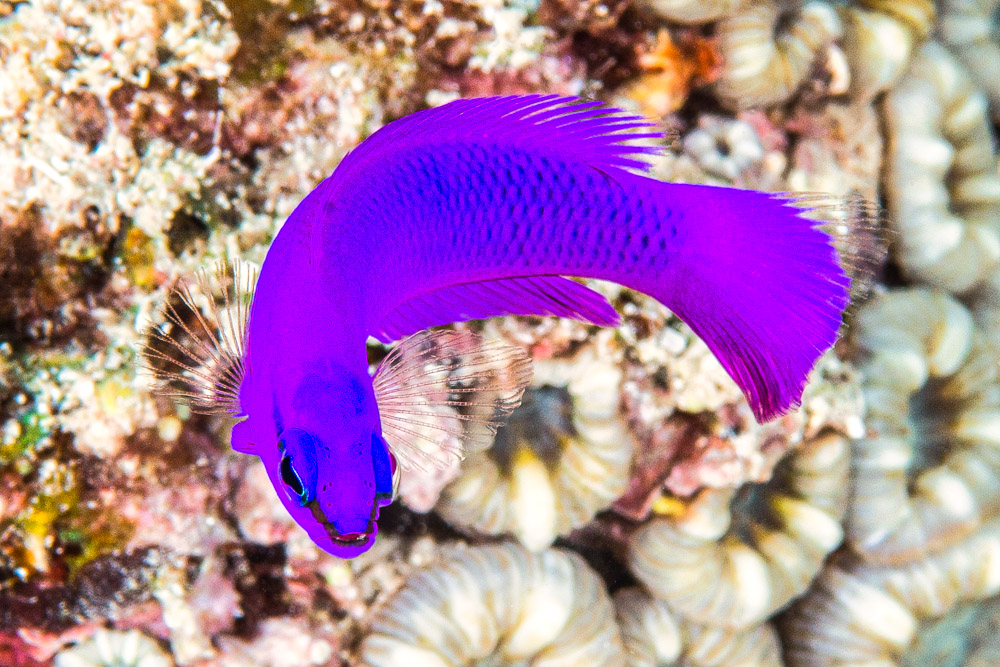
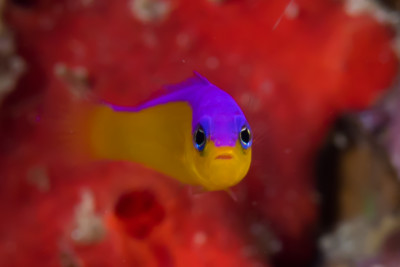
The orchid dottyback is a small reef fish endemic to the Red Sea. Belonging to the Pseudochromidae family, which has the highest level of endemism in the region, this species is a cryptobenthic mesopredator essential to the dynamics of coral reefs. It inhabits the shallow areas of coral reefs less than sixty meters deep.
Who is it?
Morphology
-
Average size5 cm
-
Maximum size6.3 cm
-
Average size5 cm
-
Maximum size6.3 cm
How to recognize This fish ?
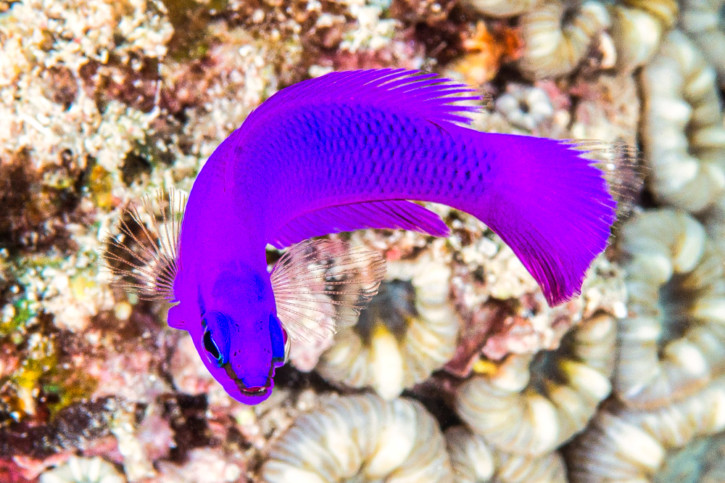
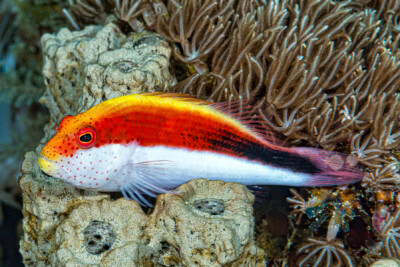
The adult reaches a maximum standard length of 5 cm. The body is laterally compressed, typical of fish inhabiting vertical reefs. The coloration ranges from deep purple to electric blue, with a distinctive black longitudinal line through the eye, a characteristic of the genus. The fins are rounded and the same color as the body. In the larval stage, the species is slender and lightly pigmented. The metamorphosis and the appearance of cycloid scales covering the trunk occur around 10.3–11.5 mm, when the preopercular spines disappear.
Sexual dimorphism
Although dimorphism is not very visible in young fish, the fin shape differs between adults. The male has a less rounded fin than the female, which tends towards a lanceolate fin.
Behaviour & Life cycle
-
dietcarnivorous
-
Sociabilitysolitary
-
territorialNo
-
Way of livingdiurnal
The orchid dottyback is a benthic species confined to the vertical walls of reefs and coral overhangs. It is usually found solitary or in discreet small groups, quickly seeking refuge in crevices when in danger. Larvae have active swimming abilities influencing their dispersal.
Unlike other pseudochromes in the Red Sea like P. flavivertex (dominated by copepods) or P. olivaceus, P. fridmani shows a marked trophic specialization for mollusks. Stomach content analyses indicate that over 50% of its diet consists of mollusks, especially bivalves and gastropods. Crustaceans (copepods, amphipods) make up the remaining dietary supplement. This distinct feeding niche reduces interspecific competition with other sympatric species.
Reproduction
-
Reproductionovipare qui pond sur substrat caché
The species is oviparous and deposits demersal eggs grouped in a spherical mass of about 1-2 mm in diameter, typical of the family. Hatching occurs after 4-5 days, releasing swimmer larvae around 2.5-4.5 mm in size.
Larval development is well-documented in captivity. Metamorphosis and recruitment on the reef occur around 12 mm in total length, after approximately 21 days in the pelagic phase. Fin growth (dorsal, anal, pectoral) follows a precise sequence, with complete formation of soft rays around 8.4-9.2 mm.
Harmless species
This species does not pose a particular threat to humans if encountered in its natural habitat.
Origin and distribution
Geographic distribution & Conservation
Pseudochromis fridmani is endemic to the Red Sea, ranging from the gulfs of Aqaba and Suez (north) to the Farasan Islands (south). It has never been observed beyond latitude 15°N (absent in Yemen and Djibouti). The species is common in the shallow waters of the Gulf of Aqaba (Eilat, Israel) and southern Sinai (Egypt). Although heavily exploited for the aquarium trade, it is not specifically evaluated by the IUCN, but its geographical restriction and dependence on reef wall habitats make it potentially vulnerable to local coral reef degradation.
Conservation and international regulations
Where to see this species?


What is its habitat?
Natural environment characteristics
-
Temperature22 - 26 °C
-
Depth1 - 60 m
Biotope presentation
This species exclusively inhabits coral reefs, with a strong preference for vertical faces (outer slopes) and overhangs providing shelter. It is found at depths ranging from 1 to 30 meters, with possible reports up to 60 meters. The presence of complex structures (branching corals, caves) is essential for its territorial behavior and protection against predators. Larvae develop in the pelagic zone before settling on these same reef habitats.

Main recommendations for fishkeeping
Deontology
In order to preserve wildlife, if you acquire this animal, it must not be released into the wild. See also, the Fishipedia charter.
Fishipedia supports the practice of responsible and environmentally friendly aquarium keeping. We encourage maintenance if it is motivated by a desire to understand the biological functioning of living things and if it is done with respect for animal life.
We believe that aquaristics is an opening to the discovery of aquatic environments, especially freshwater, and that this knowledge is necessary to better protect and respect these environments. Logically, we refute the compulsive purchase of animals that would not find a sufficient and / or adapted place in the host aquarium.
Our recommendations
-
Min volume60 liters
-
Population minnot specified
-
Temperature22 - 26 °C
-
pH (acidity)8.2 - 8.4
Characteristics
-
Difficulty breedingmoderate
-
Behaviourmoderately aggressive
General reminders
It is strongly advised to read the complete dedicated file and to get information on the feedbacks of maintenance of the envisaged animal, this to avoid any potential conflict whose end result is generally the death of the individual (or the other inhabitants). It is important not to overload your aquarium to limit pollution. This will make maintenance easier.
General reminder on maintenance datas
Le démarrage d'un aquarium est une partie primordiale pour l'équilibre et le bien-être des poissons. Lorsque l'on met en eau un aquarium, l'eau passe naturellement par un cycle biologique : le cycle de l'azote. Celui-ci dure environ trois semaines. Tous les 2 jours, nous vous conseillons de tester votre eau jusqu'à ce que le taux de nitrite soit à zéro pendant plusieurs jours d'affilée.
Pour accélérer ce cycle, vous pouvez utiliser un activateur de bactéries comme JBL Denitrol. Cette solution riche en bactéries vivantes et enzymes permet une mise en place rapide du cycle de l'azote. Les poissons peuvent alors être introduits plus rapidement.
Il est important de tester l'eau de son aquarium régulièrement pour maintenir un environnement sain pour les poissons et les autres habitants. Les tests d'eau permettent de mesurer les niveaux de différents paramètres tels que le pH, la dureté totale, ainsi que les taux de nitrates, de nitrites et d'ammoniaque.
Pour réaliser ces tests, vous pouvez utiliser des produits d'analyse spécialisés tels que JBL ProScan qui permet de réaliser un diagnostic de l'eau directement via un smartphone. Il existe également des coffrets de tests plus classiques de bandelettes, comme JBL PROAQUATEST.
En cas d’usage de l’eau du robinet, vous pouvez utiliser un conditionneur d’eau de type Biotopol de JBL pour éliminer les substances nocives comme le chlore, le cuivre, le plomb et le zinc. Une eau trop dure ou trop calcaire peut être inadaptée à de nombreuses espèces tropicales d’eau douce. Si nécessaire, vous pouvez la couper avec de l’eau osmosée ou de pluie filtrée afin d’obtenir une dureté plus adaptée aux besoins de vos poissons et de vos plantes. Les conditionneurs d'eau garantissent une meilleure santé aux poissons et une meilleure croissance des plantes.
Chlorine and chloramine are dangerous for the health of animals. Used to disinfect water, these agents are present in significant quantities in tap water. We recommend using an anti-chlorine agent every time you change the water. In addition to chlorine, treatments and medicines sold for aquarium use sometimes contain dangerous heavy metals in high doses.
Specific needs for the orchid dottyback
The orchid dottyback is a marine species which lives naturally at a temperature between 22 °C and 26 °C. Nitrate levels should remain below 50mg/L. To keep the water clean and unpolluted, plan on changing 20% to 30% of the water volume each month. In seawater, it is also possible to remove nitrates using one of the following methods: Jaubert, denitrator on sulfur, biopeletts, vodka method.
The breeding of this species is accessible on condition of being well informed about its needs in aquarium . Any cohabitants must be chosen with care to avoid the loss of animals.
Cohabitation & Environment
In a community aquarium context, this species should be kept in a minimum volume of 60 liters.
Tips for feeding
The orchid dottyback is carnivorous.
This species can eat dry food (flakes, pellets), fresh food and frozen food. To avoid deficiencies, it is recommended to vary the types of food.
Feed animals in moderation to maintain good water quality. Meals should be eaten within 2–3 minutes, served in several small portions rather than a single large ration.
Uneaten food quickly decomposes, releasing ammonia, nitrites, and nitrates, which disturb the aquarium’s biological balance.
Make sure each species can access food properly, slower or bottom-dwelling individuals may require targeted feeding.Reproduction protocol
-
egg-laying protectionYes
Hybridization risks
In general, it is advised not to mix several species of the same genus or different varieties of the same species, to avoid the risks of hybridization.
These animals might interest you
To go further








Sources & Contributions
Participation & Validation
The Fishipedia team and specialist contributors are committed to providing high-quality content. However, although the information comes from scientific sources or testimonials from specialists, the cards may contain inaccuracies.
Translation
Translation done with the valuable contribution of our translators, who make this information available to a wider audience. We sincerely thank them for their commitment.

Benoit Chartrer
Bibliographic references
- GBIF — Pseudochromis fridmani
- iNaturalist — Pseudochromis fridmani
- Captive reproduction and embryonic development of the Orchid Dottyback (Pseudochromis fridmani) — Tânia Araújo — Catarina Mendes — Fábio Miranda — Catarina Manuel — Fábio Samouco — João Chambel — Paulo Maranhão — Marine and Environmental Sciences Centre, Portugal —
Where to see this species?
Scientific partners




Tags
Species of the same family