barred shovelnose catfish
| Family | Pimelodidae |
|---|---|
| Genus | Pseudoplatystoma |
| IUCN category (World) | LC |
Introduction
Pseudoplatystoma fasciatum, sometimes called Barred Shovelnose Catfish, is a large freshwater catfish living in South America. Like some congeners, it is called 'Bagre rayado' or 'Pintadillo' in Spanish-speaking countries, 'Pintado' in Brazil.
This species seems to be present in a wide range: the basins of the Guianas, the Amazon, the Orinoco and the Paraná River. In several regions, it is possible that certain 'varieties' actually correspond to other species, described or not.
This fish is one of the top predators in its environment. It has significant economic value for local fishing communities. There is also a market for ornamental fish, but the impact on populations is unknown. However, captures for the aquarium trade likely represent a tiny part of total catches compared to commercial and subsistence fishing. Despite the importance of this species for the quality of the environment and populations, few studies exist on the health status of populations to date.
Who is it?
Morphology
-
Type
-
Average size80 cm
-
Maximum size90 cm
-
Longevity12 year
-
Patterntasks
-
Type
-
Average size80 cm
-
Maximum size90 cm
-
Longevity12 year
-
Patterntasks
How to recognize This fish ?
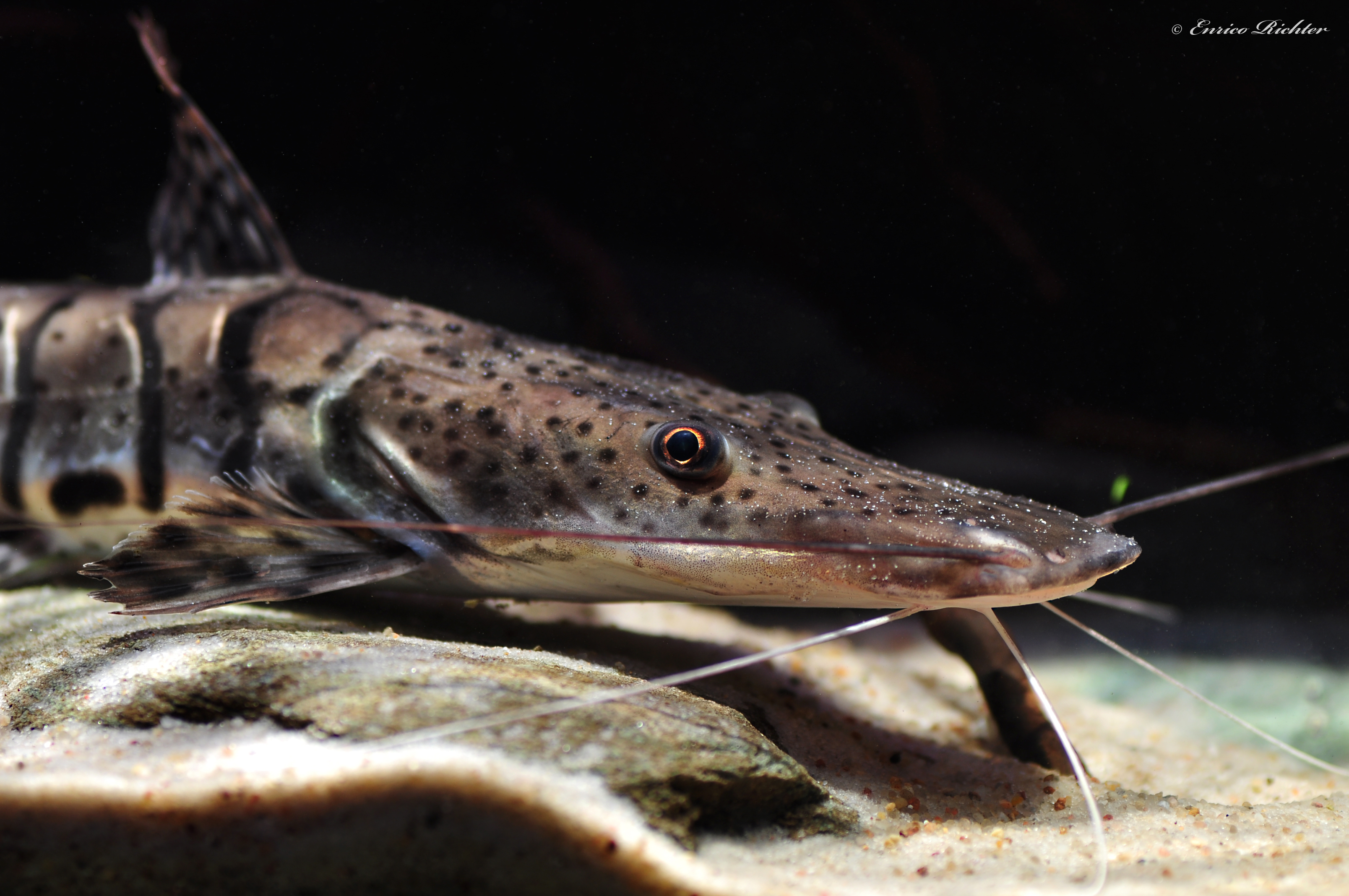
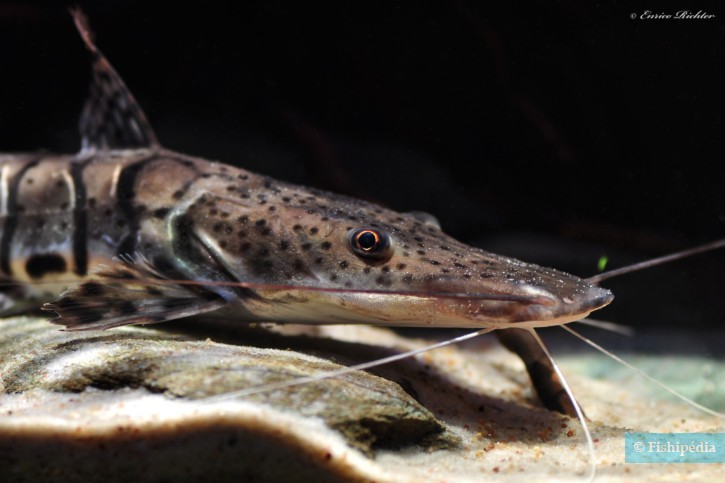
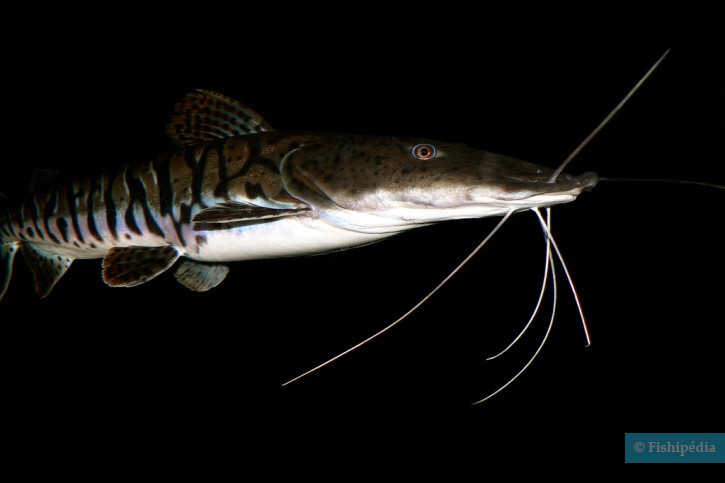
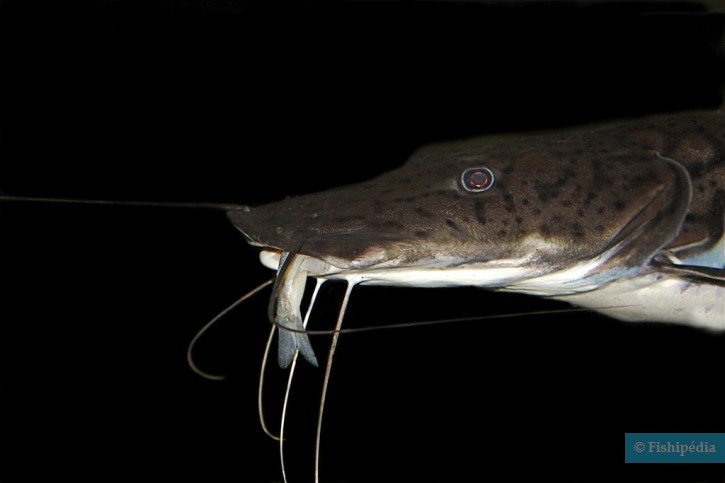
This fish has the particularity to possess several pairs of barbels, which allow him to search the bottom and to detect the food thus moved.
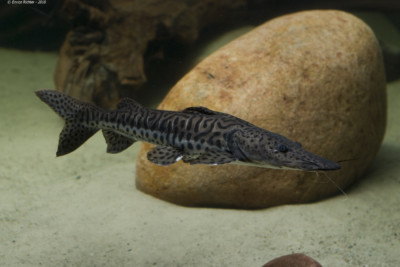
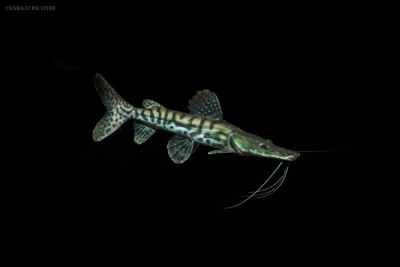
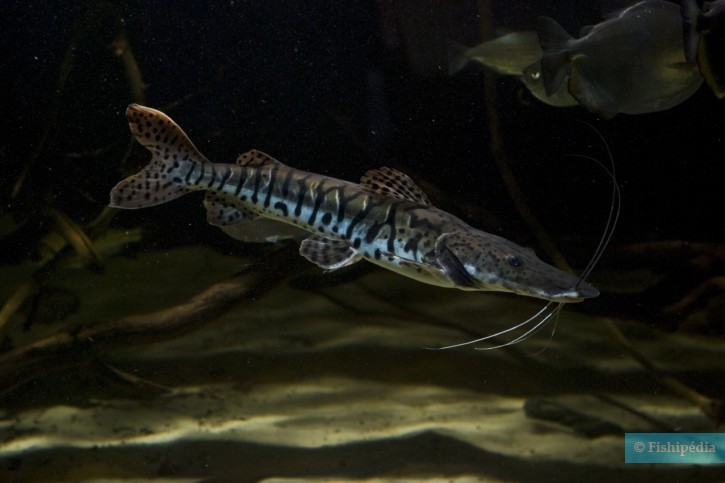
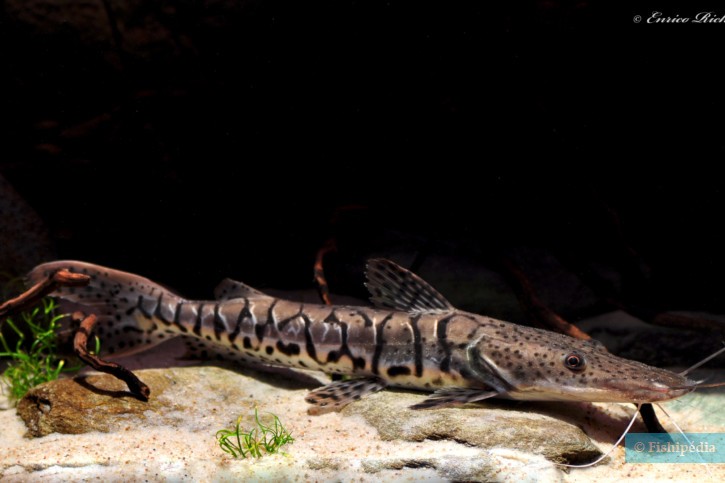
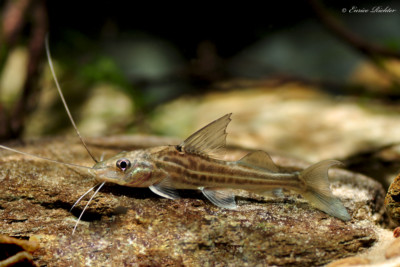
Like its congeners, P. fasciatum has a long, flat head, with a triangular profile. The lower jaw is short, the rostrum flattened. The anterior edge of the mouth is covered with thick skin. All fins are brownish to golden, a color close to that of the flanks above the lateral line. They are also speckled with black.
In adults, the abdomen is white. The entire body is covered with stripes, vertical bars, and imperfect black spots. The flanks are also characterized by the presence of shorter vertical white bars than black ones.
The maxillary barbels are very long and extend beyond the pelvic fins.
Subspecies are sometimes mentioned, their statuses seem to be validated:
- P. fasciatum brevifile
- P. fasciatum nigricans
- P. fasciatum intermedium
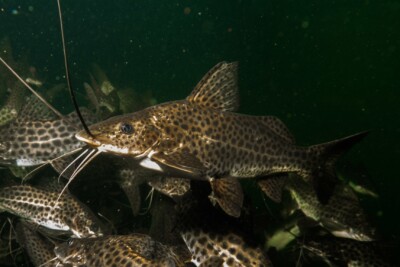
A form from Villa Tunari, in the Andes, is presented as P. fasciatum although its pattern is covered with oval or round tricolored spots, which probably corresponds to another species.
P. fasciatum is distinguished from its close congener P. orinocoense by its less long and less regular vertical bars. In P. trigrinum, the vertical white bars are absent and the black bars are distinctly more sinuous.
Sexual dimorphism
Females are larger and can reach 110 centimeters. Males rarely exceed 90 centimeters.
The coloration seems very similar regardless of gender.
Behaviour & Life cycle
-
dietcarnivorous
-
Sociabilityliving in a group or alone
-
territorialNo
-
Way of livingdiurnal
The barred shovelnose catfish hunts by ambush and is part of the predators in its biotope. It frequents riverbeds and sometimes flooded forest areas. It seems to appreciate dark areas provided with vegetal shelters (tree trunks, aquatic plants).
Up to 40 centimeters, it hunts various food sources and then becomes exclusively piscivorous. It particularly preys on armored catfish, cichlids, and characids. Most of its activity takes place at dusk and dawn. It is less nocturnal than its congener P. tigrinum.
It was once considered a migratory fish as it followed its prey, which were themselves migratory. Some individuals move opportunistically during the year. Different individuals seem to tolerate each other.
Reproduction
-
Reproductiondont le mode de reproduction est encore inconnu
The barred shovelnose catfish is a fish whose reproductive mode is poorly known. The female reaches sexual maturity at an average of 56 centimeters, the male at 45 centimeters. The estimated fecundity is significant, with several million eggs per kilogram.
Reproduction takes place from late November to early January, when the waters are warmest. Eggs are laid in flooded areas without additional care or parental guard.
Harmless species
This species does not present any particular danger to humans if encountered in its natural environment.
Origin and distribution
Geographic distribution & Conservation
The type locality comes from the Suriname River (Mees, 1974). According to Bleeker, this species is found only in the Guianas, including the Essequibo and Corantijn basins.
It is possible that it is also present in the Orinoco and Amazon. In-depth studies on populations should be carried out to confirm this. Populations once classified under P. fasciatum have ultimately been raised to species level, such as P. reticulatum, recorded in the Amazon and Paranà River.
Conservation and international regulations
Where to see this species?



What is its habitat?
Natural environment characteristics
-
Temperature24 - 28 °C
-
pH (acidity)6 - 8
-
gh (hardness)4 - 30
-
FlowMedium and Slow
Biotope presentation
The barred shovelnose catfish appreciates areas characterized by a strong presence of vegetation in which it camouflages itself to hunt. During the rainy season, it frequents flooded forests characterized by particularly acidic black waters. Outside of this period, it lives in riverbeds.
Fishkeeping
Not recommended
We do not recommend keeping this species in an aquarium. It has unpredictable needs which, if not met, generate significant stress, potentially leading to a shorter life expectancy, an interruption of its growth or the development of pathogens.
To go further
Species of the same family
Espèces du même genre
To read on the web

Sources & Contributions
Participation & Validation
The Fishipedia team and specialist contributors are committed to providing high-quality content. However, although the information comes from scientific sources or testimonials from specialists, the cards may contain inaccuracies.

Benoit Chartrer
Translation
Translation done with the valuable contribution of our translators, who make this information available to a wider audience. We sincerely thank them for their commitment.

Marine Kassel
In collaboration with : Estudios Amazónicos - Urku
Bibliographic references
- GBIF — Pseudoplatystoma fasciatum
- iNaturalist — Pseudoplatystoma fasciatum
- Biologie de Pseudoplatystoma fasciatum et P. tigrinum (Teleostei: Pimelodidae) dans le bassin du Mamoré (Amazonie Bolivienne) — Gérard Loubens — Jacques Panfili — Ichthyol. Explor. Freshwaters —
- Taxonomy of the catfish genus Pseudoplatystoma Bleeker (Siluriformes: Pimelodidae) with recognition of eight species — Brooks M. Burr — URIEL ANGEL BUITRAGO–SUÁREZ — ZOOTAXA —
Where to see this species?
Scientific partners




Species of the same family
Same genus