
Introduction
The jaguar is the largest feline in the Americas and the only current representative of the genus Panthera in the New World. Historically present from the southwest United States to northern Argentina, its range now covers only 51% of its original territory. Classified as 'Near Threatened' by the IUCN, the species has experienced a decline of 20-25% in its mature individuals over the past three generations. Internationally, jaguar trade is strictly regulated by the CITES Convention (Appendix I / A), categorizing it as an endangered species.
The species has total protection in France: its naturalization, transportation, sale, and trade are prohibited throughout the national territory, with specific export restrictions from French Guiana where it remains present.
Who is it?
Morphology
-
Size170 - 183 cm
-
Weight80 - 113 kg
-
Motiftasks
-
Mimicryplants
-
Size170 - 183 cm
-
Weight80 - 113 kg
-
Motiftasks
-
Mimicryplants
How to recognize This mammal ?
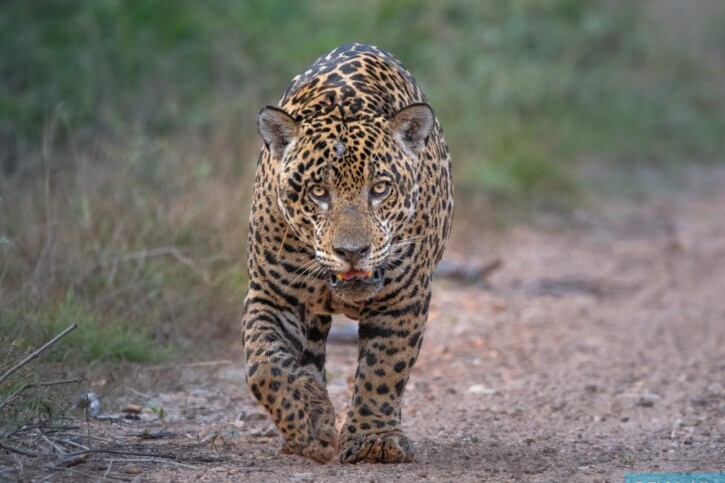
The jaguar has a sturdy, muscular body, with a shoulder height ranging from 69 to 79 cm and a body length varying from 147 to 183 cm. Adult weight typically ranges between 50 and 80 kg, although individuals can reach up to 113 kg in regions with abundant prey.
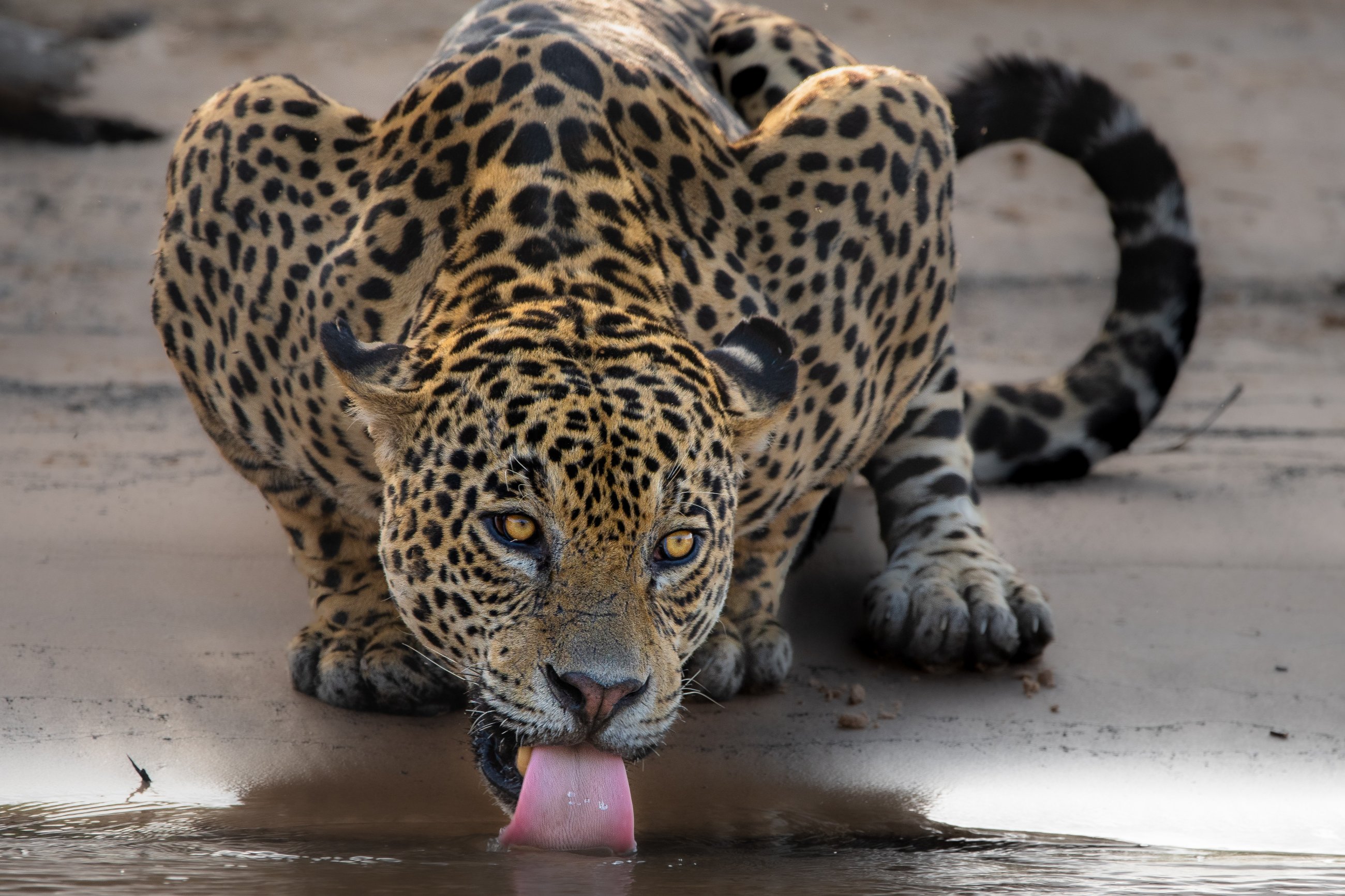
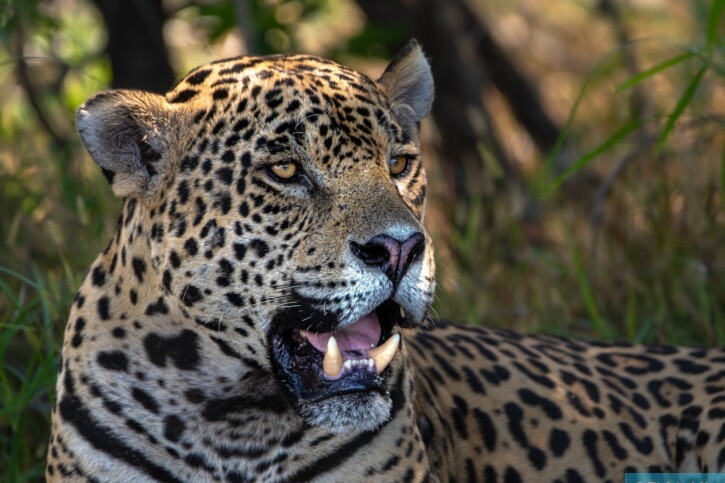
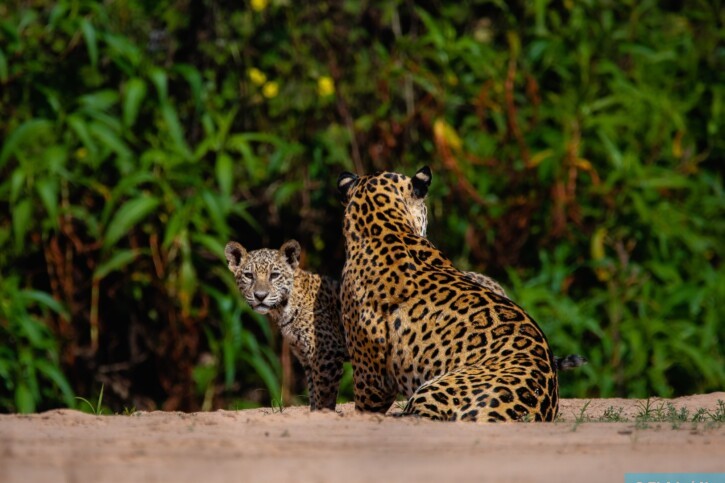
At birth, cubs weigh between 0.7 and 0.9 kg. The coat, ranging from light yellow to orange beige, is adorned with black rosettes known as ocelli. On the flanks, these ocelli are open and often contain one or more black spots at their center, a distinctive pattern. The rump, belly, head, and tail bear solid spots, while the belly and inner flanks are white.
A melanistic form, entirely black, also exists; in these individuals, the spots remain visible in contrast under bright light.
Taxonomically, although up to nine subspecies were historically described (such as P. o. onca from Brazil, P. o. peruviana from Peru, P. o. hernandesii from Mexico, P. o. centralis from Costa Rica, P. o. arizonensis from the United States, or P. o. paraguensis from Paraguay), recent genetic and morphological research no longer justifies this differentiation.
The 2017 revision of Felid taxonomy now considers the jaguar as a monotypic species, without valid subspecies, with observed variations simply reflecting local adaptations north to south. Two fossil subspecies, Panthera onca augusta and Panthera onca mesembrina, are also recognized.
Sexual dimorphism
In addition to differences in size and weight, where males are significantly larger, dimorphism is expressed by the extent of home ranges. Males cover much greater distances than females, with their territories often encompassing those of several females. Telemetry studies indicate that males disperse over longer distances than females upon emancipation.
Behaviour & Life cycle
-
dietcarnivorous
-
Sociabilityliving in a group or alone
-
territorialYes
-
Way of livingdiurnal
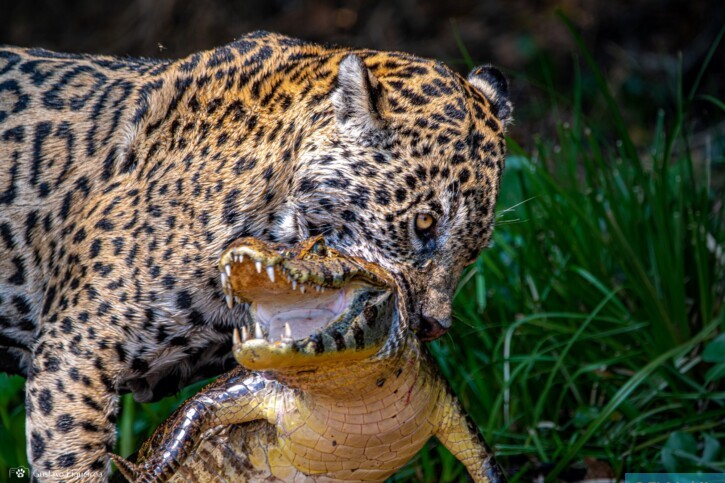
The jaguar is a solitary and opportunistic hunter, a strict carnivore whose diet includes over 85 species of prey. It mainly consumes large ungulates but adapts its strategy to local resources: in Costa Rica, it preys on peccaries, white-tailed deer, two-toed sloths, or coatis. In coastal areas like Tortuguero and Santa Rosa National Parks, marine turtles form a significant part of its diet. As the only large feline capable of crushing caiman shells, it often hunts them by grabbing them by the neck to pull them out of the water and devour them on the shore.
This feline has a unique relationship with water, demonstrating exceptional swimming abilities. In 2024, biologists documented a male jaguar crossing a 2.3-kilometer artificial reservoir in Brazil, setting a record six times longer than the previous one from 1932. This ability explains the presence of genetically healthy populations on isolated islands and suggests that jaguars make occasional crossings to maintain connectivity between fragmented populations.
Territories vary significantly depending on habitat and sex. In South America, they typically range from 30 to 250 km². Preliminary results in French Guiana indicate even greater variability, from 50 to 450 km², with males consistently occupying larger territories than females. The maximum observed reproductive longevity in the wild is 13 years for a female. Sexual maturity is reached between 24 and 30 months for females and 36 to 48 months for males.
Reproduction
-
Reproductionvivipare
Reproduction can occur at any time of year. The female is receptive for 6 to 17 days, and gestation lasts from 91 to 101 days, usually resulting in the birth of two cubs (up to four) weighing 0.7 to 0.9 kg. Newborns rely exclusively on maternal milk for 10 to 11 weeks, and mothers continue nursing for 5 to 6 months, staying with them until 24 months. The interval between births is about two years in the wild. The generation length is calculated at 6.84 years.
Risks for humans
-
VenomousNo
-
BiteYes
Contrary to the widespread perception that jaguar attacks are rare, a comprehensive compilation of cases in the Brazilian Amazon from 1950 to 2025 reveals 84 confirmed incidents. The majority of victims are adult men active in remote rural areas, with most attacks occurring during daylight.
Incidents are evenly split between provoked attacks (often by domestic dogs) and unprovoked attacks (sometimes predatory, targeting children). The presence of dogs increases the risk of provocation but significantly improves the chances of survival for victims. Out of the 84 attacks, 12 were fatal for humans, but the jaguar was killed in nearly half of the cases in retaliation, illustrating how fear and local reprisals directly threaten population viability.
Origin and distribution
Geographic distribution & Conservation
The historical range of the jaguar extended from the southwest United States (where some stray individuals persist near the Mexican border) to the Rio Negro in Argentina. Today, its current Extent of Occurrence is estimated at 9.02 million km², but the species actually occupies only 51% of its historical territory, compared to an estimated 46% in 2002. The main stronghold of the species is in the tropical forest of the Amazon Basin, which accounts for 57% of its total range. The jaguar has virtually been eliminated from the drier northern parts of its range, including Arizona, New Mexico, northern Sonora state in Mexico, northern Brazil, the pampas and scrublands of Argentina, as well as all of Uruguay.
Population viability varies significantly across regions. Areas with a high probability of survival (70% of the current range, over 6 million km²) mainly include the Amazon Basin, the Pantanal, the Gran Chaco, the Selva Maya (Guatemala, Mexico, Belize), and the Choco-Darien region (Panama, Colombia, Honduras). Areas with a medium probability (18% of the range, 1.6 million km²) include the northern Cerrado, the Venezuelan and Colombian llanos, Colombia's Caribbean coast, the highlands of Costa Rica and Panama, southern Mexico, and the Mexican sierras (Sierra de Tamaulipas, Sierra Madre Oriental). Areas with a low probability of survival (12% of the range), considered conservation priorities, encompass the Brazilian Atlantic forest and Cerrado, some parts of the Argentine Chaco, the Gran Sabana (Brazil, Venezuela, Guyana), the dry coastal forests of Venezuela, and the remaining fragments in Central America and Mexico.
Population densities fluctuate depending on habitat and protected areas. In Mexico, density ranges from 0.75 to 6 adults/100 km², with a national population estimated between 4,000 and 5,000 individuals in 2011; the Selva Maya population is estimated at 2,000 individuals, while the La Lacandona ecosystem counts between 62 and 168 individuals. Northern and central Mexico populations are increasingly isolated. In Central America, densities range from 0.74 to 11.2 individuals/100 km², higher in humid forests and national parks. The Belizean Selva Maya shows densities of 7.5 to 8.8 individuals/100 km², and the Cockscomb Basin Sanctuary from 3.5 to 11.0 individuals/100 km². The populations in the Talamanca mountains (Costa Rica, Panama) and protected areas in Guatemala, Honduras, and Nicaragua are under high pressure. In South America, the Brazilian Pantanal presents densities of 6.6 to 11.7 individuals/100 km². Bolivian Amazonia shows 2.8 individuals/100 km², and Colombian Amazonia between 2.5 and 4.5 individuals/100 km². Densities decrease in drier or fragmented habitats: 2 individuals/100 km² in the Brazilian Cerrado, 3.5 in the Caatinga, 2.2 in the Atlantic forest (where the subpopulation is estimated at only 200 ± 80 adults), and between 2.2 and 5 in the Bolivian Gran Chaco. The populations in the Argentine Chaco and Brazilian Caatinga are low-density and threatened by livestock.
It is important to note that many density estimates prior to 2010 are positively biased due to inadequate sampling, rendering past assessments overly optimistic. A recent analysis of 34 isolated subpopulations reveals that 97% of them meet 'Critically Endangered' (25 subpopulations) or 'Endangered' (8 subpopulations) criteria. Only the vast Amazon subpopulation, housing approximately 89% of the total global population (57,000 individuals out of an estimated total of 64,000), is considered to be of 'Least Concern'.
Conservation and international regulations
What is its habitat?
Natural environment characteristics
-
Temperature5 - 30 °C
-
FlowMedium, Slow and Stagnant
Biotope presentation
The jaguar occupies a wide range of habitats, favoring humid tropical forests and wetlands but also found in savannas and dry forests. Its presence is consistently associated with the proximity of water sources. The species' ability to swim long distances allows it to cross hydroelectric reservoirs or estuaries. While reported up to 3,000 meters in altitude, it generally avoids mountain forests and high plateaus.
To go further
To read on the web
Sources & Contributions
Participation & Validation
The Fishipedia team and specialist contributors are committed to providing high-quality content. However, although the information comes from scientific sources or testimonials from specialists, the cards may contain inaccuracies.

Benoit Chartrer
Translation
Translation done with the valuable contribution of our translators, who make this information available to a wider audience. We sincerely thank them for their commitment.
Benoit Chartrer
Scientific partners



Tags


