
Introduction
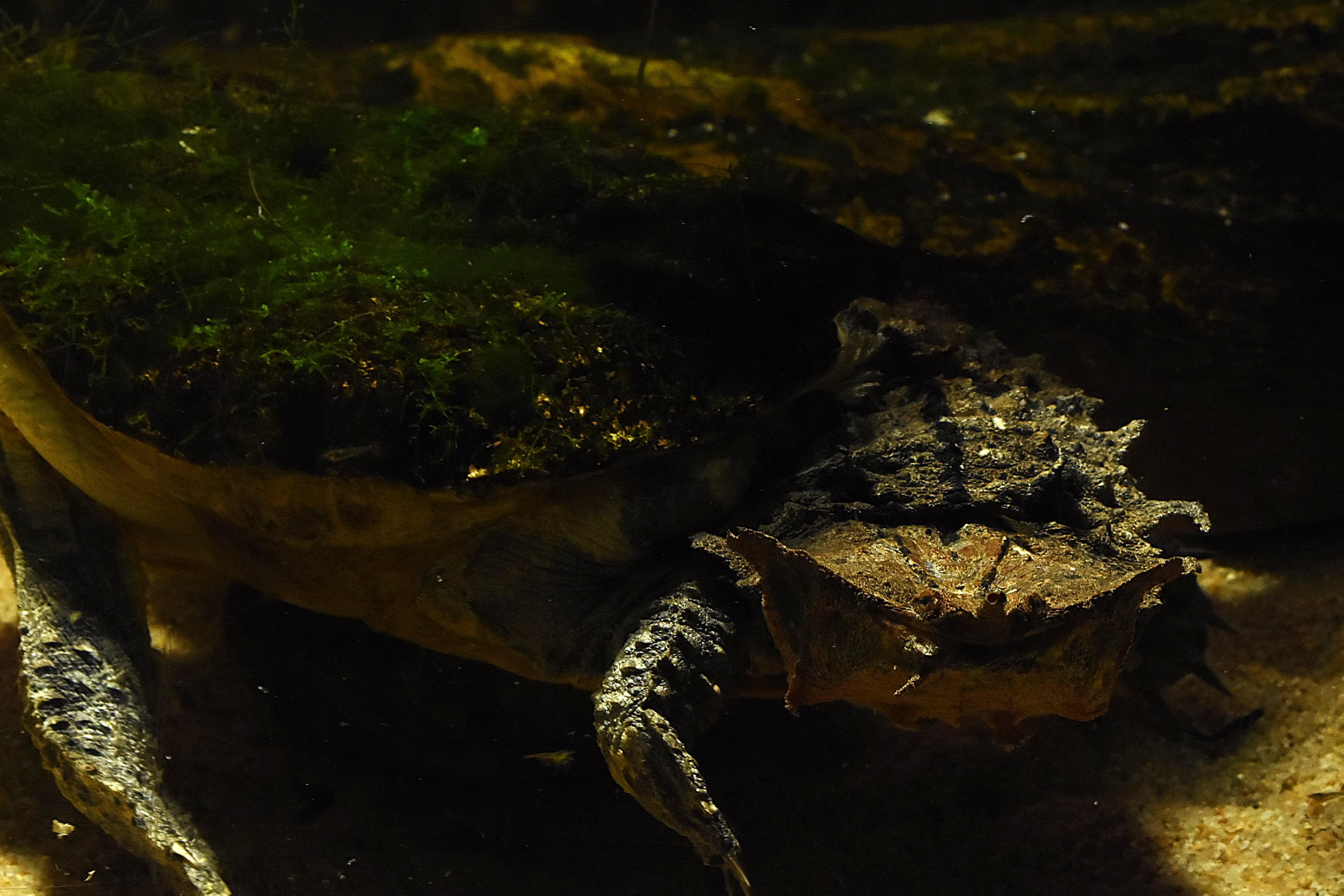
Chelus fimbriata, commonly known as the Amazonian Matamata or Leaf Turtle, is a freshwater turtle species belonging to the Chelidae family.
Formerly thought to cover the entire Amazon and Orinoco basins, its distribution range was restricted by genetic studies in 2020: C. fimbriata is now native to the Amazon basin (Brazil, Peru, Bolivia, Ecuador, Guyanas) and the Mahury drainage in French Guiana, while populations in the Orinoco basin and Venezuelan/Colombian Llanos belong to the sister species Chelus orinocensis.
An oviparous and strictly aquatic species, it is renowned for its prehistoric appearance and hunting technique by suction.
Who is it?
Morphology
-
Type
-
Size40 - 50 cm
-
Mimicryplants
-
Type
-
Size40 - 50 cm
-
Mimicryplants
How to recognize This reptile ?
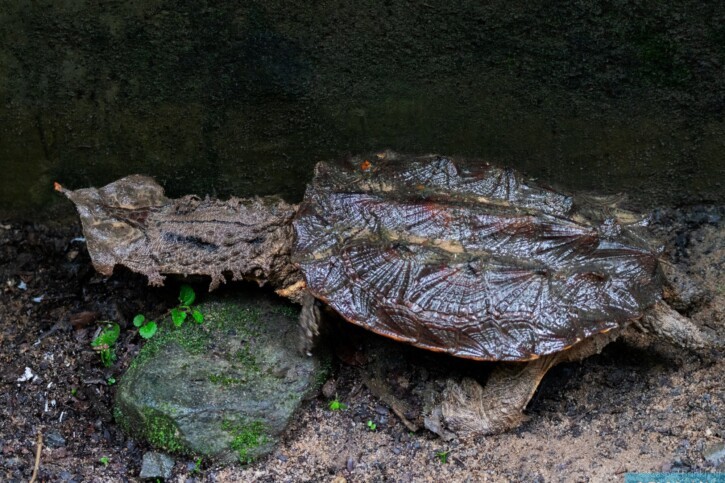
The Amazonian Matamata is one of the most easily recognizable turtles, with a flat, triangular, and rough shell resembling a dead leaf or piece of bark.
Its color ranges from dark brown to grayish, allowing for perfect camouflage in dark waters. The head is wide, triangular, and depressed, with an elongated tubular snout and numerous skin projections (barbels) on the neck and jaw that mimic aquatic vegetation. The eyes are small and located on top of the head.
The plastron is reduced, cream to brownish in color, leaving the limbs largely visible. In terms of size, an exceptional record was documented in 2006 on the Apure River (Venezuela): a live female measured 50.2 cm in median midline length (MML), 52.6 cm in total shell length, with a total animal length of 83 cm and a weight of 17.7 kg. Although this specimen comes from the distribution range of C. orinocensis, it illustrates the growth potential of the genus, with C. fimbriata commonly reaching 40-45 cm.
Sexual dimorphism
Females are much larger and heavier than males, with an almost flat plastron. Males, smaller, have a longer and thicker tail at the base, as well as a slightly concave plastron that facilitates mating. The females' tail is short and slender.
Behaviour & Life cycle
-
Sociabilitysolitary
-
Way of livingnocturnal
-
VenomousNo
-
Dietpredator
The Amazonian Matamata is an exclusively aquatic turtle, extremely slow and disinclined to move on land. It spends the majority of its time immobile on the bottom or floating just below the surface. Its activity is predominantly nocturnal and crepuscular; although it may remain in a hunting position during the day, its movements and prey suction attempts intensify at dusk and dawn.
Solitary, it does not form any structured groups, and individuals only tolerate each other during the breeding season or when concentrated in refuge areas during the dry season.
Its behavior is based on passive mimicry: it rests on mud or beds of dead leaves, sometimes allowing itself to be naturally covered by sedimentation, but without actively seeking to bury itself.
Although it can hold its breath for long periods due to a slow metabolism, it must resurface to breathe atmospheric air. It does so discreetly, taking advantage of darkness to maintain its camouflage.
Its hunting technique is unique: the sudden opening of its tubular mouth creates a powerful vacuum that sucks in water and prey in a fraction of a second.
To repel predators, it can expel the contents of its cloaca, releasing a foul odor.
Reproduction
-
Reproductionovipare
-
Clutch size0 - 0 eggs
Reproduction is oviparous and seasonal, closely linked to river flood cycles. In the Amazon basin, breeding occurs from August to November, during the water receding period.
Females dig rudimentary nests in sandy banks or sometimes lay eggs directly on the ground. Clutch sizes range from 5 to 28 eggs depending on the regions. Incubation lasts several months, and hatching, which occurs between July and October, generally coincides with the rising waters.
Harmless species
The species is completely harmless to humans. Lacking an aggressive biting force (its mouth is adapted for suction, not tearing), it poses no danger.
Origin and distribution
Geographic distribution & Conservation
Chelus fimbriata is endemic to the Amazon basin (Brazil, Peru, Bolivia, Ecuador, Colombia, Guyanas) and the Mahury drainage. It has been accidentally introduced in Florida (USA). The species is currently not considered globally threatened, although it is sometimes captured for the exotic animal trade or locally for its meat (which is not highly prized).
Conservation and international regulations
Where to see this species?

What is its habitat?
Natural environment characteristics
-
Temperature24 - 28 °C
-
pH (acidity)5 - 7
-
FlowSlow and Stagnant
Biotope presentation
The Amazonian Matamata inhabits stagnant fresh waters or very slow currents: marshes, oxbow lakes, flooded forest lakes, and rivers with black or clear waters. It favors muddy bottoms rich in decomposing organic matter and dense vegetation, where its camouflage is optimal.
It avoids strong currents and open waters as it requires dense vegetation cover for ambush hunting. It is unable to actively swim in open water and instead walks on the bottom or uses limited leg movements to travel.
To go further
To read on the web
Sources & Contributions
Participation & Validation
The Fishipedia team and specialist contributors are committed to providing high-quality content. However, although the information comes from scientific sources or testimonials from specialists, the cards may contain inaccuracies.

Benoit Chartrer
Translation
Translation done with the valuable contribution of our translators, who make this information available to a wider audience. We sincerely thank them for their commitment.
Where to see this species?
Scientific partners




Tags


