
Giant South American Turtle
| Family | Podocnemididae |
|---|---|
| Genus | Podocnemis |
| IUCN category (World) | NE |
Introduction
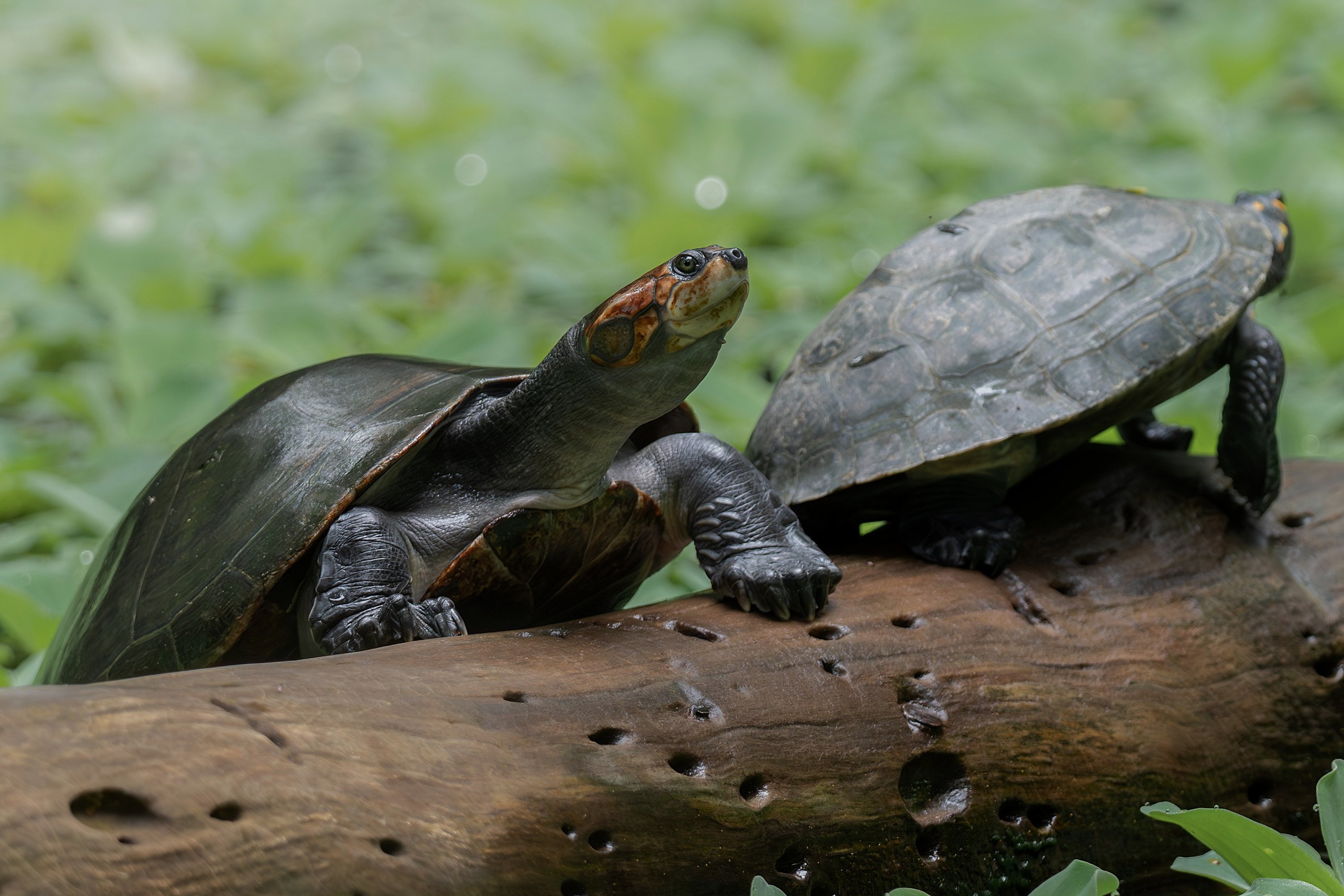
The Giant South American Turtle, also known as the Arrau Turtle, is the largest freshwater turtle in South America. Once widespread in the Amazon and Orinoco basins, the species has seen a drastic decline in numbers over the past two centuries due to human overexploitation. Experts recommend listing this species as 'Endangered' due to the fragmentation of its populations.
Who is it?
Morphology
-
Type
-
Size70 - 80 cm
-
Mimicryplants
-
Type
-
Size70 - 80 cm
-
Mimicryplants
How to recognize This reptile ?
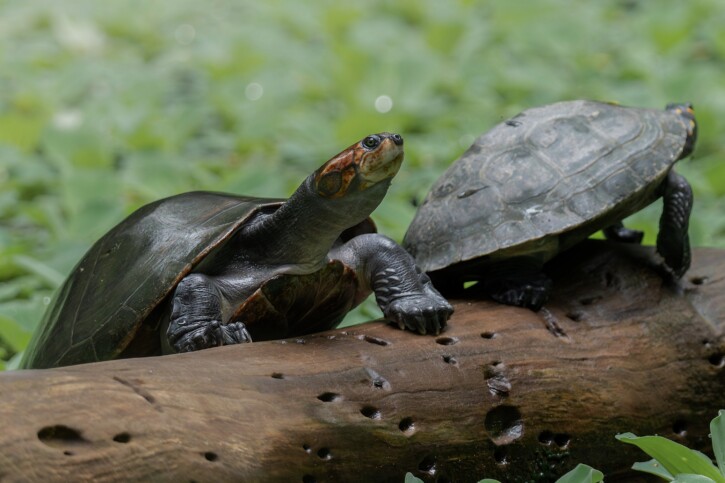
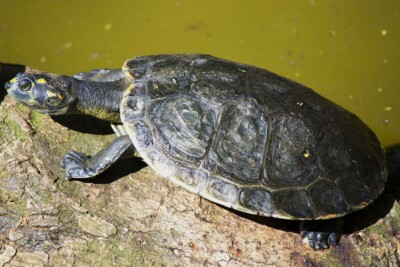
This turtle has a wide, domed shell designed for active swimming in moderate currents. Its coloration ranges from olive green to brown, often modified by algae attached to the scales. Its long neck retracts horizontally inside the shell, leaving part of the head visible, distinguishing it from turtles with a vertically retracting 'S'-shaped neck.
Sexual dimorphism
The size difference between the sexes is very pronounced in this species. Females are significantly larger, with an average carapace length of 64 to 71 cm and width of 43 to 55 cm, weighing between 15 to 46 kg, reaching up to 65 kg for larger specimens over 80 cm. Adult males remain more modest, measuring on average 40 to 50 cm long and 30 to 38 cm wide.
Behaviour & Life cycle
-
Sociabilitygregarious
-
Way of livingdiurnal
-
VenomousNo
-
Dietgrazer
A social animal, the Giant South American Turtle lives in groups and undertakes massive migrations, numbering in the thousands, from flooded forests to sandy beaches during the breeding season. It is active during the day in the water, with peak activity in the late morning and afternoon, while females exclusively lay eggs at night. Outside the breeding season, the species feeds during the day.
Primarily herbivorous, it closely follows the flood cycle. During high water season, it feeds in flooded forests, lagoons, and swamps, consuming fruits, tree seeds, legumes, and green leaves. It supplements this plant-based diet by ingesting freshwater sponges, eggs, and sometimes acts as a scavenger by consuming dead fish.
Newborns appear to have a more omnivorous diet initially before their digestive system fully adapts to herbivory. During the breeding period, females almost completely stop feeding.
Reproduction
-
Reproductionovipare
-
Clutch size0 - 0 eggs
Reproduction is synchronized with the hydrological cycle: nesting occurs during the dry season when water levels are low, on elevated sandy beaches often reused year after year. Females dig flask-shaped nests 60 to 80 cm deep and deposit between 78 and 132 spherical eggs with parchment shells, although lower averages are sometimes observed.
Incubation lasts 45 to 48 days in sand reaching 60°C on the surface, with temperature determining the sex of the hatchlings (more females at higher temperatures), and hatching coincides with the beginning of the rainy season, guided by maternal aquatic vocalizations.
Harmless species
The species poses no aggressive risk to humans. It is described as shy and elusive out of the water, immediately diving at the slightest disturbance.
Origin and distribution
Geographic distribution & Conservation
The distribution range of the species covers most of the Amazon and Orinoco basins, including Bolivia, Ecuador, Colombia, Brazil, Peru, Guyana, and Venezuela, with occasional sightings in Trinidad and Tobago during exceptional floods.
The main threat remains human overexploitation, particularly the massive collection of eggs and hunting of adults for meat and oil, exacerbated by deforestation, pollution, and the construction of hydroelectric dams.
Despite severe historical decline, beach protection and hatchling release programs, conducted by several governments and organizations, have stabilized or increased some local populations, while the species is listed on CITES Appendix II to regulate international trade.
Conservation and international regulations
Where to see this species?

What is its habitat?
Natural environment characteristics
-
Temperature25 - 30 °C
-
FlowMedium and Slow
Biotope presentation
The Giant South American Turtle inhabits the tropical freshwater of large rivers, lakes, lagoons, and flooded forests, tolerating moderate currents. It closely depends on the flood cycle: during the high water season, it feeds in flooded forests and swamps consuming fruits, seeds, legumes, and green leaves, supplementing its herbivorous diet with freshwater sponges, eggs, or fish carrion. Water temperature in its natural habitat is tropical, averaging between 26 and 30°C, becoming warmer during the nesting season on exposed sandy beaches.
To go further
To read on the web
Sources & Contributions
Participation & Validation
The Fishipedia team and specialist contributors are committed to providing high-quality content. However, although the information comes from scientific sources or testimonials from specialists, the cards may contain inaccuracies.

Benoit Chartrer
Translation
Translation done with the valuable contribution of our translators, who make this information available to a wider audience. We sincerely thank them for their commitment.
Where to see this species?
Scientific partners




Tags


