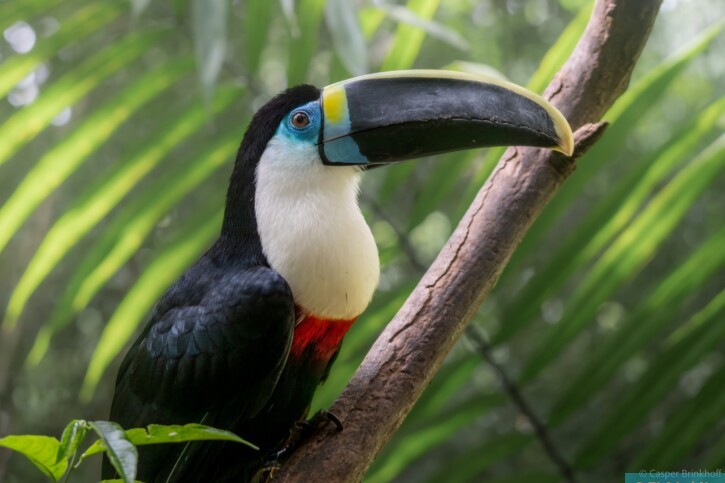
red-billed toucan
| Family | Ramphastidae |
|---|---|
| Genus | Ramphastos |
| IUCN category (World) | LC |
Introduction
The red-billed toucan (Ramphastos tucanus) is a large iconic bird of the tropical forests of South America, belonging to the Ramphastidae family.
Although described as common throughout its range, which extends from Venezuela and Colombia to Bolivia and eastern Brazil, its populations are experiencing a continuous decline due to accelerated deforestation in the Amazon basin, pressure from hunting for local consumption, and intensive trapping for the international trade of pets.
Who is it?
How to recognize This Bird ?
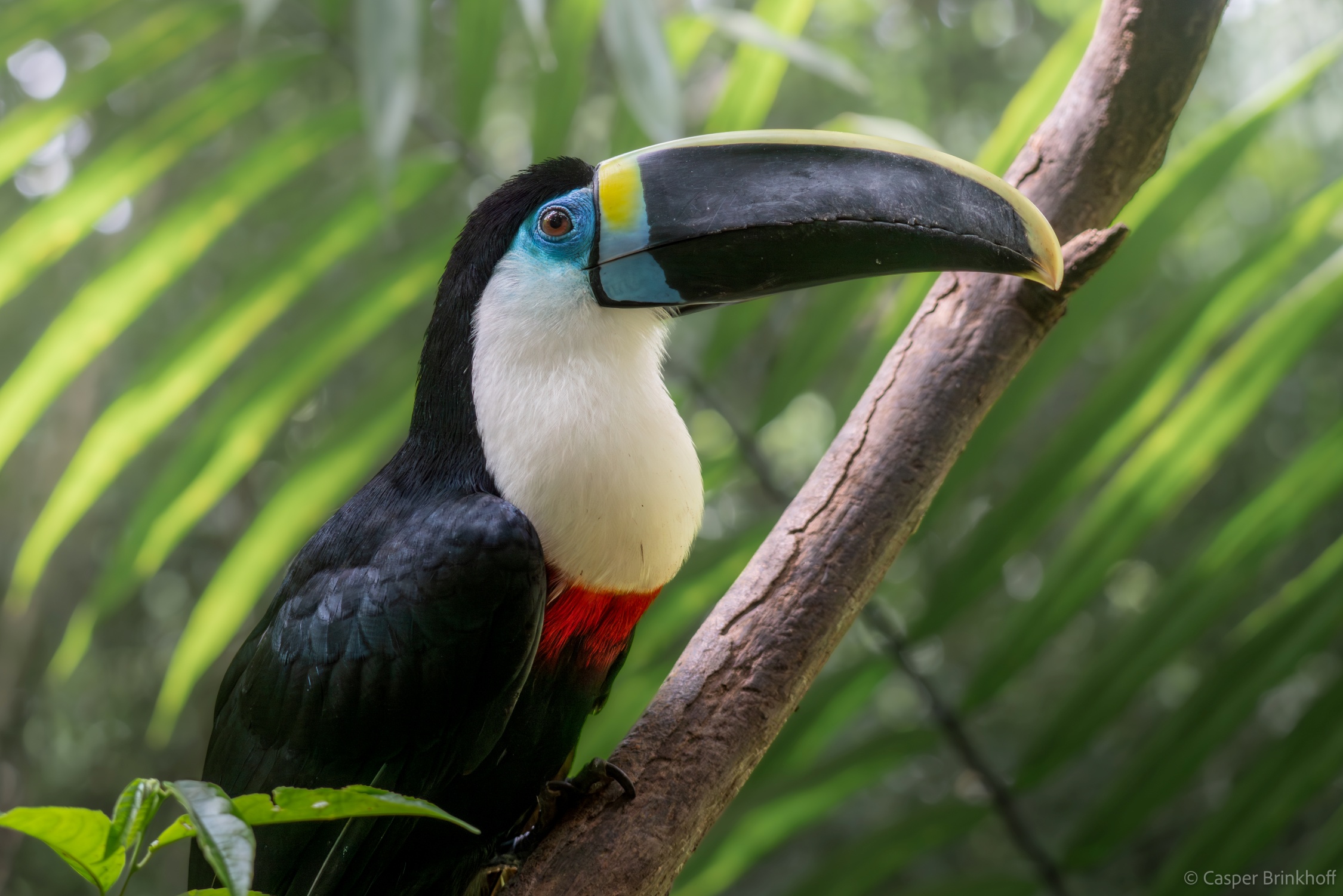
The plumage of this species is mainly jet black, extending from the crown to the rump through the neck and mantle. The throat and chest, of pure white, are sharply delimited from the black flanks and belly by a narrow scarlet red pectoral band.
The under-tail coverts are bright red, forming a marked contrast with the black tail feathers, while the upper-tail coverts are pale yellow. The massive culmen features black lateral ramphotheca, a lemon yellow culmen crest, and a bluish lower mandible base. A circle of azure blue bare skin surrounds the eye. The species lacks sexual dimorphism: both sexes sport an identical plumage.
Sexual dimorphism
There is no visible dimorphism in this species.
Behaviour & Life cycle
-
dietomnivorous
-
Sociabilityliving as a couple or in a group
-
territorialNo
-
Way of livingdiurnal
Gregarious and social, this bird generally moves in pairs or small family groups of up to six individuals, although larger gatherings are observed on fruit trees.
As a dominant arboreal species, it displays aggression to defend access to food resources against other species. Its activity is marked by social interactions within the group, including chases, fruit tossing, and bill clashing.
Highly vocal, it emits characteristic calls of the Amazon forest, composed of a descending note followed by several high notes. It sometimes undertakes small seasonal migrations, particularly between inland forests and coastal areas in French Guiana.
An omnivore with a predominant frugivorous diet, this toucan consumes a wide variety of fruits, flowers, and nectar. It supplements its diet with animal proteins, capturing insects (beetles, caterpillars, cicadas, termites), lizards, and actively preying on the eggs and nestlings of other birds, especially passerines.
To feed, it uses the typical technique of its family: it grabs the fruit at the tip of its beak, tosses it into the air, and tilts its head back to swallow it whole. It then cleans its beak by rubbing it against a branch or scratching it with its foot. For drinking, it scoops water with a lateral sweeping motion before tossing its head back.
Reproduction
-
Reproductionovipare
The nesting season varies according to geography. The species nests in natural tree cavities, located between 1 and 18 meters high, often reusing old nesting sites. The clutch usually consists of two to three white, elliptical-shaped eggs. The incubation, alternately carried out by the male and female, lasts about 15 days. Both parents actively participate in raising the young. The chicks open their eyes around 29 days and fledge around 49 days. Natural predation, especially by capuchin monkeys, poses a constant threat to the eggs and nests.
Harmless species
This red-billed toucan poses no danger to humans. However, handling a wild individual can result in injuries due to its powerful and sharp beak, capable of inflicting severe pinches.
Origin and distribution
Geographic distribution & Conservation
The distribution range covers the Amazon and the Guianas, including Bolivia, Brazil, Colombia, Ecuador, Peru, and Venezuela. Although the species is still very common in some preserved areas like Suriname or certain parts of French Guiana (where the population is estimated at over 500,000 individuals), the overall trend is declining.
This decline is estimated between 1% and 19% over three generations, mainly caused by habitat loss due to cattle ranching, soybean cultivation, road networks expansion, and mining activities (gold). Direct human pressure, through hunting and trapping for export to Asia, makes the species locally rare in some regions.
Conservation and international regulations
Where to see this species?

What is its habitat?
Natural environment characteristics
-
Temperature20 - 30 °C
Biotope presentation
This red-billed toucan mainly frequents lowland tropical forests (up to 1,100 m altitude), especially along old riverbeds and mature forests near water. It shows some adaptability by also colonizing regenerating secondary forests, forest edges, clearings, isolated forest patches, wooded pastures, plantations, gardens, and even mangroves. Its presence is common near human dwellings and villages.
To go further
To read on the web
Sources & Contributions
Participation & Validation
The Fishipedia team and specialist contributors are committed to providing high-quality content. However, although the information comes from scientific sources or testimonials from specialists, the cards may contain inaccuracies.

Benoit Chartrer
Translation
Translation done with the valuable contribution of our translators, who make this information available to a wider audience. We sincerely thank them for their commitment.
Where to see this species?
Scientific partners