
longtail knifefish
| Family | Sternopygidae |
|---|---|
| Genus | Sternopygus |
| IUCN category (World) | LC |
Introduction
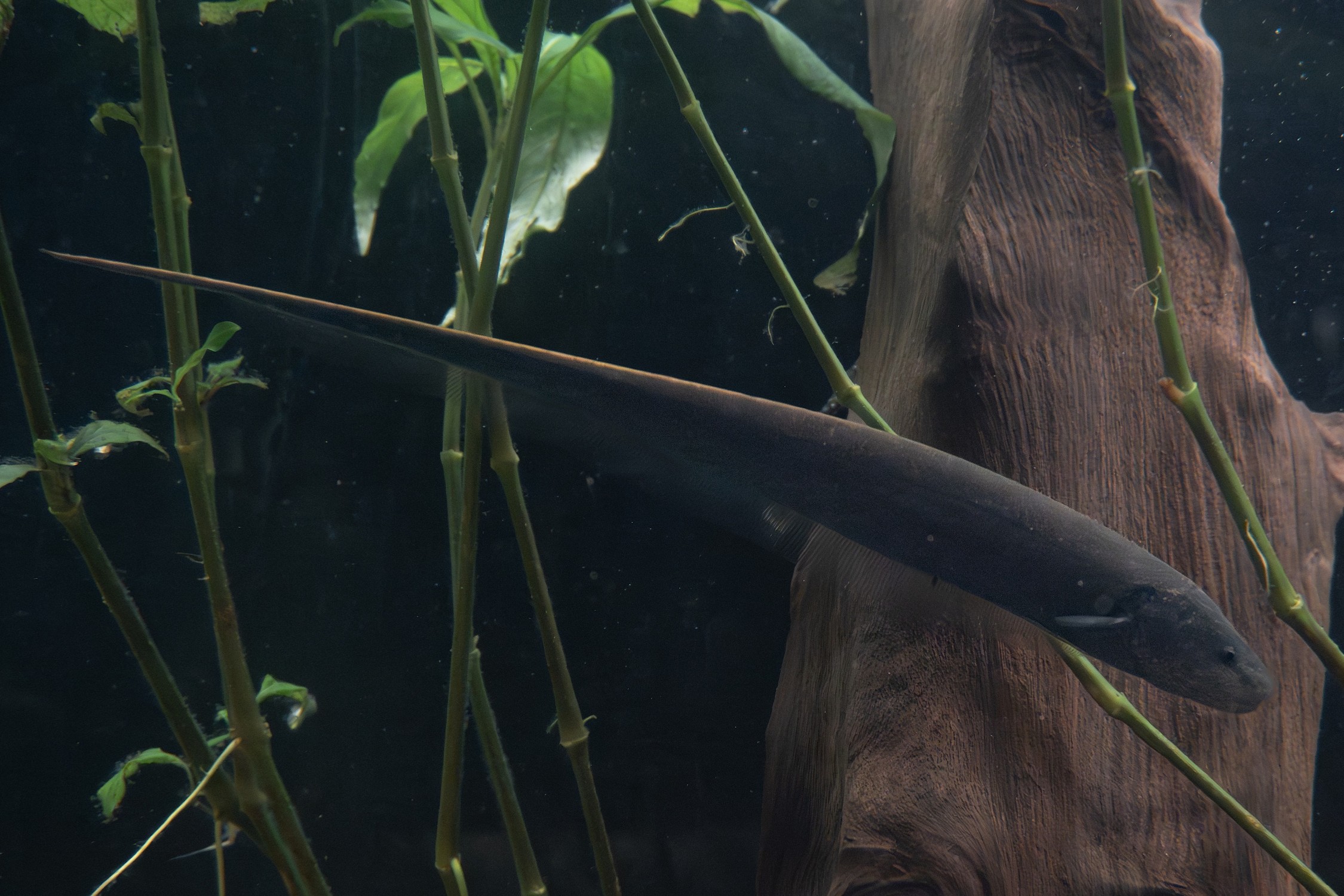
The longtail knifefish (Sternopygus macrurus) is a species of electric fish belonging to the order Gymnotiformes, a major group of Neotropical freshwater fauna ranging from Guatemala to Argentina.
It is one of the most widespread species in the genus Sternopygus, known as the 'longtail knifefish' or 'rattail knifefish'.
A unique feature among species in the genus, S. macrurus is reported from both sides of the Andes (cis-Andean and trans-Andean), although recent studies suggest that populations on the Pacific slope (Colombia) may represent distinct species complexes or be more closely related to other trans-Andean species.
The species is known for its ability to generate weak electric signals (<1V) used for navigation, food detection, and communication.
Who is it?
Morphology
-
Average size80 cm
-
Maximum size140 cm
-
Average size80 cm
-
Maximum size140 cm
How to recognize This fish ?
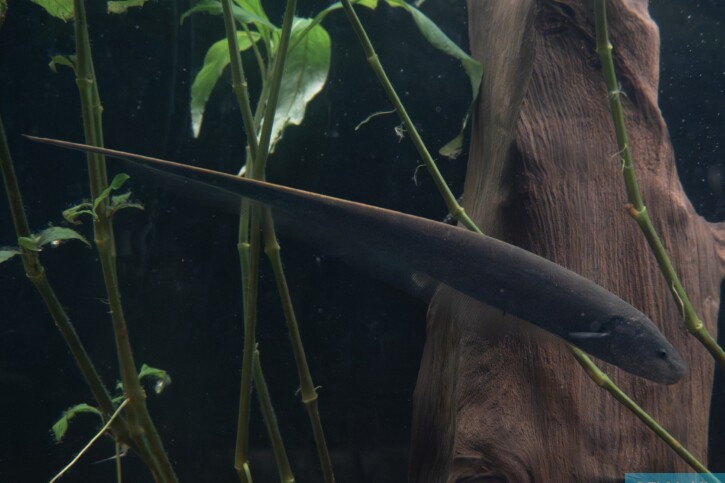
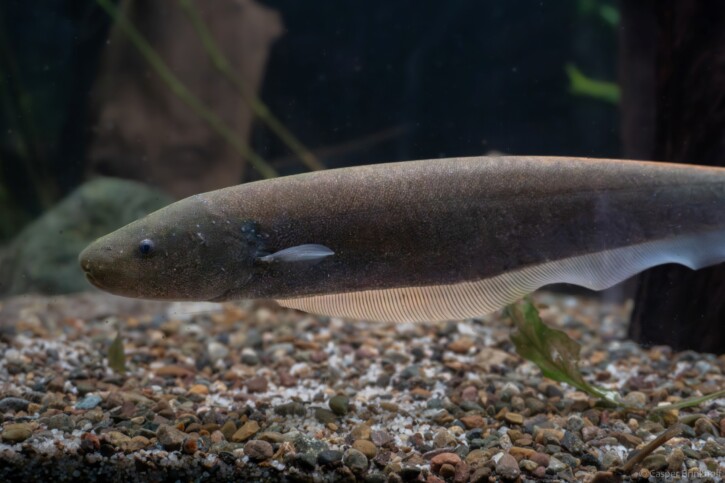
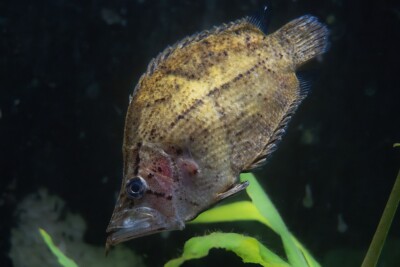
This longtail knifefish has a highly elongated, laterally compressed body entirely devoid of scales. Its anal fin is exceptionally long. It lacks a caudal fin and adipose fin, instead ending in a tapered caudal appendage.
The head is distinguished by several diagnostic features of the genus: a free and exposed orbital margin, a large gill opening, and a wide mouth with the gape extending below the anterior nostrils. The anus is located in the anterior third of the body and may move forward with age.
Sternopygus macrurus typically display a dark gray-brown pigmentation. A distinctive feature is the presence of a dark humeral spot located just behind the head. This spot can vary among individuals, ranging from a faint mark with poorly defined edges to a large dark spot with distinct borders.
Unlike some other species in the genus, mature S. macrurus generally do not display a dark saddle pattern in adulthood, although variations exist in other closely related species.
Sexual dimorphism
Sexual dimorphism is mainly electrical and physiological. Mature females produce electric organ discharges (EODs) at higher frequencies than mature males. This difference is modulated by plasma androgens, particularly during the breeding season.
Behaviour & Life cycle
-
dietcarnivorous
-
Sociabilityliving as a couple or alone
-
territorialYes
-
Way of livingdiurnal
The longtail knifefish is a carnivorous predator, with a strong piscivorous tendency. While juveniles feed on small invertebrates (insect larvae), adults predominantly consume other fish. Stomach content analyses indicate that fish dominate the diet in frequency, number, and weight (>80%). Cannibalistic behavior has been documented. The species uses its electric signals to detect hidden prey in complex environments.
The species exhibits marked territorial behavior, especially in males that defend their living area. In these fish, electrical communication is central. Males increase their discharge rate (EOD) and produce specific interruptions to attract females.
Unlike other Gymnotiformes, the genus Sternopygus lacks jamming avoidance response. The adult electric organ develops from hypaxial and epaxial muscle groups. Electroreceptors and the electric organ are functional from the larval stage (as early as the 11th day), enabling immediate orientation in complex dark environments.
Reproduction
-
Reproductionovipare qui dépose ses Œufs dans la végétation
Reproduction occurs before or during the rainy season. Fecundity is high (up to 6,473 eggs). Spawning is phytophilous: eggs (3 mm in diameter) are deposited among vegetation. Hatching occurs on the 4th day, and first feeding on the 11th day.
Harmless species
The longtail knifefish poses no danger to humans. Its electric discharges are weak (<1V) and are solely used for navigation and communication.
Origin and distribution
Geographic distribution & Conservation
The distribution range of Sternopygus macrurus is vast, covering much of South and Central America, with reported occurrences up to 1,042 m in altitude.
- Trans-Andean and cis-Andean distribution: It is the only species in the genus reported from both sides of the Andes. It is found in the Pacific drainage basins of Colombia (although these populations are undergoing recent taxonomic reassessments sometimes aligning them with the group S. aequilabiatus) and in all major cis-Andean basins.
- Major basins: Magdalena and Catatumbo basins (Colombia), entire Amazon basin (including Napo, Madre de Dios), Orinoco basin, Guianas Shield, northeastern Brazilian Atlantic drainages (Tocantins, Parnaíba, etc.), São Francisco basin, Rio de Janeiro region, and Paraguay-Paraná basin.
- Central America: Present as far north as Costa Rica and Panama.
- Biogeographical context: The species distribution has been shaped by the Andean uplift (Miocene/Pliocene), isolating eastern and western populations. Historically used as a 'catch-all taxon' due to its broad distribution and morphological variability, the species is currently undergoing molecular revisions suggesting the presence of cryptic species complexes, particularly on the Pacific slope.
Given this extremely broad distribution, the species faces no identified major imminent threats, although precise taxonomy refinement is ongoing.
Conservation and international regulations
Where to see this species?

What is its habitat?
Natural environment characteristics
-
Temperature22 - 28 °C
-
pH (acidity)6 - 6.5
-
gh (hardness)4 - 15
-
FlowSlow and Stagnant
Biotope presentation
The longtail knifefish inhabits a wide variety of freshwater habitats in the lowlands: deep river channels, floodplain lakes, marshes, and streams. It prefers lentic (calm) waters and often stays near the bottom or in main riverbed nests, using its electrolocalization abilities to navigate dark and structurally complex environments.
To go further
To read on the web

Sources & Contributions
Participation & Validation
The Fishipedia team and specialist contributors are committed to providing high-quality content. However, although the information comes from scientific sources or testimonials from specialists, the cards may contain inaccuracies.

Benoit Chartrer
Translation
Translation done with the valuable contribution of our translators, who make this information available to a wider audience. We sincerely thank them for their commitment.
Where to see this species?
Scientific partners




Tags


