
Introduction
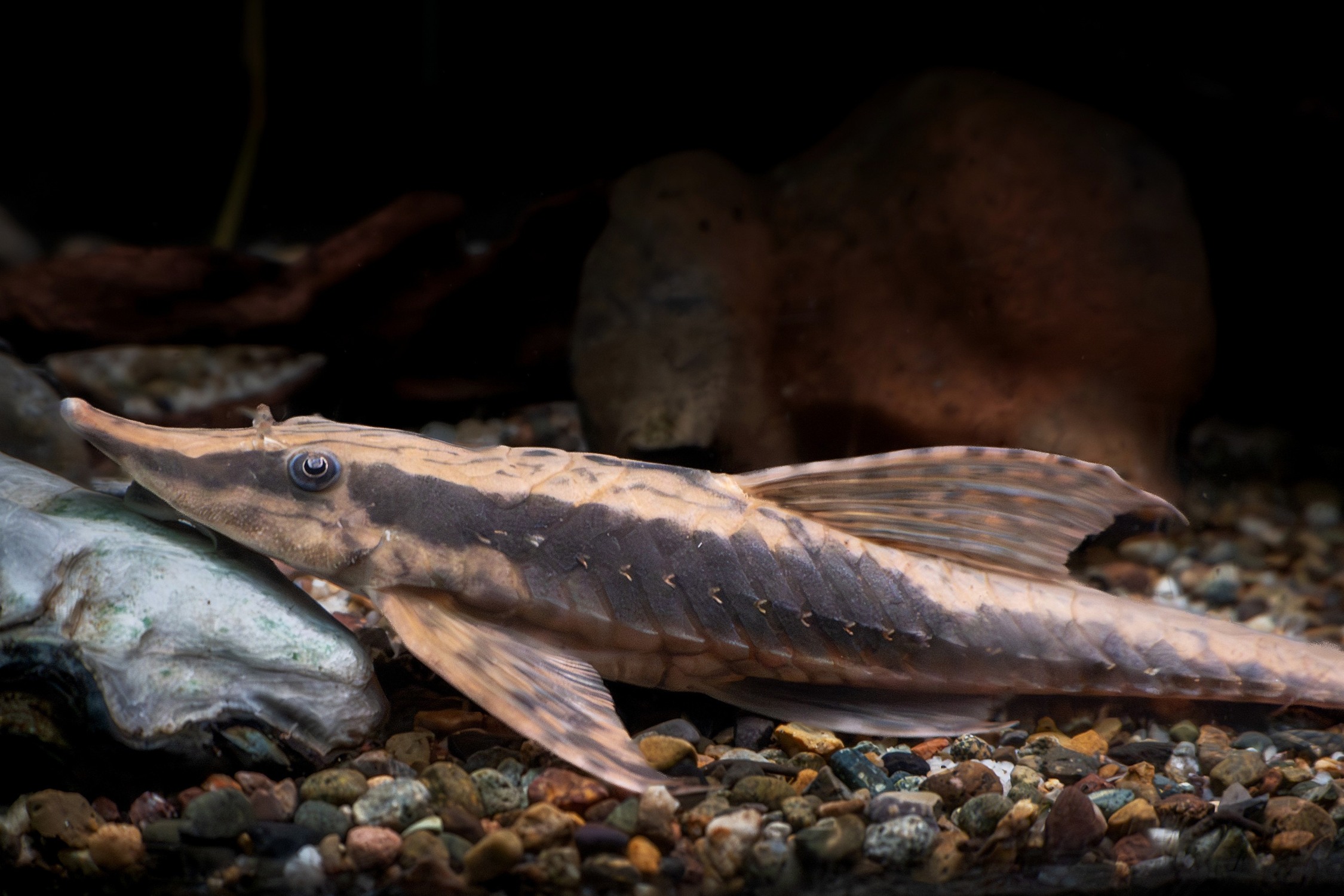
Sturisoma nigrirostrum is a freshwater armored catfish belonging to the Loricariidae family and the Loricariinae subfamily.
It is native to the western Amazon basins, primarily documented to date in Peru and Bolivia. This species is distinguished by its extremely elongated body, resembling that of a miniature sturgeon, and by the dark pigmentation characteristic of the ventral face of its snout.
Who is it?
Morphology
-
Average size25 cm
-
Maximum size30 cm
-
Mimicrysand
-
Patternrayure horizontale
-
Average size25 cm
-
Maximum size30 cm
-
Mimicrysand
-
Patternrayure horizontale
How to recognize This fish ?
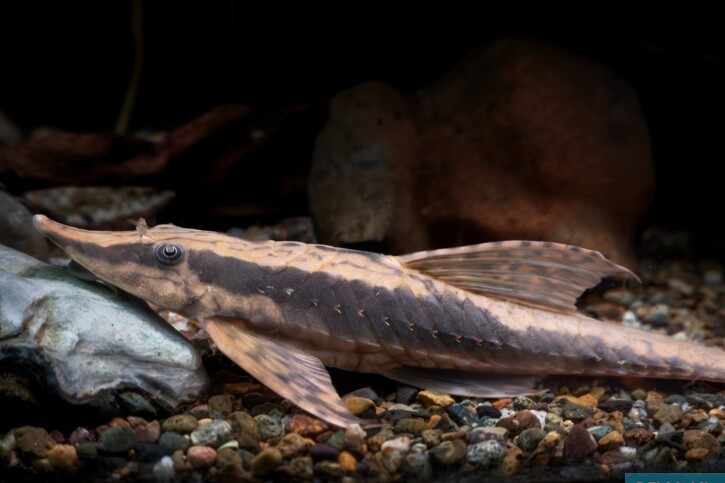
The body of this catfish is very long, thin, and fully protected by ossified dermal plates arranged in longitudinal series. The dorsal profile is straight while the belly is flat. The head, triangular in dorsal view, extends into a widened and depressed rostrum. The maximum size observed for this species is around 24 cm in standard length (without the tail), approximately 30 cm in total length.
The base color is brown or dark yellow on the antero-dorsal part, becoming pale yellow on the ventral face. A dark dorso-lateral band runs from the tip of the snout, through the eye, and extends along the lateral line to halfway of the caudal peduncle, without reaching the caudal fin. The ventral face of the rostrum is uniformly dark, blending with these lateral bands. The dorsal, pectoral, pelvic, and anal fins are hyaline (transparent). The caudal fin has a dark longitudinal strip along the first two lower branched rays. The species lacks an adipose fin.
Sexual dimorphism
Adult males exhibit marked sexual dimorphism with the development of short, thin, and numerous odontodes (dermal teeth) on the sides of the head. The first unbranched ray of the pectoral fin also bears some odontodes, although less developed. In females, the head remains smooth, devoid of these hypertrophied structures.
Behaviour & Life cycle
-
dietscavenger and herbivorous
-
Sociabilitysolitary
-
territorialNo
-
Way of livingdiurnal
Adapted to benthic life, this fish has a mouth transformed into a ventral oral disk, allowing it to firmly grip substrates and stay in the current while grazing. Confined to small to medium-sized rivers with soft bottoms, it moves with agility thanks to its long anal fin and prehensile tail.
Like most Loricariinae, it assumes a resting posture clinging to supports (wood, rocks, vegetation), using its tail to balance.
The mouth morphology and tooth structure (fine, bifid, and numerous teeth) suggest an herbivorous and detritivorous diet. The species actively grazes on periphyton, filamentous algae, biofilms, and organic detritus deposited on sandy or muddy bottoms and submerged substrates.
Reproduction
-
Reproductionovipare
As with other Loricariidae, spawning likely occurs on a hard substrate or partially buried, with male guarding the eggs until hatching.
The highly elongated body morphology suggests that the male wraps its tail around the spawn to protect and oxygenate it, a typical behavior of the Sturisoma genus.
Harmless species
This fish presents no venomous danger. However, handling without protection may cause slight scratches or superficial cuts due to the roughness of its bony plates and the presence of sharp cephalic odontodes in males.
Origin and distribution
Geographic distribution & Conservation
The distribution range of this species covers the Ucayali River basin in Peru (type locality: Contamana) and extends to the upper Amazon basin in Brazil, especially in the Yavari River. It occurs at altitudes between 90 and 250 meters.
It is classified as 'Least Concern' as its population is presumed stable, it occupies protected areas, and no major anthropogenic threats currently affect its entire habitat. Historical reports in Ecuador and Bolivia are considered identification errors, actually corresponding to closely related species like S. guentheri or S. reisi.
Conservation and international regulations
Where to see this species?

What is its habitat?
Natural environment characteristics
-
Temperature24 - 28 °C
-
pH (acidity)6 - 7
-
FlowMedium
Biotope presentation
This catfish exclusively inhabits small to medium-sized rivers characterized by soft bottoms (sand, silt). Strictly benthic, it occupies the lower water column of these cis-Andean rivers, avoiding excessively turbulent rapids in favor of moderate currents where fine sediments accumulate.
To go further
Species of the same family
To read on the web

Sources & Contributions
Participation & Validation
The Fishipedia team and specialist contributors are committed to providing high-quality content. However, although the information comes from scientific sources or testimonials from specialists, the cards may contain inaccuracies.

Benoit Chartrer
Translation
Translation done with the valuable contribution of our translators, who make this information available to a wider audience. We sincerely thank them for their commitment.
Where to see this species?
Scientific partners




Tags
Species of the same family


